4 Radeon RX 470 GPUs and 32GB of GDDR5 on One PCB: Inside the Quad-Chip PCIe Board With Four 8-Pins
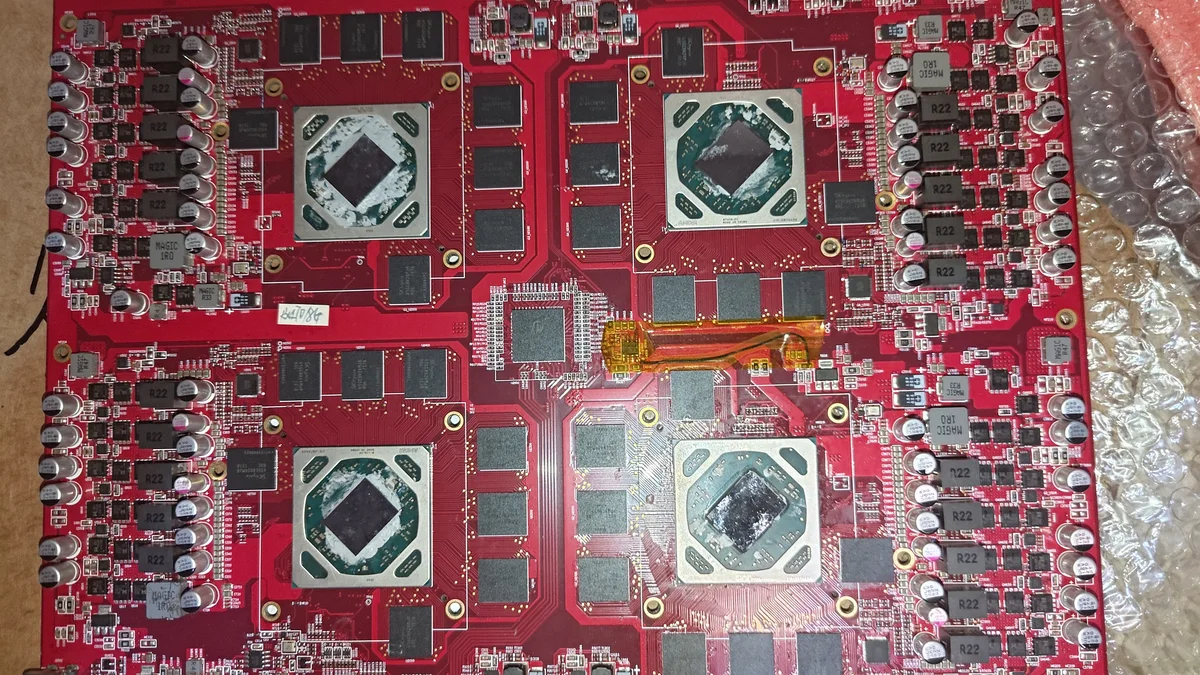
Packing four desktop graphics processors onto a single printed circuit board usually sounds like an April Fools' render or a proprietary datacenter blade. Yet hardware collector GOK (@GOKForFree on X) has just surfaced high-resolution photos of a massive red PCIe expansion board housing four AMD Radeon RX 470 GPUs (14nm Polaris 10 silicon) and a combined 32GB of GDDR5 memory on a single PCB.
A 2x2 Grid of Polaris 10 Silicon With 8,192 Stream Processors
Photographed next to a standard desktop motherboard for scale, the bare circuit board dwarfs a conventional ATX footprint. Rather than lining up the dies horizontally like classic dual-GPU flagship cards, the board arranges its four processors in a symmetrical 2x2 square grid. A handwritten label sitting between the top two GPU packages explicitly identifies the unit as an "RX470 8G" configuration.
Because each Radeon RX 470 chip carries 2,048 stream processors across 32 Compute Units, combining four of them onto one board yields a theoretical total of 8,192 stream processors. Surrounding each Polaris 10 die are eight SK hynix GDDR5 memory modules (part number H5GC8H24MJR-R0C, rated at 8Gb or 1GB per chip across a 256-bit bus per GPU). That gives each graphics core its own dedicated 8GB frame buffer, bringing the board's total physical memory to 32GB of GDDR5 VRAM.
Four 8-Pin Power Connectors, One HDMI Port, and a PCIe 2.0 Switch
Feeding four desktop-class GPUs on a single board demands serious power delivery. The right edge of the PCB lines up four 8-pin PCIe power connectors, capable of drawing up to 600W from the power supply on top of the motherboard slot. Each Polaris 10 die is paired with its own independent 5+1 phase VRM array (using R22 chokes for the core and MAGIC 1R0 inductors for the memory) split across the top and bottom edges of the board.
| Specification | Hardware Details on the PCB |
|---|---|
| Board Marking | DYII-XQ570 V1.0 / REV:1.0 (with silkscreened AMD logo) |
| Graphics Processors | 4x AMD Radeon RX 470 (Polaris 10, 14nm FinFET architecture) |
| Stream Processors | 8,192 total stream processors (4x 2,048 SP) |
| Memory Configuration | 32GB GDDR5 total (4x 8GB SK hynix across 4x 256-bit buses) |
| PCIe Bridge Chip | Pericom / Diodes Inc. PI7C9X2G packet switch (PCIe 2.0, wired as x8) |
| Power Delivery | 4x 8-pin PCIe power connectors (up to 600W cable capacity) |
| Display Output | 1x single HDMI port (no DisplayPort or DVI outputs) |
Looking closely at the center of the board reveals its true engineering purpose. Positioned directly between the four GPUs is a PI7C9X2G packet switch chip from Pericom Semiconductor (Diodes Incorporated), which operates strictly at PCIe 2.0 speeds. Furthermore, the physical PCIe x16 edge connector is only wired for 8 lanes (PCIe x8), meaning each RX 470 die is bottlenecked to roughly two PCIe 2.0 lanes, while display connectivity is stripped down to a single HDMI port at the top-left corner.
A Custom Chinese Crypto-Mining Relic Rather Than an Official AMD Prototype
Although the PCB features a silkscreened AMD logo next to the DYII-XQ570 V1.0 identifier, this monster was almost certainly not engineered by AMD's internal hardware teams. As GOK pointed out in a follow-up inspection, the board lacks an official AMD Ordering Part Number (OPN, typically formatted as 109-XXXXXX-XX).
During the height of the Ethereum mining craze between 2017 and 2021, boutique factories in China frequently designed high-density multi-GPU boards using salvaged or surplus Polaris silicon and stamped the AMD logo onto the silkscreen, much like Sapphire's dual-GPU Radeon RX 570 16GB mining card from 2021. Because Ethereum's DAG file required at least 8GB of local VRAM per chip but almost zero PCIe bus bandwidth, wiring four 8GB Polaris dies through a cheap PCIe 2.0 switch made perfect sense for rackmount mining rigs.
For PC builders who actually want high-frame-rate 1440p and 4K gaming today without dealing with server-grade heat and unusable multi-GPU drivers, modern AMD Radeon RX desktop graphics cards deliver vastly superior performance on a single die. In fact, strong 16GB RDNA 4 value is the primary reason AMD recently overtook Nvidia in GPU unit sales on Amazon US as competing flagship prices climbed.
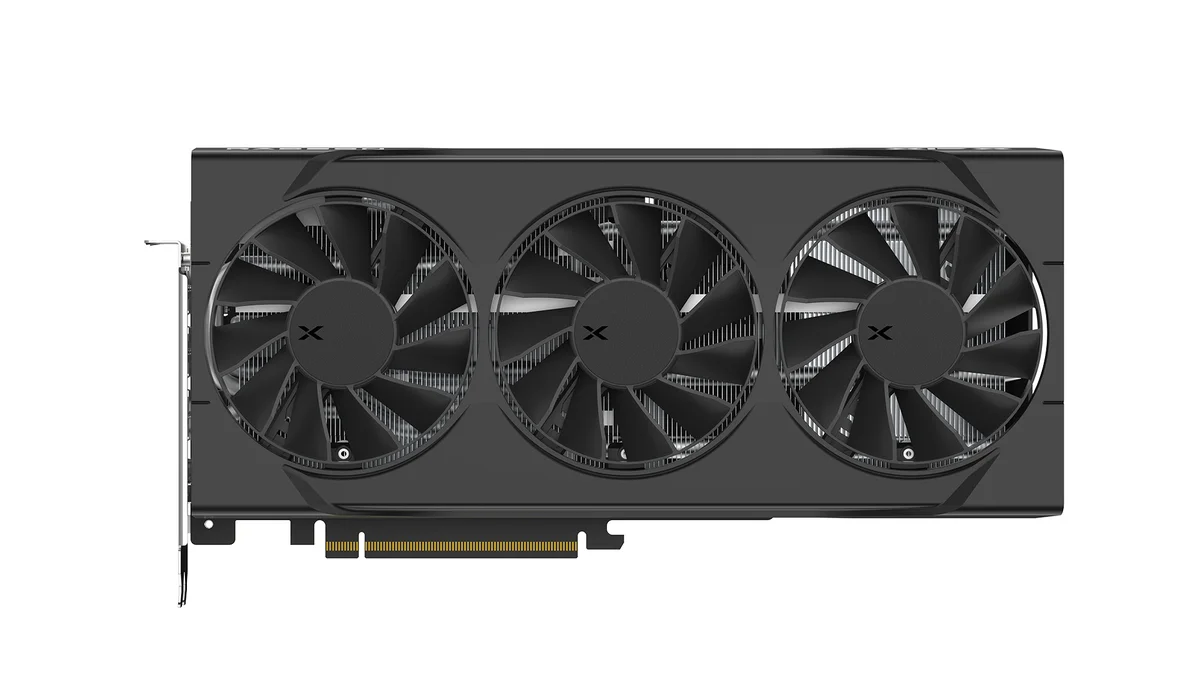
AMD Radeon RX 9070 XT (16GB GDDR6)
- AMD RDNA 4 Architecture (Navi 48)
- 16GB GDDR6 Memory on 256-bit Bus
- Full Support for AMD FSR 4 & AFMF 3
- Best-in-Class 1440p and 4K Value
My Take on the Spec Sheet
We obviously haven't tested this one-off board in our lab, and even its current owner hasn't been able to fire it up yet because it arrived as a bare PCB without its custom server heatsink. Still, examining the board layout offers a fascinating look at how far custom hardware factories went during the crypto boom. We have not yet had a physical unit on our desk—if the manufacturer's team would like to send over a review sample so we can put it through our full real-world testing protocol, our lab doors are wide open.
Let's be realistic about the numbers: seeing 32GB of VRAM on a single card sounds incredible at first glance, but that memory is split into four isolated 8GB pools with no high-speed die-to-die interconnect. Bottlenecking each Polaris 10 chip behind a PCIe 2.0 switch (PI7C9X2G) with roughly two lanes per GPU (~1 GB/s of host bandwidth per chip) makes it completely useless for modern gaming or even multi-GPU local LLM inference, where PCIe transfers would choke immediately. Add in 500W to 600W of thermal output across four tightly packed 14nm dies that likely required screaming rackmount blower fans, and this quad-RX 470 board stands as an awesome piece of silicon history for a collector's shelf, not a viable GPU for any 2026 PC build.

PC hardware enthusiast and competitive gamer, Arthur 'Heimdall' splits his time between France and the UK working in enterprise B2B software solutions. A business school graduate passionate about component benchmarking, he has been building, modding, and tuning PCs since childhood, optimizing every thermal degree and millisecond of display latency. An avid gamer across Assassin's Creed and sandbox titles, he forged his alliance with Grimtag and Chaya during late-night World of Warcraft raids before joining Pro-Gamer.