Call of Duty Breaks Wallhacks for Good: How RICOCHET’s Server Culling Blinds Cheaters
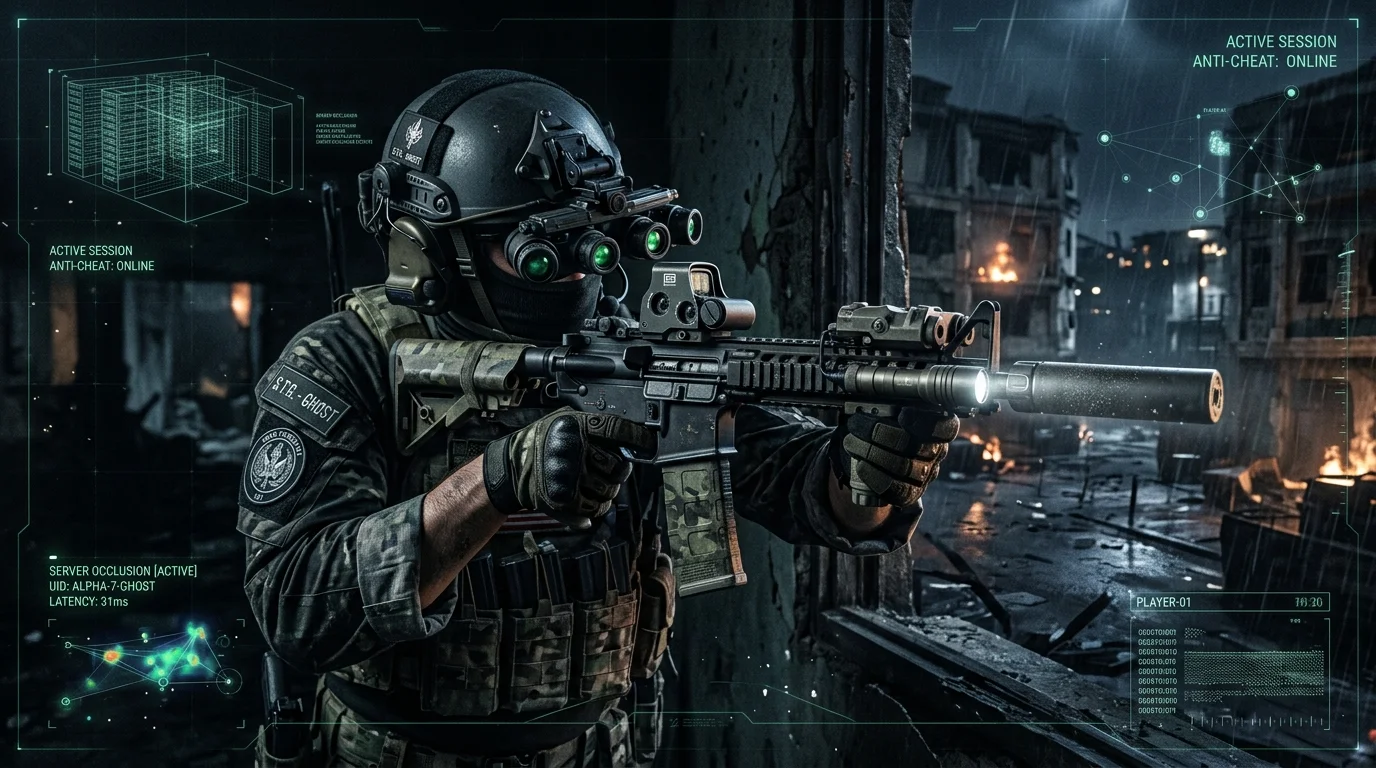
The rampant issue of cheat software in competitive first-person shooters may have finally met its match. Rather than continuing an endless game of cat-and-mouse against local driver disguises, Activision's Team RICOCHET has unveiled a pivotal server-side architectural upgrade for Call of Duty: Server Culling. By fundamentally changing how positional packets are transmitted to client machines, this server-side occlusion system cuts off all data for hidden opponents, rendering traditional wallhacks completely blind.
How Server Culling Renders Wallhacks Powerless
Under conventional multiplayer network architecture, game servers continuously stream player coordinates to client machines within a wide bubble to ensure instant responsiveness when enemies emerge around corners. The severe drawback of this design has always been vulnerability: unauthorized third-party software, known as ESP (Extra Sensory Perception), hooks into system memory to read those unrendered coordinates and draw player wireframes through solid concrete.
To eliminate this exploit at its foundation, Activision security engineers have integrated custom occlusion layers directly into the level geometry across Modern Warfare 4, Warzone, and upcoming seasonal maps. Before broadcasting any network packet to a player's machine, the host server calculates precise lines of sight in real time. If an enemy soldier is occluded behind a wall or out of visual range, their position and model data are discarded entirely from the downstream network stream. As far as the client machine is concerned, that opponent does not exist in local memory until they are about to become visible.
Neutralizing DMA Hardware and Kernel-Level Cheats
This server-side approach represents an indispensable countermeasure against hardware-based cheating. In recent seasons, malicious actors increasingly turned to Direct Memory Access (DMA) PCIe cards. These peripheral devices physically read the host machine's RAM from a secondary PC without executing any local process, effectively bypassing kernel-level (Ring 0) detections established by modern anti-cheat solutions.
With Server Culling active, expensive DMA hardware becomes entirely irrelevant. Because the server deliberately refuses to send positional data over the network wire, there are literally zero coordinate values residing in local RAM for external hardware to parse. Cheaters running multi-thousand dollar dual-PC setups will stare at an empty radar until an adversary naturally steps into valid line of sight.
Targeting an $8.5 Billion Black Market
This technical escalation directly targets the underlying economy fueling illicit tools. In a comprehensive financial and cybersecurity analysis released earlier, Activision revealed that the video game cheat market represents an astonishing $8.5 billion black market globally. Sophisticated criminal networks and unauthorized software firms generate millions in recurring monthly subscriptions while eroding community trust in premier competitive franchises.
By neutralizing wallhacks, which represent the single most popular and profitable feature across commercial cheat suites, Activision delivers a direct blow to developers' profit margins. When combined with dynamic in-game mitigations such as real-time weapon disarming and damage shields, Server Culling removes the primary selling point that cheat brokers rely on to sustain their subscription revenues.
My Take: Blinding Cheaters at the Source Is the Only Winning Move
Architecturally speaking, Server Culling is by far the smartest strategic move Team RICOCHET has executed to date. Engaging in an endless arms race at the Windows kernel level is fundamentally a losing proposition when cheat providers lease signed enterprise certificates and deploy external PCIe DMA hardware. By establishing that the game server is the sole arbiter of truth and strictly withholding occluded coordinates, the developers solve the problem at the root: what never arrives in client memory can never be exploited by third-party hooks.
The true benchmark for success will now rest on server-side performance and netcode optimization. Calculating occlusion masks dynamically for dozens of players simultaneously places significant compute demands on host servers. If the system experiences even a microsecond of processing lag when players slide past doorframes, players could experience jarring model pop-in or exacerbated peeker's advantage. If Activision backs this initiative with top-tier server infrastructure and responsive tick rates, they may have just dealt the most devastating blow to wallhack developers in modern gaming history.

SEO consultant for over 20 years and digital entrepreneur, Charles 'Grimtag' Ronchain is the founder of Pro-Gamer.gg, Retrocharting.com, and Gamescharting.com. A competitive gamer, streamer, and retro game collector, he has worked in the video game industry for over 15 years, notably as a consultant for leading game price comparison platforms. Passionate about real-time performance data and gaming technology, he analyzes competitive esports, gaming hardware benchmarks, and creator workflows on Pro-Gamer.gg with an authentic player perspective.