13x Less BVH Memory and 0.43 ms Rebuilds: How AMD's New RT-MLAS Extension Tackles Open-World Ray Tracing on Radeon RX 9000
Real-time ray tracing in large open worlds keeps hitting the same structural wall: once a scene fills up with moving objects, level-of-detail (LOD) transitions, and animated foliage, updating Bounding Volume Hierarchies (BVHs) every frame burns through VRAM and stalls frame pacing. On November 24, 2026, AMD published a concrete developer-facing answer on GPUOpen called RT-MLAS (Ray Tracing Multi-Level Acceleration Structures), live today on AMD Radeon RX 9000 and Radeon AI PRO R9700 and R9600 GPUs.
The provisional Vulkan extension VK_AMDX_multi_level_acceleration_structure ships right now inside the AMD Software: Adrenalin Edition 26.20.25.01 (Expanded Vulkan Extension Support) driver. AMD also confirmed plans to bring native DirectX 12 support later on, running alongside broader industry shifts like Microsoft's recent DirectX Raytracing clustered geometry upgrade.
Two Reusable Middle Layers to Keep the TLAS Lean
Standard DirectX 12 and Vulkan ray tracing pipelines lock developers into a rigid two-tier hierarchy. At the bottom sit BLAS units (Bottom-Level Acceleration Structures) holding raw mesh geometry. On top sits a single TLAS (Top-Level Acceleration Structure) cataloging every object instance across the world. In sprawling environments built from modular architecture or dense crowds, engineers are forced into an ugly trade-off.
Building a separate BLAS per small part (walls, doors, windows, roof pieces) and instancing every single one directly inside the TLAS saves geometry memory, but produces an oversized TLAS that takes far too long to rebuild every frame. Conversely, baking each unique house into its own standalone BLAS keeps the TLAS fast, but duplicates shared components across video memory.
RT-MLAS, authored by AMD GPU Architect Andy Wright and detailed in the official Vulkan proposal, breaks that deadlock by adding up to two extra reusable hierarchy layers called MDLAS (Mid-Level Acceleration Structures). An MDLAS can hold BLAS instances as well as references to other MDLAS nodes, complete with full per-level transforms. Developers can assemble each house type into an MDLAS from shared door and window BLASs, letting the TLAS simply instance those mid-level blocks across the entire neighborhood.
Verified Benchmarks on Radeon RX 9070 and RX 9070 XT
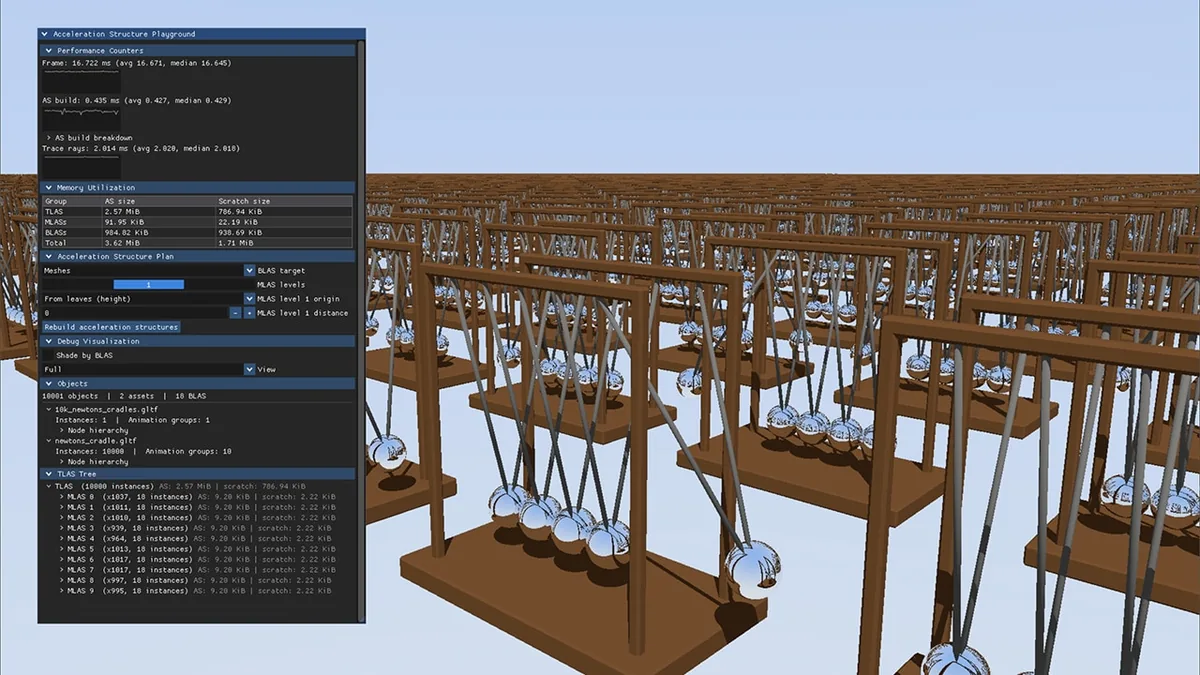
Alongside the driver, AMD released the open-source Acceleration Structure Playground sample on GitHub. AMD's benchmark scene animates 10,000 Newton's cradles using 10 shared rigid animation offsets on a test bench pairing an AMD Radeon RX 9070 with a Ryzen 7 5800X, 32 GB of RAM, and Windows 11 Pro (build 10.0.26200) running Adrenalin 26.20.25.01.
| BVH Acceleration Method | AS Memory Footprint | Median Rebuild Time |
|---|---|---|
| RT-MLAS (Reusable MDLAS) | 3.62 MiB | 0.43 ms |
| BLAS per component (flat TLAS) | 47.17 MiB | 0.97 ms |
| BLAS per unique cradle (rebuilt) | 11.55 MiB | 1.60 ms |
In this workload, RT-MLAS slashes acceleration structure memory by 13x compared to flat component instancing (-92.3%) while cutting median rebuild time by more than half (-55.7%). Against rebuilding a dedicated BLAS per unique cradle, RT-MLAS trims memory usage by 68.7% and runs rebuilds 3.7x faster (0.43 ms versus 1.60 ms).
At the Graphics Programming Conference 2026, AMD Fellows Holger Gruen and Josh Barczak also demonstrated (official GPC 2026 PDF slides) how pairing RT-MLAS with tetrahedral cage animation scales to over 40,000 independently animated plants (around 500 million active triangles with LOD selection, or 3 billion without LOD). Running on a Radeon RX 9070 XT, the scene sustains over 60 FPS at 1080p with ray-traced primary and shadow rays, shifting performance away from constant TLAS rebuild bottlenecks so the GPU becomes purely traversal-limited.
RT-MLAS vs. P-TLAS: Clear Trade-Offs and Honest Limits
AMD is unusually transparent about where RT-MLAS sits next to P-TLAS (Partitioned Top-Level Acceleration Structures). Because P-TLAS flattens spatial partitions into a monolithic internal tree, it often delivers faster raw ray traversal when every zone is unique and untransformed. RT-MLAS trades some of that flatness for granular memory control: each MDLAS partition lives in its own independent memory allocation, engines can decide per partition whether to rebuild or refit in place, and repeated animated hierarchies can be shared across the world.
The catch is real, and AMD spells it out directly: tracking extra hierarchy levels introduces measurable ray traversal overhead today. In simpler scenes with little repetition, RT-MLAS will not pay for itself. Its crossover point only clicks in massive, heavily animated scenes, especially when combined with tetrahedral cages. Even so, it gives a clear look at how AMD is hardening its ray-tracing stack ahead of AMD's upcoming CES 2027 showcase around RDNA 5.
My Test Bench
Dropping acceleration structure memory from 47.17 MiB down to 3.62 MiB while keeping median rebuilds at 0.43 ms on a Radeon RX 9070 is a genuinely meaningful engineering result. Inside a 16.6 ms frame budget for 60 FPS gameplay, shaving over a millisecond off BVH maintenance without blowing up VRAM directly protects frametime consistency in dense open worlds.
That said, I am keeping expectations grounded for retail games. Right now, RT-MLAS is a provisional AMD-exclusive Vulkan extension limited to RDNA 4 hardware (Radeon RX 9000 and AI PRO R9000), and AMD openly acknowledges the extra ray-traversal penalty on lighter scenes. Until the promised DirectX 12 path lands and cross-vendor support aligns inside major game engines, multiplatform AAA studios are unlikely to rewrite their BVH pipelines around a single-vendor Vulkan extension. The architecture solves a genuine bottleneck, but gamers will have to wait for DirectX 12 adoption before feeling it in commercial releases.

PC hardware enthusiast and competitive gamer, Arthur 'Heimdall' splits his time between France and the UK working in enterprise B2B software solutions. A business school graduate passionate about component benchmarking, he has been building, modding, and tuning PCs since childhood, optimizing every thermal degree and millisecond of display latency. An avid gamer across Assassin's Creed and sandbox titles, he forged his alliance with Grimtag and Chaya during late-night World of Warcraft raids before joining Pro-Gamer.