18 Million OLED Laptops by 2027: How Samsung Display's G8.6 Lines and Apple's Entry Reshape the PC Market

While the broader global notebook market braces for two consecutive years of contraction, the organic light-emitting diode segment is moving in the exact opposite direction. According to the latest market analysis published by TrendForce in October 2026, global OLED notebook shipments are projected to climb by 38.5% year-over-year in 2026 (reaching 12.6 million units), followed by an even stronger surge of 42.3% YoY in 2027 to hit 18.0 million units. This sustained expansion pushes OLED penetration past the milestone 9% to 10% threshold across the global laptop market, fueled by the commercial ramp-up of Generation 8.6 (G8.6) panel fabs and Apple's entry into the segment.
18 Million Units in 2027 and a Clear Trajectory Toward 46.6 Million by 2030
The shipment figures compiled by TrendForce confirm that OLED displays in mobile computing have outgrown their ultra-luxury niche. Building on an estimated 12.6 million units in 2026 (+38.5% YoY), global shipments are forecast to reach 18.0 million notebooks in 2027 (+42.3% YoY) before climbing to 25.7 million units in 2028 (+42.8% YoY).
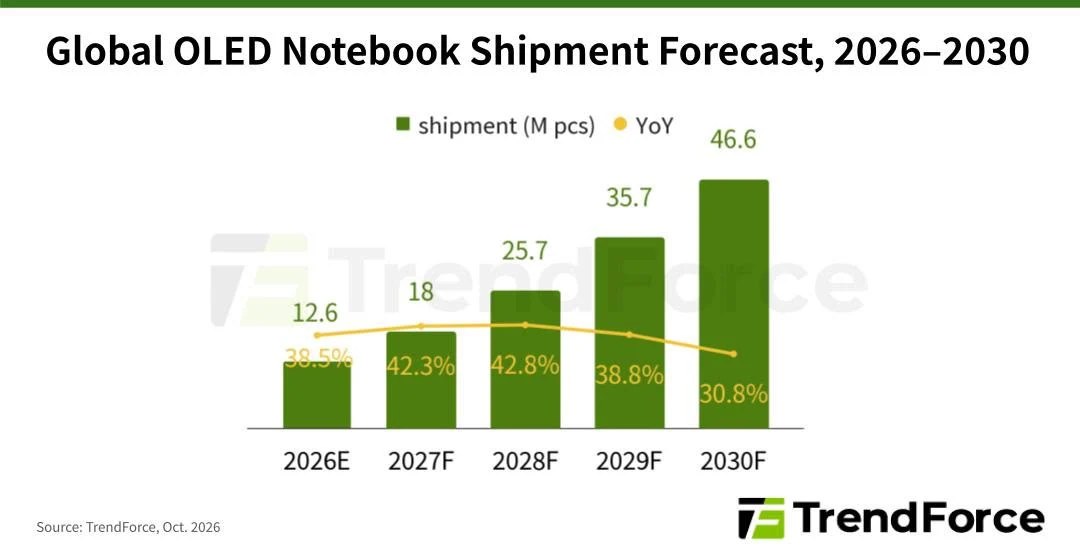
Looking further ahead, TrendForce projects global volumes to reach 35.7 million units in 2029 (+38.8% YoY) and 46.6 million notebooks by 2030 (+30.8% YoY). Below is the complete five-year forecast breakdown from TrendForce:
| Year | Global OLED Shipments | YoY Growth | Key Supply Chain Milestones |
|---|---|---|---|
| 2026 (Estimated) | 12.6 million units | +38.5% | Windows OEM expansion (ASUS, Lenovo, HP) & initial G8.6 mass production |
| 2027 (Forecast) | 18.0 million units | +42.3% | 1.2M to 1.5M MacBook Pro PROLED XDR units & Samsung Display G8.6 A6 ramp |
| 2028 (Forecast) | 25.7 million units | +42.8% | Multi-vendor G8.6 capacity across Samsung Display, BOE, and Visionox |
| 2029 (Forecast) | 35.7 million units | +38.8% | Expected debut of OLED MacBook Air (targeted by BOE, LG Display, TCL CSOT) |
| 2030 (Forecast) | 46.6 million units | +30.8% | Widespread standardization across mid-range and premium notebooks |
Apple's PROLED XDR Catalyst and Samsung Display's Exclusive G8.6 A6 Line
Apple's official entry into the OLED laptop sector with its newly unveiled MacBook Pro featuring the PROLED XDR Display serves as a major catalyst for 2027. Marking the first model in the MacBook lineup to adopt a tandem OLED touchscreen (stacking two organic emissive layers for higher sustained brightness and panel longevity) with a pixel density of 254 pixels per inch (PPI), the new machine is forecast by TrendForce to ship between 1.2 million and 1.5 million units in 2027. While its $2,899 starting price for the 14-inch configuration and parallel sales alongside existing Mini-LED models (complemented by the entry-level MacBook Neo strategy) may temper immediate replacement volume, the halo effect across the industry is substantial.
On the manufacturing front, Samsung Display (SDC) has secured the exclusive initial panel supply slot for the PROLED XDR MacBook Pro. To meet Apple's specifications, Samsung Display designated Phase 1 of its new G8.6 A6 production line at its Asan campus in South Korea as a dedicated facility for Apple. The new MacBook Pro represents the first commercial product to enter mass production on an 8.6-generation fine metal mask (FMM) IT OLED line, utilizing larger glass substrates that significantly improve cutting efficiency for 14-inch and 16-inch laptop panels compared to legacy G6 lines.
What G8.6 Panel Manufacturing Means for Windows Gaming Laptops
Until now, OLED laptop adoption has been driven primarily by Windows OEMs such as ASUS (through its ROG Zephyrus G14 and G16 Nebula OLED lineup), Lenovo (Legion Pro and Yoga series), HP (Omen Transcend), Razer, and MSI. Just as PC users closely track how Microsoft is rethinking the classic Start Menu shortcut in Windows 11, display supply chain shifts are directly shaping the next wave of portable gaming hardware.
Because meeting Apple's 254 PPI tandem OLED specifications involves steep material costs and strict yield requirements, rival panel makers including BOE (ramping its own G8.6 B16 line in Chengdu), Visionox (G8.6 V5 line), LG Display, and TCL CSOT are focusing their near-term IT OLED capacity on Windows notebook brands while competing to qualify for the OLED MacBook Air expected in 2029. For PC gamers, this expanding G8.6 supply directly accelerates the availability of high-refresh 14-inch and 16-inch 240Hz OLED laptops across broader price tiers:
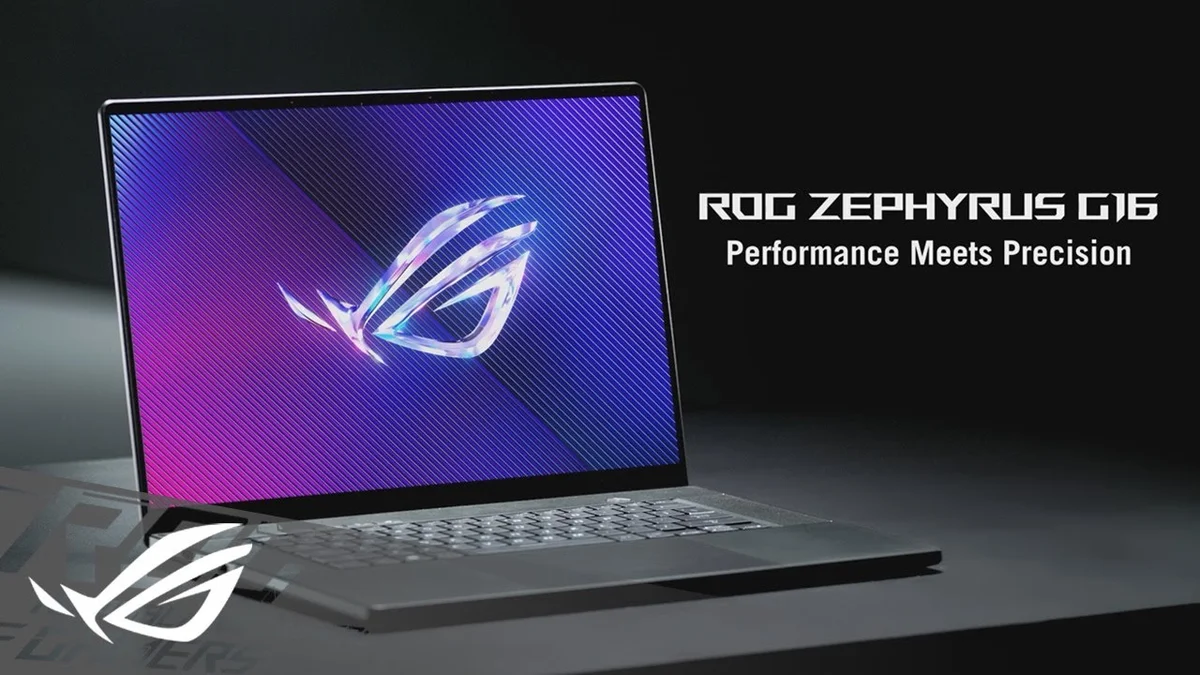
240Hz OLED Gaming Laptops (ASUS ROG Zephyrus / Lenovo Legion)
- 14-inch and 16-inch 240Hz OLED displays with 0.2ms response time
- VESA DisplayHDR True Black infinite contrast & 100% DCI-P3 color gamut
- High-performance ASUS ROG Zephyrus, Lenovo Legion Pro, and HP Omen laptops
My Take
Beyond the headlines surrounding Apple's $2,899 tandem OLED MacBook Pro, the real hardware inflection point in TrendForce's report is the transition to G8.6 glass substrates. As long as laptop OLED panels were cut on sixth-generation lines originally engineered for smartphone screens, manufacturing 16-inch panels carried heavy substrate waste and kept pricing locked in the ultra-premium bracket. Hardware engineering at major PC brands has always pushed boundaries behind the scenes, much like the unreleased 2,100 MHz ASUS ROG Matrix Radeon RX 5700 XT prototype that recently surfaced, and G8.6 fabs from Samsung Display, BOE, and Visionox finally solve the economics of mid-size OLED cutting. Hitting 18 million OLED notebooks in 2027 means 240Hz, 0.2ms OLED panels will rapidly trickle down into mid-range gaming laptops, leaving slow IPS panels with backlight bleed firmly in the past.

PC hardware enthusiast and competitive gamer, Arthur 'Heimdall' splits his time between France and the UK working in enterprise B2B software solutions. A business school graduate passionate about component benchmarking, he has been building, modding, and tuning PCs since childhood, optimizing every thermal degree and millisecond of display latency. An avid gamer across Assassin's Creed and sandbox titles, he forged his alliance with Grimtag and Chaya during late-night World of Warcraft raids before joining Pro-Gamer.