7 Gbps Wireless and Dedicated Gaming AI Agent: TCL Unveils 5G AI CPE X5 at Network X 2026
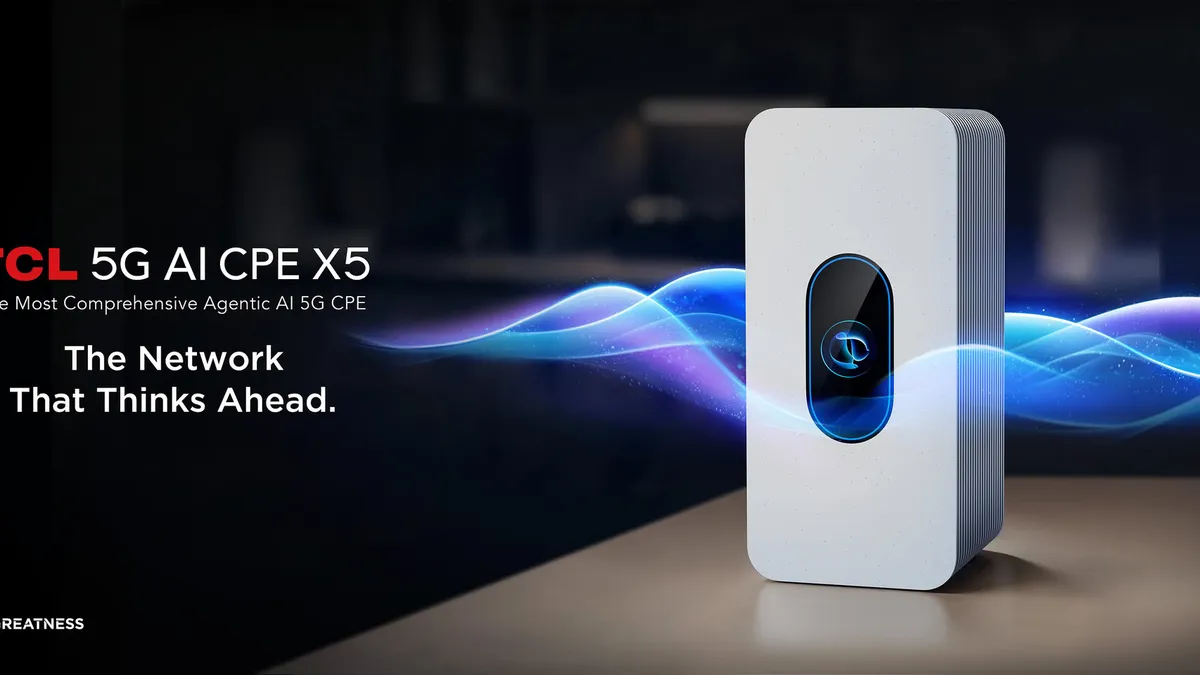
Unveiled on the show floor at Network X 2026, TCL is redefining fixed wireless broadband for demanding households with its flagship indoor gateway: the TCL 5G AI CPE X5. Honored as a 2026 IFA Innovation Award winner, this high-performance router is built from the ground up for competitive online multiplayer, cloud gaming enthusiasts, and connected households. By pairing 5G-Advanced throughput with an autonomous on-device AI agent, TCL aims to eliminate the compromises long associated with wireless home broadband.
5G-Advanced and 8Rx Architecture: Delivering 7.01 Gbps Peak Speeds
At the heart of the TCL X5 is a next-generation cellular engine compliant with 3GPP Release 18 (5G-Advanced), capable of reaching theoretical peak downlink speeds of 7.01 Gbps. To bridge the gap between theoretical specifications and real-world indoor stability, TCL implemented an advanced 8Rx antenna architecture.
The internal array combines four directional C-band antennas delivering high gain up to 13 dBi alongside four complementary omnidirectional C-band antennas. Laboratory benchmarks confirm a 51% downlink throughput surge compared to traditional 4Rx gateway designs. For gamers residing outside fiber-optic coverage zones, this architecture transforms cellular connectivity into a genuine gigabit lifeline, effortlessly downloading 100 GB game patches in minutes.
Looking for a high-performance 5G router for gaming?
Explore ultra-fast 5G cellular modems and gateways optimized for lag-free competitive gameplay.
On-Device Agentic AI to Protect Latency and Gaming Priorities
Beyond raw transfer speeds, the defining innovation inside the TCL 5G AI CPE X5 is its unified agentic AI architecture. Rather than forcing users through convoluted web configuration dashboards, the gateway interprets natural language commands directly. A single phrase like "Optimize the network for a competitive gaming session" triggers the AI agent to assess current signal metrics, switch operating profiles, and prioritize latency-critical traffic on the fly.
This system features dedicated application-aware local QoS. The hardware automatically identifies multiplayer game packets, cloud gaming video streams, and voice chat communications, isolating them from background household traffic like heavy downloads or 4K video playback to prevent bufferbloat and ping spikes. Crucially, all packet analysis is processed strictly on-device, ensuring personal network telemetry never uploads to external cloud servers. This decentralized edge-computing philosophy mirrors the engineering choices behind the Wi-Fi 8 Dragonwing gateway developed by Qualcomm and Gemtek, proving that localized neural processing is becoming essential for enthusiast-tier networking hardware.
Proactive Self-Healing and Next-Gen Living Hub
Sudden disconnects and intermittent signal drops during ranked competitive matches remain a major frustration. The X5 addresses connection instability through a closed-loop self-care engine that continuously monitors Wi-Fi bands, wired LAN ports, and cellular reception. When encountering frequency drift, channel interference, or resource congestion, the router executes autonomous mitigation routines in the background without requiring a manual power cycle.
TCL also expands the device role into a Home Computing Center. The unit is designed to coordinate local smart home peripherals, smart cameras, and NAS hardware, while dynamically adjusting power consumption based on real-time application demands.
With the 5G AI CPE X5, TCL proves that wireless home broadband is no longer merely a temporary fallback for unconnected gamers, but a standalone high-speed competitor built for high-stakes digital performance.

SEO consultant for over 20 years and digital entrepreneur, Charles 'Grimtag' Ronchain is the founder of Pro-Gamer.gg, Retrocharting.com, and Gamescharting.com. A competitive gamer, streamer, and retro game collector, he has worked in the video game industry for over 15 years, notably as a consultant for leading game price comparison platforms. Passionate about real-time performance data and gaming technology, he analyzes competitive esports, gaming hardware benchmarks, and creator workflows on Pro-Gamer.gg with an authentic player perspective.