Aim Biomechanics: Arm vs Wrist Aiming, Desk Ergonomics, and the cm/360 Pro Standard
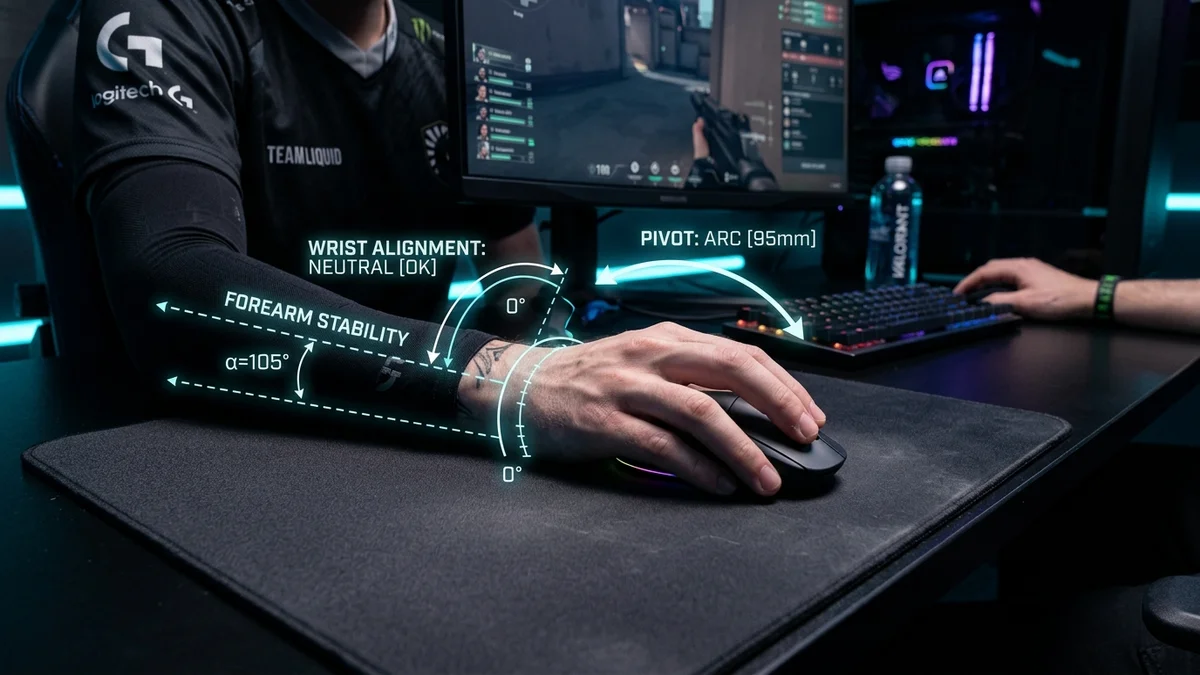
Altering your mouse sensitivity after every lost match is the single biggest trap keeping 90% of FPS competitors hardstuck.
Consistent aim does not come from copying a viral configuration, but from understanding the anatomical levers of your arm and how human motor memory actually works.
Joint Anatomy: Why Wrist-Only Aiming Caps Your Potential
Relying exclusively on wrist pivot movements exerts asymmetric mechanical stress across the flexor tendons and the carpal tunnel canal.
Beyond restricting your comfortable horizontal arc to barely thirty degrees, wrist flicking induces rapid micro-fatigue during long tournament sets.
Because smaller muscle groups tire significantly faster than major muscle groups, wrist aimers experience subtle tremors that degrade micro-adjustments in late-game rounds.
The Pro Hybrid Model: Shoulder for Swiping, Fingers for Micro-Corrections
Top-tier players in Counter-Strike 2, Valorant, and Apex Legends do not choose between arm and wrist mechanics; they layer them systematically.
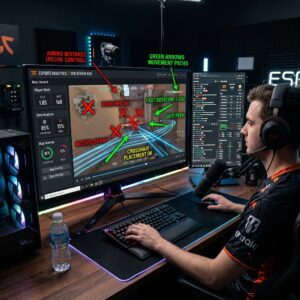
The shoulder and elbow handle large navigational sweeps (Arm Aiming) for ninety and one-hundred-eighty-degree clearing angles, maintaining a flat horizontal axis without jerkiness.
The wrist and fingertips engage only in the final deceleration phase to lock onto the adversary's head hitboxes.
Pairing this technique with a lightweight mouse reduces static friction, allowing effortless arm initiations without dragging resistance across the mousepad.
Desk Height and Elbow Geometry: Finding the Neutral Pivot Point
Before fine-tuning sensor settings, your workstation ergonomics dictate your movement efficiency.
Your chair and desk should be adjusted so your elbows form a 90 to 100-degree angle, with the forearm resting smoothly across the pad rather than digging into the desk bevel.
Resting approximately two-thirds of your forearm on the pad creates a predictable glide surface while keeping the shoulder girdle relaxed.
The Universal cm/360 Standard: Locking Muscle Memory Across Engines
Arbitrary in-game sensitivity sliders and DPI numbers cannot be directly compared across different gaming engines.
Competitive coaches use cm/360 (the physical distance in centimeters required for a full 360-degree rotation in-game) as the gold standard of motor benchmarking.
Tactical shooters reward a low-sensitivity bracket between 35 cm and 55 cm per full rotation for pinpoint first-bullet accuracy.
Arena and tracking shooters benefit from 25 cm to 35 cm per rotation to handle swift verticality and target transfers.
Standardizing your physical distance rather than arbitrary software numbers ensures your aim transfers seamlessly to every new title you pick up.
Pro Player Benchmarks: Real In-Game Settings and cm/360 Data
To grasp the practical reality of aim biomechanics, competitive analysts track the exact configurations used by global champions.
Here are verified tournament benchmarks across Counter-Strike 2 and Valorant in 2026:
| Player | Game | DPI | Sensitivity | eDPI | cm / 360° | Biomechanical Style |
|---|---|---|---|---|---|---|
| NiKo | CS2 | 800 | 0.815 | 652 | 63.8 cm | Pure Arm Aiming (elbow and shoulder) |
| ZywOo | CS2 | 400 | 2.00 | 800 | 52.0 cm | Balanced Hybrid (arm and wrist) |
| donk | CS2 | 800 | 1.25 | 1000 | 41.6 cm | Fast Hybrid (aggressive rifling) |
| TenZ | Valorant | 1600 | 0.195 | 312 | 41.9 cm | Claw Hybrid (fingertip micro-adjustments) |
| s1mple | CS2 | 400 | 3.09 | 1236 | 33.6 cm | High-Sens Wrist Aiming (rapid AWP reaction) |
Deconstructing the Three Pro Archetypes
These verified benchmarks illustrate how physical aiming mechanics adapt to competitive tactical roles.
Pure Arm Aiming (showcased by NiKo at 63.8 cm per rotation) requires a large 45 to 50 cm mousepad. This low-sensitivity profile delivers unmatched crosshair stability immune to heart-rate spikes during tense clutches.
The Hybrid bracket (utilized by ZywOo, donk, and TenZ between 41 cm and 52 cm) represents the competitive standard for over 75% of elite professionals. The forearm clears wide ninety-degree sweeps while the hand effortlessly locks onto headshots.
Finally, high-sensitivity Wrist Aiming (such as s1mple at 33.6 cm) offers blazing flick speed for aggressive sniping. However, this demands rigorous tendon warmups to safeguard joint health over a multi-year esports career.

SEO consultant for over 20 years and digital entrepreneur, Charles 'Grimtag' Ronchain is the founder of Pro-Gamer.gg, Retrocharting.com, and Gamescharting.com. A competitive gamer, streamer, and retro game collector, he has worked in the video game industry for over 15 years, notably as a consultant for leading game price comparison platforms. Passionate about real-time performance data and gaming technology, he analyzes competitive esports, gaming hardware benchmarks, and creator workflows on Pro-Gamer.gg with an authentic player perspective.