How to Become an Esports Data Analyst in 2026: Career Paths, Real Salaries, and Key Skills
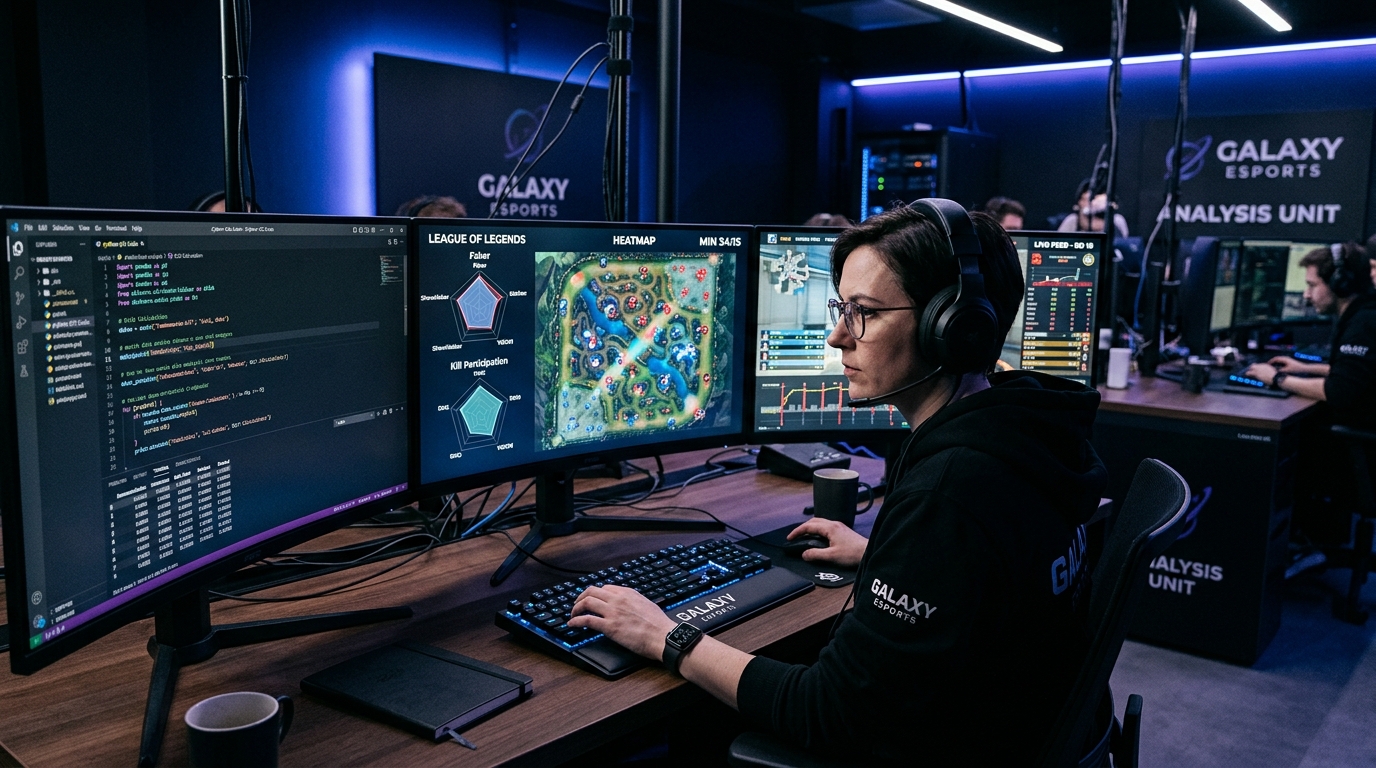
Gone are the days when esports coaching relied solely on a former pro player's gut feeling or endless, passive VOD reviews. In 2026, top-tier competitive esports has completed its statistical revolution, modeled directly after the analytical frameworks of the NBA, MLB, and European soccer.
At the center of this paradigm shift, the Esports Data Analyst has emerged as the indispensable right hand to head coaches and performance directors across premier powerhouses like Team Vitality, Karmine Corp, Cloud9, and G2 Esports.
Daily Duties: What Does an Esports Analyst Actually Do?
An esports analyst does not spend their working hours kicking back and watching live streams. Their day-to-day mission revolves around transforming millions of raw data points generated by game servers into actionable tactical advantages that the coaching staff can deploy immediately:
- In League of Legends: The analyst parses official match replay files (
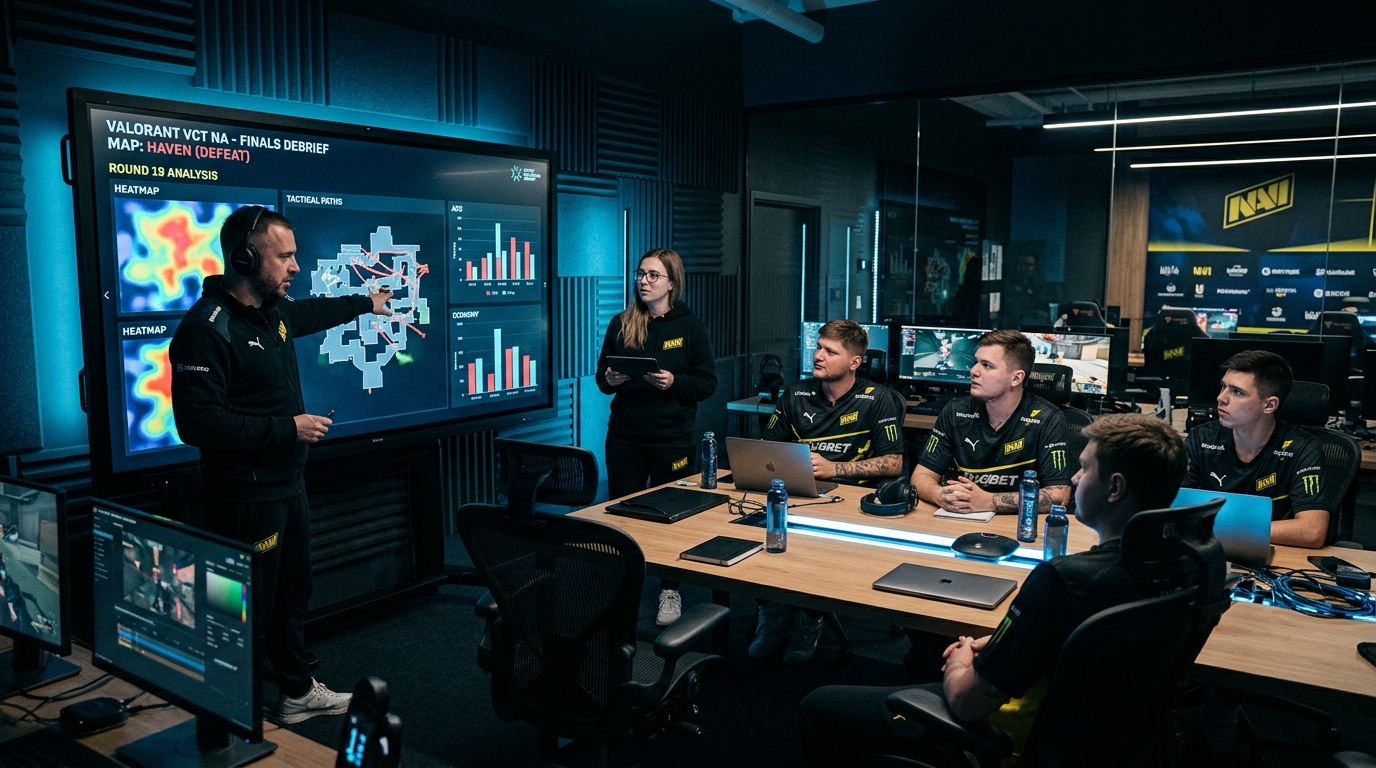
.rofl) and queries telemetry APIs to map opponent jungle routing, track recall timings down to the exact second, and model first dragon contest probabilities based on lane matchups and wave states. - In Counter-Strike 2 and Valorant: The workflow centers on parsing server demo files (
.dem) using tailored Python scripts (such as theawpylibrary). The analyst builds duel heatmaps, calculates trade efficiency (a teammate's ability to avenge an elimination within two seconds), and pinpoints defensive blind spots during bomb site retakes.
Essential Industry Tools: From GRID to Oracle's Elixir
To execute this surgical work, competitive analysts operate within a specialized ecosystem of dedicated platforms and technical tools:
- Oracle's Elixir & LoL Esports Data Portal (LDP): Founded by Tim Sevenhuysen (former head of data for 100 Thieves) and connected directly to Riot Games official data pipelines, Oracle's Elixir remains the ultimate benchmark for pulling granular match histories, gold differentials, and lane efficiency metrics across competitive leagues worldwide.
- GRID Esports: The backbone data platform of the competitive gaming industry, serving as the official data partner for Riot Games, Ubisoft, and KRAFTON to deliver secure, low-latency live telemetry feeds.
- Omnic.ai & Shadow Analytics: Dedicated 2D and 3D computer vision tactical platforms used to reconstruct rounds from aerial perspectives and calculate utility efficiency (smoke cover duration, flash effectiveness).
- Shikenso Analytics: The leading computer vision intelligence firm, relied on by esports front offices and commercial units to accurately track and quantify sponsor jersey and broadcast exposure.
- The Core Developer Tech Stack: Deep mastery of Python (specifically Pandas, NumPy, and Matplotlib for statistical modeling and data wrangling), SQL for querying relational databases and match APIs, and data visualization platforms like Tableau Software or PowerBI to deliver intuitive, easy-to-digest dashboards directly to players.
Real-World 2026 Salary Breakdown: How Much Does an Esports Data Analyst Make?
Following the major economic reset that swept through competitive gaming (the "esports winter"), team payrolls have recalibrated around sustainable operations. Compensation varies substantially between regional Tier 2 circuits, franchised Tier 1 global leagues, and software publishers:
Realistic Esports Salary Benchmark (Global & Regional 2026)
| Tier / Experience Level | Competitive Ecosystem | Observed Compensation | Contract Status & Real Conditions |
|---|---|---|---|
| Tier 2 Standard (Freelance / Part-Time) | NACL, VCL Challengers, European Regional Leagues (ERLs) | $900 - $1,700 / month | Freelance contractor or monthly stipend; frequently part-time alongside school or second job |
| Tier 2 Top Contenders (Full-Time) | Top academy squads (Karmine Corp Blue, Cloud9 Challengers, Vitality.Bee) | $2,200 - $3,200 / month ($26,000 - $38,000 / year) | Full-time contract, performance bonuses for promotion or Challengers / EMEA Masters runs |
| Tier 1 Established (Global Franchises) | LCS, LEC, VCT, CS2 Majors (Sentinels, G2, Team Liquid, Fnatic) | $4,000 - $6,500+ / month ($50,000 - $80,000+ base) | Gaming facility / housing support, percentage of tournament prize pools, and Major sticker revenue cuts |
| Data Scientist at Game Publishers & SaaS | GRID, Shikenso, Riot Games, Valve, Blizzard | $75,000 - $130,000+ / year | Standard international tech compensation packages, full medical benefits, 401(k), equity/stock options |
For those starting out in Tier 2, financial uncertainty and juggling multiple gigs are standard hurdles. As veteran professional coach Yeger highlighted in our exclusive interview on the reality of professional esports coaching, freelance contracts and balancing side projects remain the customary proving ground to establish credibility before landing a salaried, full-time spot.
Conversely, at the elite Tier 1 level, performance incentives can dramatically boost annual earnings. In Counter-Strike 2, Valve distributes digital sticker capsule revenues directly to participating organizations and players. Several top organizations contractually allocate a percentage of this revenue pool to their head coach and lead analyst. During a Valve Major where an organization generates between $1 million and $3 million in sticker sales, a 1% to 3% analyst cut translates into a direct qualification bonus of $15,000 to $45,000 for technical staff.
Education and Academic Paths: What Degree Actually Matters?
There is no accredited collegiate degree officially titled "Esports Data Analyst." In practice, esports general managers and coaching directors overwhelmingly favor candidates with traditional STEM degrees over generalized esports management certificates:
The ideal educational background is a bachelor's or master's degree in applied mathematics, statistics, computer science, or data science. That formal quantitative foundation is precisely what separates an enthusiastic fan who chats about matches from a data scientist capable of building reliable, predictive win models.
If you are exploring specialized gaming schools, consult our comprehensive guide to esports and video game training academies to identify institutions that feature rigorous technical modules in programming and data engineering.
Be sure to also review our breakdown of real job placement rates across video game and esports institutions to avoid sinking steep tuition dollars into programs lacking verifiable career outcomes.
The Golden Rule to Landing Your First Team Contract
Never apply to an esports organization with just a traditional resume. In competitive esports, recruitment is strictly portfolio-driven and proof-based. The vast majority of analysts signed by top organizations like Team Liquid, Vitality, G2, or Cloud9 were scouted through their publicly published analytical work:
Develop an open-source GitHub repository parsing public telemetry from the most recent major championship. Build an interactive Tableau Public dashboard visualizing early-game pathing vulnerabilities, and share your data breakdowns on X (formerly Twitter) and LinkedIn. Proving you can translate complex code pipelines into tangible, match-winning tactical adjustments is the single fastest path to getting hired by competitive head coaches and front offices.

SEO consultant for over 20 years and digital entrepreneur, Charles 'Grimtag' Ronchain is the founder of Pro-Gamer.gg, Retrocharting.com, and Gamescharting.com. A competitive gamer, streamer, and retro game collector, he has worked in the video game industry for over 15 years, notably as a consultant for leading game price comparison platforms. Passionate about real-time performance data and gaming technology, he analyzes competitive esports, gaming hardware benchmarks, and creator workflows on Pro-Gamer.gg with an authentic player perspective.