What Modern Gaming Did to Your Kids (And Why It Might Already Be Too Late)
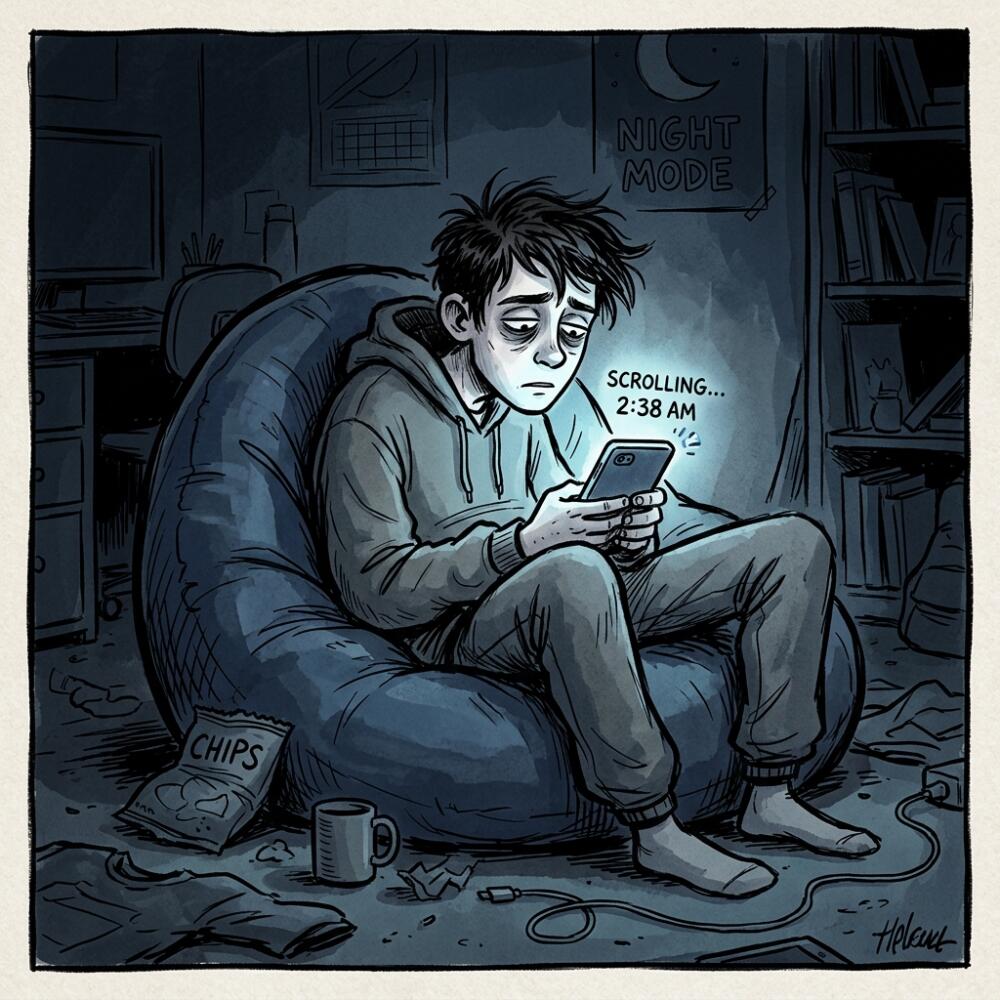
You can already hear the collective eye rolls and deep sighs from the TikTok generation: "Great, another boomer lecture about how 'back in my day things were better.' You're just out-of-touch relics who can't handle modern times."
Let them sigh. But if you are a smart gamer or a curious parent, take five minutes to read what follows. This report is not another moralizing sermon from disconnected critics. It is a cold, neuroscience-backed economic analysis of a harsh reality: the modern video game industry targets your brain in the exact same way Big Tobacco targeted the lungs of previous generations.
Today, a massive portion of video games is no longer designed for the pure joy of play. Instead, games are engineered as attention pumps, meticulously optimized to hook you on cheap micro-rewards. To understand this invisible manipulation, we first need to look at an everyday staple: white bread.
The Mechanics of Addiction: The Instant Gratification Trap
To understand how modern game design hijacks our attention, consider a daily analogy: sugar.
Just as eating a traditional baguette of white bread triggers a massive blood sugar spike (refined starch is converted so rapidly by digestive enzymes that a single loaf equates to absorbing 20 to 25 sugar cubes), overwhelming the pancreas with insulin and creating an impulsive craving for more, modern gaming runs on a "dopamine glycemic spike." The industry took a healthy pleasure (demanding, rewarding video games) and ultra-refined it into a continuous intravenous drip of cheap thrills and automated gratification.
Labeling this dependency as "harmless" is scientifically false. The addictive power of instant gratification (and sugar) on our neural circuits rivals that of hard drugs. A landmark study from CNRS Bordeaux led by Serge Ahmed (2007) demonstrated that 94% of rats preferred sweetened water over intravenous cocaine, even when the animals were already severely addicted to cocaine.
This identical hidden trap snares the modern gamer: players believe they are enjoying a fun, harmless video game, when in reality they are hooked to an algorithm engineered to seize their attention as fast and as long as possible to maximize monetization.
When "Game Over" Meant the End of the World and a Lesson for Life
For gamers who grew up in the 80s or 90s, firing up a console (Atari 2600, Commodore 64, NES, Sega Master System, Sega Genesis, Super Nintendo, Game Boy, or the original Tomb Raider on PS1) required genuine grit. Old-school game design did not negotiate with your feelings.
Frustration as a Core Engine for Growth
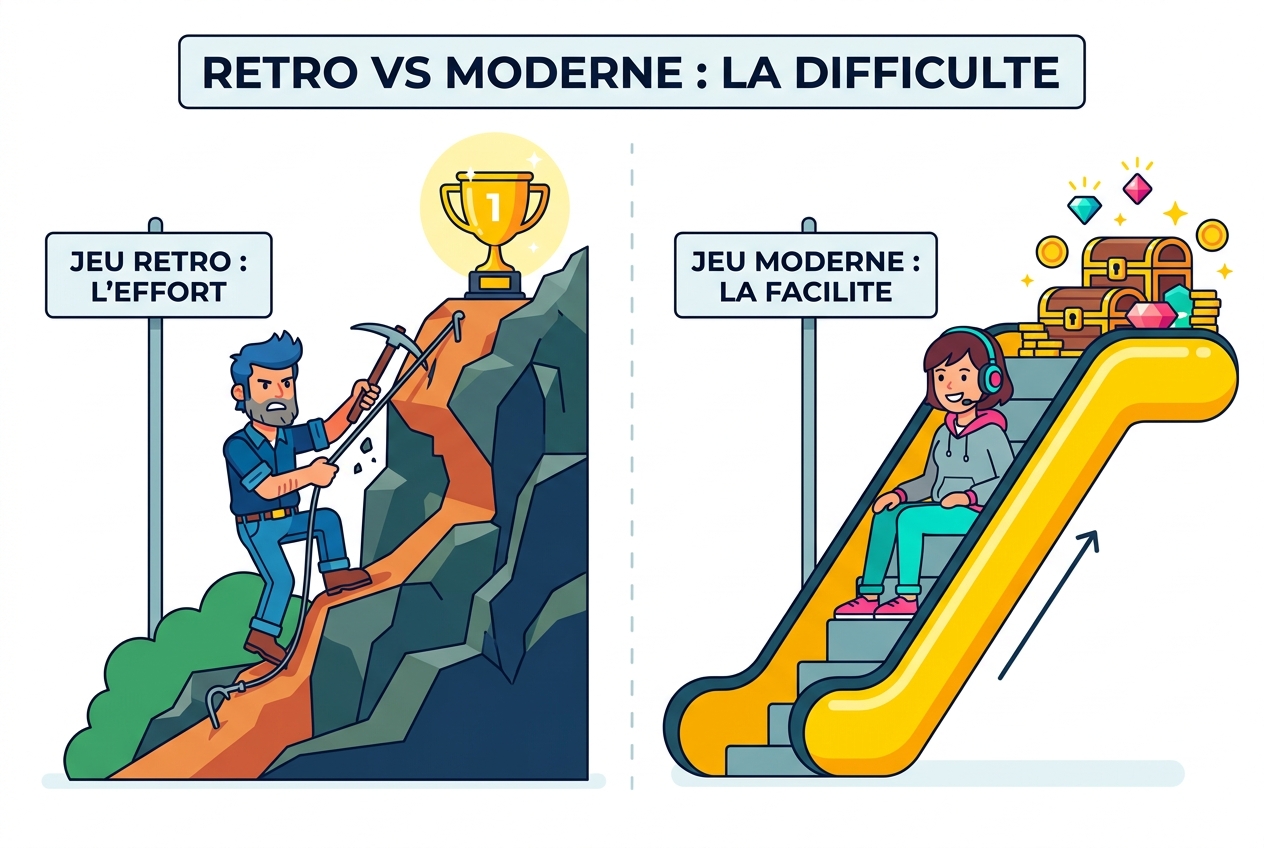
Take a game like Alex Kidd in Miracle World or Super Mario Bros.: you had three lives, zero auto-saves, no memory card, and no passwords. If you lost your final life to the last boss after three grueling hours of hyper-focus, the verdict was cold and unforgiving: GAME OVER. You had to switch off the console, swallow the defeat, and start all over from scratch the next day. That healthy frustration taught players how to handle failure and proved that victory must be earned.
Modern Gaming: Sanitized Failure to Retain the User
Today, failure has been commercially scrubbed away. Publishers live in mortal fear that you might rage-quit the game. Miss a jump or get eliminated in combat in a modern blockbuster? You respawn instantly at full health. Even worse: enter the infamous "yellow paint" syndrome (the Yellow Paint Debate). In titles like Resident Evil 4 Remake or Final Fantasy VII Rebirth, every climbable ledge and ladder is slathered in neon yellow paint. Players no longer explore, no longer search, and no longer make mistakes. They passively trail visual breadcrumbs. By stripping away friction, developers stripped away pride. If you cannot lose, your victory means nothing.
The Dopamine War: Why Real Life Feels Boring
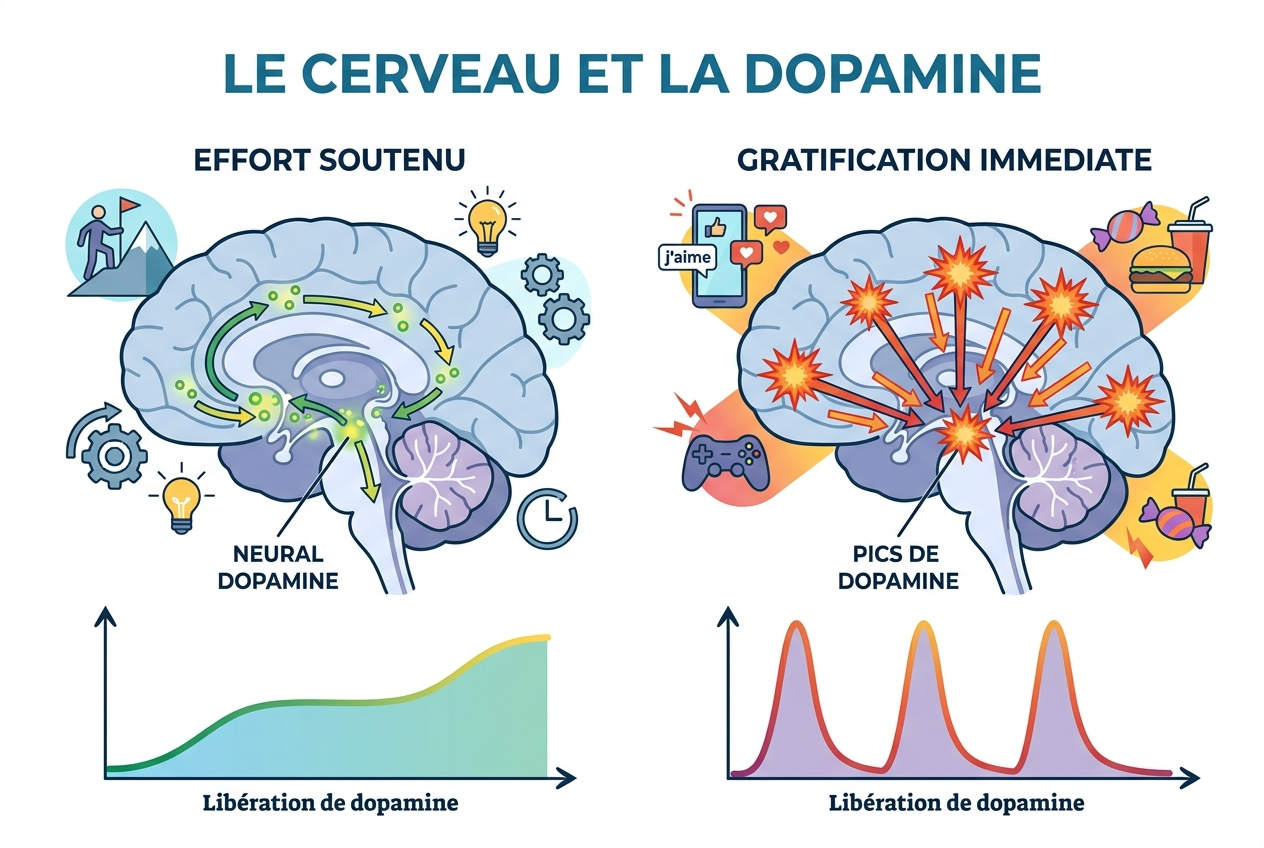
To understand the chronic apathy or lack of drive toward school and real-world goals, look at how developers hijack dopamine (the primary neurotransmitter driving motivation). The brain naturally seeks maximum dopamine for minimum effort. When a modern game hands out an instant hit for a single click, while homework or mastering a skill demands prolonged sweat for a distant payoff, your biology will choose the path of least resistance every single time.
The Skinner Box on a Global Scale
Games like Fortnite, Brawl Stars, or Roblox weaponize operant conditioning principles (the Skinner Box). Even when you lose a match, the screen erupts in confetti, celebratory sound effects, and surging XP meters. The brain absorbs a dopamine hit for near-zero cognitive investment.
A seminal study published in the scientific journal Nature (Koepp et al., 1998) empirically demonstrated that playing a video game doubles dopamine release in the striatum, reaching concentrations comparable to chemical drug stimulation.
Classroom Crises and the "Dopamine Baseline" Trap
As Stanford neurobiologist Andrew Huberman highlights in his work on the neurobiology of dopamine, the human brain regulates a tonic baseline of dopamine. Continuously bombarding yourself with hyper-fast, high-intensity stimuli (modern games paired with short-form TikTok feeds) artificially elevates that baseline. When you eventually sit in front of a textbook or tackle a long-term project, stimulation plummets. Your brain registers this drop as agonizing boredom. That is not mere laziness: your reward circuitry has become desensitized.
The Collapse of Resilience and the Quitting Reflex
In her foundational research summarized in Mindset: The New Psychology of Success, Stanford psychologist Carol Dweck outlined two primary mindsets when confronting challenges: the fixed mindset (believing intelligence and skill are innate, prompting immediate surrender upon failure) and the growth mindset (viewing struggle and effort as the true path to mastery).
Modern gaming, by deleting the stakes of failure and lavishing automatic rewards without effort, locks players into a fixed mindset. When faced with genuine real-world friction (academic, physical, or personal), quitting becomes second nature. Apathy becomes psychological armor to guard fragile egos: "I didn't fail because I'm bad at it; I failed because I didn't even try."
The Pro Gamer Mirage: From Passive Play to Iron Discipline
This is the ultimate paradox of the younger generation. Many players who reject academic diligence or traditional careers fantasize about becoming professional esports athletes (pro gamers) or streamers. They assume competitive esports is merely an extension of their daily dopamine rush. But they confuse the passive consumption of consumer software with the punishing regimen of elite athletic performance.
The Harsh Esports Reality Check: If you believe pro gaming is an endless vacation, brace yourself for a massive wake-up call. Professional esports demands the exact friction, brutal repetition, and delayed gratification that casual games actively strip away. To discover what life behind the curtain really looks like, check out our in-depth guide: Help, My Child Wants to Become a Pro Gamer.
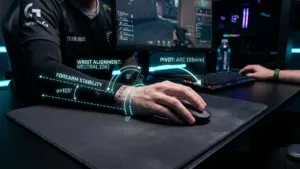
Making it as a pro gamer demands hundreds of hours inside aim trainers like Aim Lab, drilling the exact same flick shot 500 times in a row, reviewing dry statistical telemetry for hours, and learning to stomach loss after loss. It is the exact antithesis of cheap, frictionless gratification.
The Short-, Mid-, and Long-Term Fallout of a Frictionless Brain
By spending hours inside virtual ecosystems where every hurdle is flattened, young brains acclimate to a distorted reality, triggering very tangible real-world consequences:
- Short-Term: Immediate Outbursts (Gaming Rage)
The moment the screen turns off, irritability or outright rage flare up over the slightest everyday friction (cleaning a room, listening to a lecture). The brain enters acute withdrawal from high-frequency, effortless stimulation. - Mid-Term: Detachment from Real Life
School, which demands sustained focus with zero immediate rewards, morphs into an agonizing chore. Gamers lose interest in non-digital activities (sports, reading, creative arts) that feel painfully "slow." - Long-Term: Inability to Commit and Vulnerability to Addiction
Into adulthood, when facing real stakes (college degrees, career ladders, serious relationships), the quitting reflex takes over. Unable to tolerate the frustration required for long-term payoffs, adults chase quick dopamine fixes, becoming susceptible to behavioral addictions (impulse spending, gambling, doomscrolling) and stalling personal achievement.
How to Reclaim Control: Actionable Guide for Parents and Gamers
This is not about being preachy or quitting gaming altogether. Enjoying an exceptional game is an incredible experience. The goal is simply to remain the player in control rather than the product being farmed by the industry.
1. Cultivate Critical Thinking (Be a "Smart Gamer"): Whenever a game pushes a skin bundle, prompts you to crack a loot box, or showers you with loud fanfare for a routine action, take a step back. Ask yourself: "Am I genuinely having fun, or is this software just keeping me hooked to its dopamine IV drip?"
2. Embrace "Slow Gaming" and Constructive Difficulty: Gravitate toward deep, demanding titles like Celeste, Cuphead, Baba Is You, or Souls-likes like Elden Ring. In these games, triumph is not handed out by an algorithm: it is forged through learning from your mistakes and relentless perseverance. That is where real gamer pride lives.
3. Build a Healthy Digital Diet with Parents: Establish screen-free windows rooted in delayed gratification, a concept famously explored by Walter Mischel in the landmark Stanford Marshmallow Experiment. Whether it is reading a physical book, playing organized sports, tabletop board games, or practicing a musical instrument, offline pursuits recalibrate your dopamine baseline.
Frustration is not your enemy. It has always been the strongest catalyst for adult resilience. Reclaim your dopamine, and game on!

SEO consultant for over 20 years and digital entrepreneur, Charles 'Grimtag' Ronchain is the founder of Pro-Gamer.gg, Retrocharting.com, and Gamescharting.com. A competitive gamer, streamer, and retro game collector, he has worked in the video game industry for over 15 years, notably as a consultant for leading game price comparison platforms. Passionate about real-time performance data and gaming technology, he analyzes competitive esports, gaming hardware benchmarks, and creator workflows on Pro-Gamer.gg with an authentic player perspective.