Over 1,900 Game Boy Cartridges and 4 USB-C Audio Channels: How the Retro Song Bird Speaker Turns Classic Games Into a Chiptune Jukebox
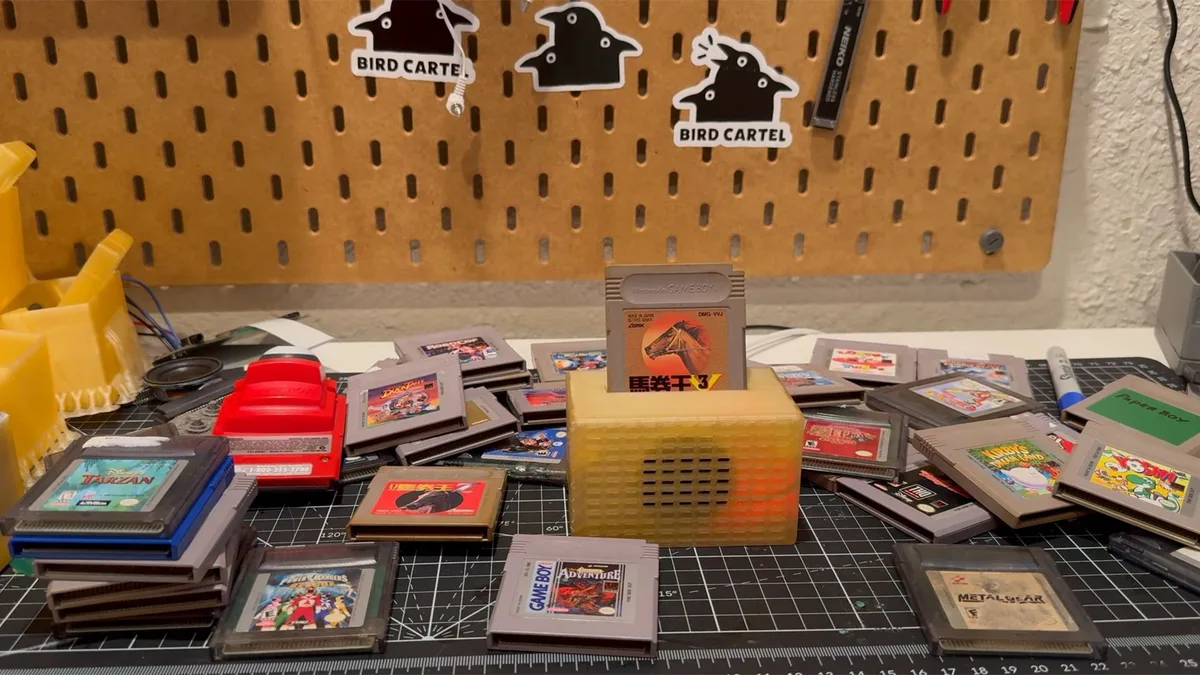
What if your old gray and translucent cartridges no longer needed a handheld console to blast their iconic 8-bit themes across your desk? Launched on November 16, 2026 by hardware designer B.J. Malicoat under his workshop banner Bird Cartel, the Retro Song Bird blew past its initial $15,000 funding goal within hours on its official Kickstarter campaign page. The pitch revolves around a purely tactile hardware experience: slot any original Game Boy (DMG) or Game Boy Color (GBC) cartridge into the top connector and play its full soundtrack immediately like a cassette tape, with no screen or software menus required.
An Onboard "Cart Map" Database Covering Over 1,900 Original Games
Unlike a standard Bluetooth speaker streaming compressed MP3 playlists, the Retro Song Bird reads the physical ROM chip inside the inserted cartridge through its 32-pin slot. To spare listeners from booting into gameplay or clearing a title screen just to hear a specific stage theme, Bird Cartel engineered an internal lookup system called the Cart Map. As soon as a cartridge clicks into place, the unit identifies the ROM header, locates the exact memory addresses housing the game's sound engine, and reproduces the handheld's audio registers with cycle-accurate precision.
At launch, the hardware database natively supports more than 1,900 official Game Boy and Game Boy Color releases. It also works out of the box with modern homebrew games built in GB Studio, rewritable flash cartridges, and chiptune tracker carts running LSDj (Little Sound DJ). Physical buttons along the top edge let users play, pause, skip forward or backward through individual music tracks and sound effects, and adjust the volume on the fly, celebrating the same era of clever console audio engineering seen in Takafumi Fujisawa's original PlayStation boot sequence sound design.
Four-Channel USB-C DAW Streaming, Save Backups, and Game Boy Camera Webcam Mode
Beyond its front-facing speaker and a 3.5mm stereo line-out jack for hooking up headphones or a desktop hi-fi setup, Bird Cartel packed serious studio utility under the translucent shell. When connected to a PC or Mac over USB Type-C, the Retro Song Bird splits the Game Boy audio processing unit into its four distinct hardware sound channels (two square/pulse wave channels, one programmable wave channel, and one noise generator) and routes them as four separate USB audio streams straight into any Digital Audio Workstation (DAW) for live remixing or stem isolation.

Collectors and chiptune producers also get a full suite of cartridge management features usually reserved for dedicated PC dumpers:
- Direct WAV Export: Save clean digital copies of full game soundtracks and isolated sound effects directly to a computer.
- Dual-Unit DJ Sync: Link two Retro Song Bird units together with tempo synchronization to mix and crossfade physical Game Boy cartridges live like vinyl turntables.
- ROM Dumping and SRAM Save Backup: Back up and restore battery-backed cartridge save files on a PC before soldering in a fresh coin-cell battery, joining the wave of preservation-focused hardware projects alongside Kouzex's DualStation Nintendo DS home console mod.
- Game Boy Camera Webcam and Alarm Clock: Plugging in Nintendo's 1998 Game Boy Camera turns the speaker into a working 128x112 pixel (5 fps) USB webcam, while a built-in clock mode lets you wake up to whatever cartridge is sitting in the slot.
Kickstarter Pricing and Shipping Timeline
Following the rapid sell-out of its $59 Early Bird tier, the Retro Song Bird is available to back on Kickstarter for $79 USD for a single unit, or $150 USD for a two-unit DJ bundle. Bird Cartel plans to provide an open developer API and over-the-air (OTA) firmware updates to expand the Cart Map compatibility list ahead of mass production, with backer shipments scheduled to begin in April 2027.
My Test Bench
Looking closely at the hardware architecture outlined by B.J. Malicoat for this Kickstarter prototype, without having had a physical unit on my test bench yet, one engineering choice immediately stands out to me: exposing all four Game Boy APU channels as independent USB-C audio streams. Plenty of retro desk gadgets stop at surface-level nostalgia, but giving musicians isolated access to the two pulse waves, the programmable wave channel, and the noise channel turns this compact cube into a legitimate studio instrument. Add in the ability to back up aging cartridge SRAM saves and a reasonable $79 entry price, and the Retro Song Bird looks like a remarkably clever piece of preservation hardware on paper, provided the 32-pin connector tolerances and onboard speaker acoustics deliver when units ship in April 2027.

PC hardware enthusiast and competitive gamer, Arthur 'Heimdall' splits his time between France and the UK working in enterprise B2B software solutions. A business school graduate passionate about component benchmarking, he has been building, modding, and tuning PCs since childhood, optimizing every thermal degree and millisecond of display latency. An avid gamer across Assassin's Creed and sandbox titles, he forged his alliance with Grimtag and Chaya during late-night World of Warcraft raids before joining Pro-Gamer.