Up to 5.9x Faster Than RTX PRO 6000 in FP64: Intel Shares First Benchmarks for Its 350W Crescent Island D270 GPU
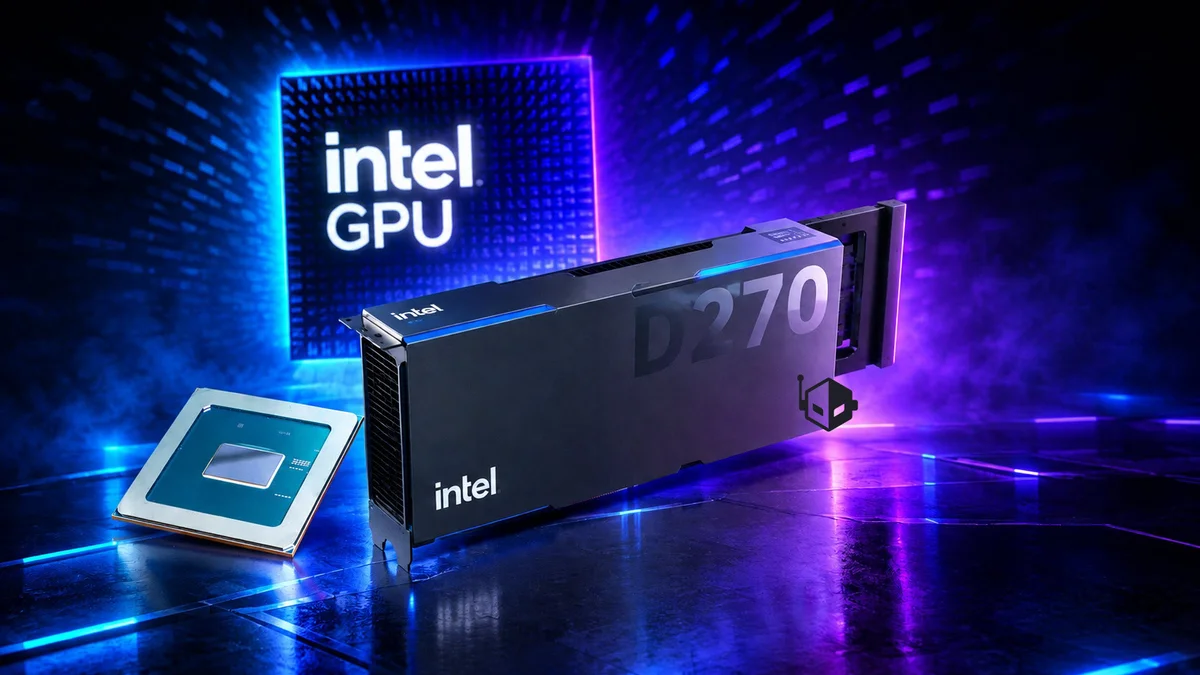
At Supercomputing 2026 (SC26), Intel officially released the first performance benchmarks for its next-generation data center and workstation accelerator, the Intel GPU D270, formerly code-named "Crescent Island." Built on the specialized Xe3P microarchitecture, the 350W air-cooled PCIe 5.0 card goes head-to-head against the 600W NVIDIA RTX PRO 6000 Blackwell Server Edition in double-precision (FP64) scientific and financial workloads, delivering up to 5.9x higher throughput.
Black-Scholes, Binomial Pricing, and 3D Seismic Benchmarks at SC26
During its SC26 technical sessions, Intel showcased internal performance figures recorded on the reference 160 GB LPDDR5X D270 card. In quantitative financial modeling workloads that rely heavily on native double-precision floating-point math via optimized SYCL and OneMKL libraries, the Xe3P accelerator posted substantial gains over a single NVIDIA RTX PRO 6000 Blackwell Server Edition running its fastest available CUDA and SYCL paths:
- Black-Scholes (European options pricing): 5.6x to 5.9x higher throughput than the RTX PRO 6000 Blackwell.
- Binomial Options Pricing: 4.6x higher throughput in favor of the Intel GPU D270.
- Black-Scholes (American options) and Monte Carlo simulations: 1.92x higher throughput compared to NVIDIA's 600W server card.
- 3D MiniMod Seismic Analysis (1-billion-point grid): Sustained throughput of 45.91 billion grid points per second, highlighting strong efficiency in memory-bound scientific simulations.
Why Intel's Xe3P Architecture Pulls Ahead in Double-Precision Math
The wide gap in financial and scientific compute stems from a fundamental architectural divergence. Workstation and server GPUs derived from graphics dies, such as the RTX PRO 6000 Blackwell, prioritize FP32, FP16, and Tensor throughput while throttling double-precision FP64 execution rates. By contrast, Intel engineered Xe3P to support native precisions ranging from FP4 and microscaling formats (MXFP4/MXFP8) all the way up to full-rate FP64, delivering 10.2 TFLOPS of peak vector double-precision compute alongside 1.3 PFLOPS of dense FP8 AI performance.
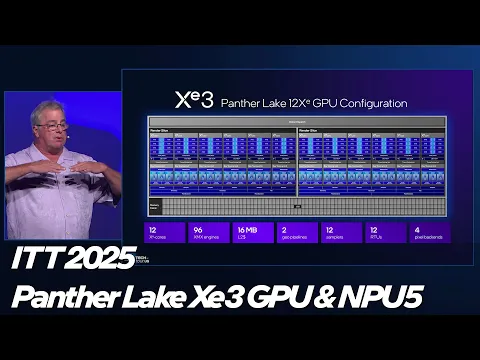
To pack 32 Xe3P cores, 256 XMX matrix engines (built around a 16-deep systolic array), and 32 MB of unified L2 cache into a 350W power envelope, Intel stripped out traditional 3D rasterization and ray-tracing units that go unused in compute clusters. While the ultra-dense liquid-cooled tier is dominated by NVIDIA's massive 50,000-CUDA-core Rubin HPC GPU unveiled at SC26, Crescent Island targets enterprise air-cooled racks that need converged AI inference and FP64 math without retrofitting data centers for liquid loops.
160 GB of LPDDR5X at 350W vs. 96 GB of GDDR7 at 600W
Memory architecture is the second pillar behind Intel's D-Series strategy. By pairing the Xe3P die with 160 GB of LPDDR5X memory delivering 1.5 TB/s of bandwidth on reference cards (and scaling up to 480 GB on partner designs), the D270 offers 66% more memory capacity than the 96 GB RTX PRO 6000 Blackwell while drawing 250W less power. This design reinforces Intel's broader resurgence across desktop and data center silicon by giving enterprise buyers a high-capacity PCIe 5.0 x16 accelerator tailored for both large KV-cache LLM inference and precision-critical HPC workloads.
My Take on the Spec Sheet
I view Crescent Island as one of Intel's smartest enterprise GPU pivots in years. Instead of burning billions trying to out-muscle 1,000W HBM liquid-cooled giants in frontier LLM training, I can see why Intel carved out a pragmatic niche with the 350W D270. Quantitative finance desks, seismic researchers, and engineering firms running standard air-cooled PCIe servers have been starved for affordable full-rate FP64 compute paired with massive memory pools. Delivering up to 5.9x higher Black-Scholes throughput than an RTX PRO 6000 Blackwell at nearly half the wattage gives Xe3P a compelling, real-world value proposition.

PC hardware enthusiast and competitive gamer, Arthur 'Heimdall' splits his time between France and the UK working in enterprise B2B software solutions. A business school graduate passionate about component benchmarking, he has been building, modding, and tuning PCs since childhood, optimizing every thermal degree and millisecond of display latency. An avid gamer across Assassin's Creed and sandbox titles, he forged his alliance with Grimtag and Chaya during late-night World of Warcraft raids before joining Pro-Gamer.