Nearly $7 Spent on Video Games for Every $1 at the Movies: How Gaming Now Dwarfs the Global Box Office

While Hollywood studios and streaming giants brace for the massive impact of GTA 6 on their November viewership, full-year financial data proves the balance of power shifted years ago. According to a new cross-industry analysis compiled by Beacon Digital PR, U.S. consumers now spend nearly seven times more money on video games or home entertainment than they do going to movie theaters.
Across the United States, consumer spending on video games (encompassing software, subscriptions, console hardware, and accessories) reached $60.7 billion according to annual figures from the Entertainment Software Association (ESA) and Circana. That figure stands as the second-highest annual total ever recorded in the American market, trailing only the pandemic-era peak.
By comparison, North American theatrical ticket sales across the U.S. and Canada totaled $8.87 billion according to Comscore, reflecting a modest 1.5% year-over-year increase. Put simply, for every $1.00 spent at a North American movie theater box office, American households spent $6.84 on video games and $7.01 on home video entertainment ($62.2 billion tracked by the Digital Entertainment Group across streaming subscriptions, digital rentals, and physical discs).
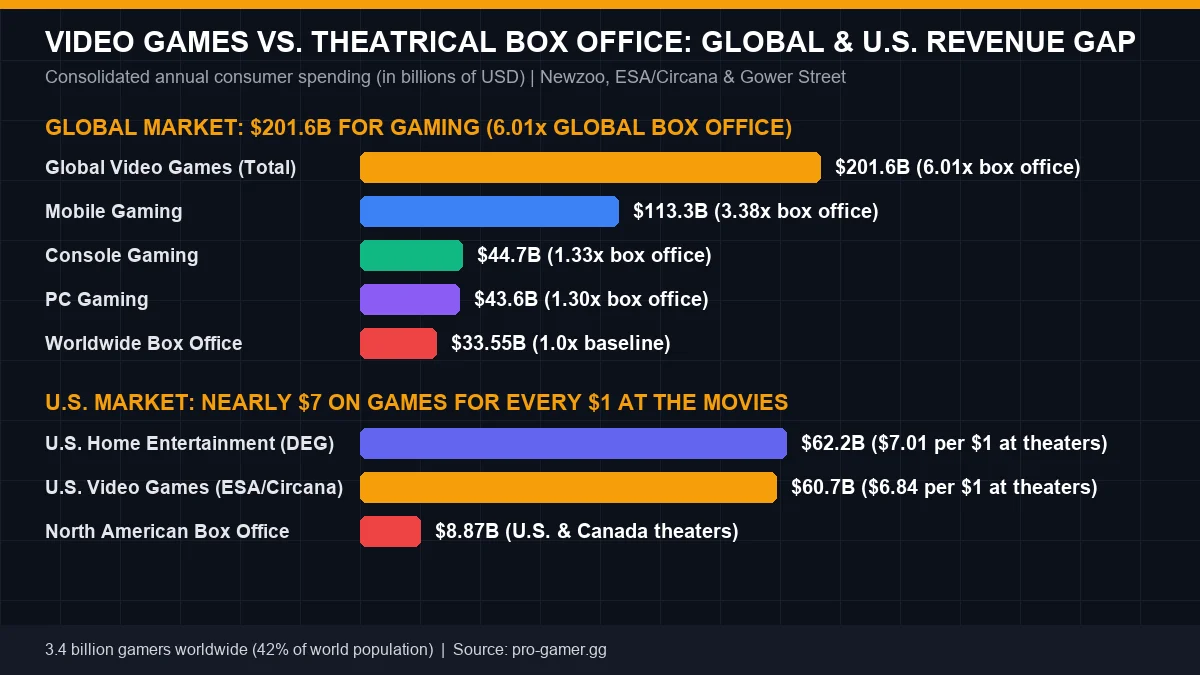
$201.6 Billion Worldwide: Every Gaming Platform Out-Earns Global Cinemas on Its Own
On a global scale, the financial gap between interactive entertainment and traditional moviegoing grows even wider. Combining finalized global games market data from Newzoo ($201.6 billion) with worldwide theatrical box office tracking from Gower Street Analytics ($33.55 billion), the video game industry generated $6.01 for every single dollar spent at movie theaters worldwide.
That represents an annual revenue gap of more than $168 billion, giving video games 86% of the combined total between the two mediums. Even more remarkably, every individual gaming platform segment out-earned the entire global theatrical box office all by itself:
| Sector / Platform | Annual Consumer Revenue | Multiple vs. Global Box Office | Primary Data Source |
|---|---|---|---|
| Global Video Game Market (Total) | $201.60 Billion | 6.01x Global Box Office | Newzoo |
| Mobile Gaming | $113.30 Billion | 3.38x Global Box Office | Newzoo |
| Console Gaming (PS5, Switch, Xbox) | $44.70 Billion | 1.33x Global Box Office | Newzoo |
| PC Gaming | $43.60 Billion | 1.30x Global Box Office | Newzoo |
| Worldwide Theatrical Box Office | $33.55 Billion | Baseline (1.00x) | Gower Street Analytics |
| U.S. Video Game Consumer Spending | $60.70 Billion | 6.84x North American Box Office | ESA / Circana |
Generating $113.3 billion on its own, mobile gaming brought in more than three times the revenue of every movie theater on Earth combined. Dedicated gaming hardware held a decisive lead as well: console gaming ($44.7 billion) and PC gaming ($43.6 billion) each topped the worldwide theatrical box office by more than $10 billion individually.
3.4 Billion Active Players Worldwide as U.S. Physical Game Sales Hit a 1995 Low
Beneath those record revenue totals lies a stark transformation in how players buy and own their games. Just as recent corporate earnings showed that digital downloads now account for 78% of all PS5 and PS4 game sales, Circana reports that U.S. consumer spending on new physical video game copies dropped to roughly $1.5 billion, the lowest annual figure recorded since 1995.
Ironically, physical media is showing far greater resilience among movie collectors than in gaming stores. While boxed video game sales continue to shrink in favor of digital storefronts and subscription libraries, DEG figures reveal that U.S. spending on 4K UHD Blu-ray discs climbed by 12% over the same period, driven by enthusiasts investing in premium home theater editions.
In terms of reach, Newzoo estimates that roughly 3.4 billion people played a video game over the past year, representing 42% of the world's total population (pegged at 8.09 billion by the U.S. Census Bureau). Unlike theatrical cinema, which relies on one-off ticket sales for a two-hour screening, gaming monetizes hundreds of millions of daily active players year-round through live-service updates, free-to-play ecosystems, and persistent social worlds.

My Take
Two numbers in this U.S. breakdown capture the irony of modern gaming better than any executive keynote: $60.7 billion in total player spending, yet only $1.5 billion left for new physical game discs, the lowest total since the original PlayStation launched in North America back in 1995. Movie collectors are actually defending their physical 4K UHD Blu-ray shelves (+12%) more fiercely than our own industry, where console makers now sell disc drives as pricey add-ons and ship plastic boxes with download codes inside.
As for the 6-to-1 revenue lead over global cinemas, it comes down to daily habit rather than ticket prices. A movie theater gets your wallet once for a two-hour screening, whereas a major console RPG, a competitive PC shooter, or a live-service ecosystem keeps players logged in with their friends every night of the week.

SEO consultant for over 20 years and digital entrepreneur, Charles "Grimtag" is the founder of Pro-Gamer.gg, Retrocharting.com, and Gamescharting.com. A competitive gamer, streamer, and retro game collector, he has worked in the video game industry for over 15 years, notably as a consultant for leading game price comparison platforms. Passionate about real-time performance data and gaming technology, he analyzes competitive esports, gaming hardware benchmarks, and creator workflows on Pro-Gamer.gg with an authentic player perspective.