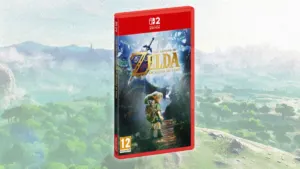
Zelda Ocarina of Time Remake Hits 60 FPS on Ultrawide Monitor With PC DLSS as Switch 2 Emulator Boots on PS5
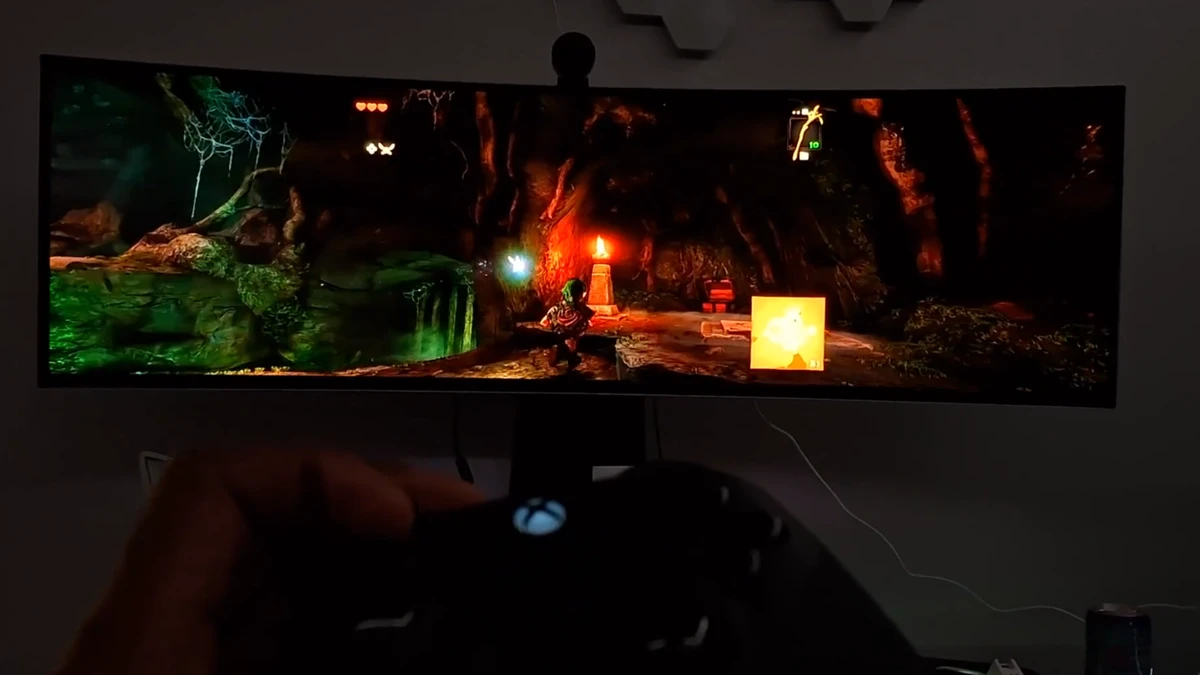
Less than four days after its official November 5, 2026 launch on the Nintendo Switch 2, The Legend of Zelda: Ocarina of Time Remake has reached a major technical milestone on PC. While the Lichii Switch 2 emulator recently hit 60 FPS on a GeForce RTX 5080 at the cost of heavy processor thread utilization, two separate native static recompilation projects are now converting the console binary directly into standalone Windows x86-64 executables.
Led respectively by developers tangerineturtle1 (project NX2navi) and sostenesfreitas, also known as Miojo (project Ocarina Recomp) on GitHub, these community builds introduce native 21:9 and 32:9 Ultrawide aspect ratios alongside NVIDIA DLSS and AMD FSR 3.1 upscaling. At the same time, homebrew developer Vampinity has managed to boot the Switch 2 remake on a jailbroken PlayStation 5 using the EglantinePS5 emulator fork.
NX2navi and Ocarina Recomp: Native Windows x86-64 Executables Running on Vulkan 1.3
Unlike traditional console emulation that translates ARM64 instructions on the fly during gameplay, native PC static recompilation without an emulator converts the Switch 2 game binary (version 1.1.1) ahead of time into C code before compiling it into a native Windows application (generating standalone nx2navi.exe and ocarina.exe executables). Graphics calls are routed directly through a custom Vulkan 1.3 renderer leveraging modern GPU Mesh Shaders.
The open-source NX2navi repository published by tangerineturtle1 stands out by integrating high-end PC features absent from the stock console release:
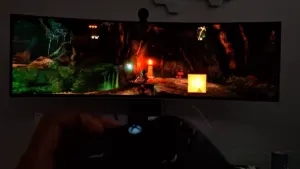
- Native Ultrawide Display Support: full rendering support for 21:9 and 32:9 ultrawide monitors across 1440p, 4K, and up to 5K resolutions, while keeping the HUD, pause menus, and pre-rendered cutscenes properly pillarboxed at 16:9 without stretching.
- NVIDIA DLSS and AMD FSR 3.1 Upscaling: built-in support for DLAA, Quality, Balanced, Performance, and Ultra Performance presets on GeForce RTX graphics cards, alongside universal AMD FSR 3.1 support across all compatible GPUs.
- Frame Generation and Uncapped Refresh Rates: native integration of FSR 3.1 Frame Generation and unlocked framerates scaling from a 60 FPS default up to 240 FPS, paired with native and enhanced HDR output.
GeForce RTX 5090 Telemetry: Up to 59 Native FPS and Over 18 GB of Peak VRAM Usage
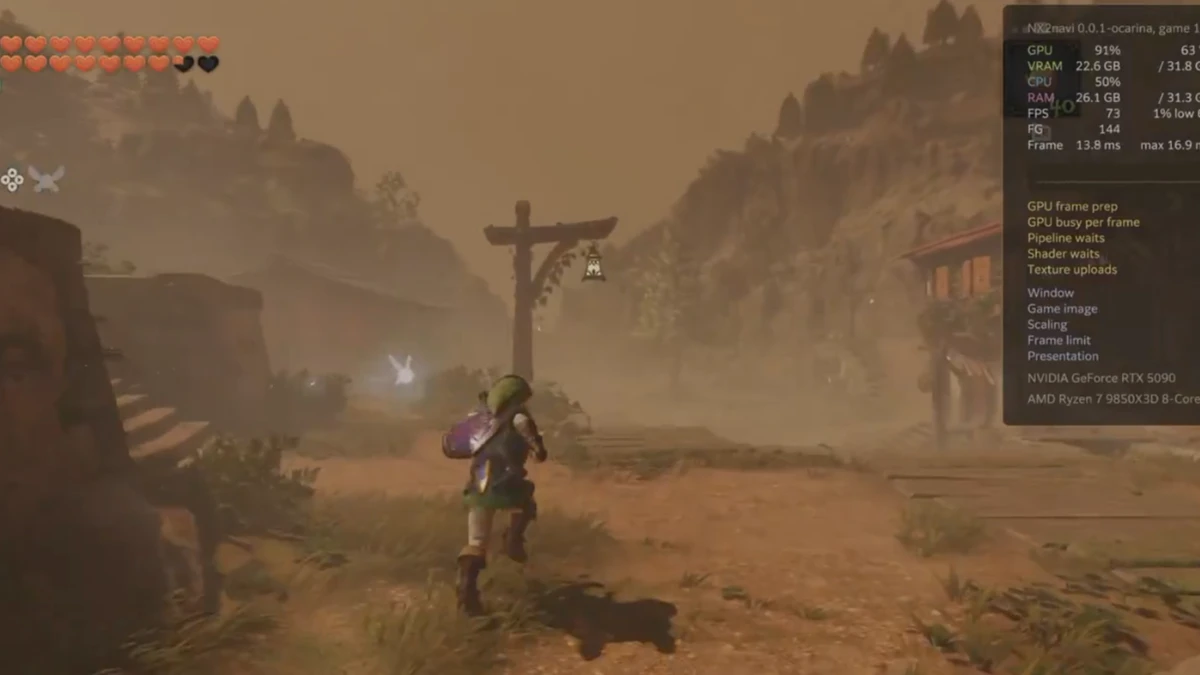
Meanwhile, the Ocarina Recomp project maintained by sostenesfreitas has been benchmarked extensively on an enthusiast test bench pairing an AMD Ryzen 9 9950X3D processor (as well as a Ryzen 7 9850X3D) with an NVIDIA GeForce RTX 5090 graphics card.
Across the opening sequence, Kokiri Forest, and inside the Great Deku Tree, the native executable maintains 59 FPS while standing still and runs between 51 and 55 FPS while moving through the village, with working audio, save data, and controller input. Early telemetry logs did, however, reveal a massive memory spike exceeding 18 GB of VRAM on the RTX 5090 during initial shader compilation passes, prompting contributors to roll out memory optimization commits. Both projects distribute zero copyrighted assets and require users to supply their own legally dumped Switch 2 game files to build the executable locally.
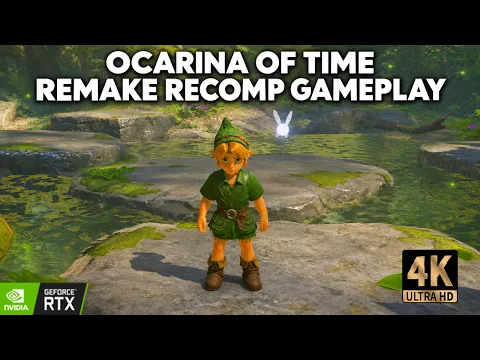
EglantinePS5: The Switch 2 Remake Boots at 20 FPS on a Jailbroken PlayStation 5
Console homebrew enthusiasts have also pushed cross-platform boundaries. Developer Vampinity shared a technical demonstration running The Legend of Zelda: Ocarina of Time Remake directly on a jailbroken PlayStation 5 operating on system firmware 12.40, unlocked via the Relapse exploit chain (which covers PS5 firmwares from 7.00 through 13.60).
The test relies on EglantinePS5, an experimental port of the Eglantine Switch 2 emulator (derived from the Eden emulator architecture) adapted for Sony's OrbisOS environment. While the build successfully boots past the title screen, loads a save file, and lets Link step out of his house into Kokiri Forest, strict OrbisOS memory limits and unoptimized translation layers hold performance to an unstable 15 to 20 FPS. Heavy missing geometry, thick fog artifacts, and inevitable memory crashes after a few minutes confirm that the PS5 port remains a technical proof of concept rather than a playable alternative.
| Execution Method | Architecture & Graphics API | Aspect Ratio & Upscaling | Measured Performance | Current Stability |
|---|---|---|---|---|
| Nintendo Switch 2 (Stock Console) | Native proprietary ARM64 | Standard 16:9 (Internal FSR) | 30 to 60 FPS target | 100% complete and stable |
| PC Switch 2 Emulator (Lichii / Eden) | Dynamic ARM64 to x86-64 translation | 16:9 (Requires Dynamic FPS mods) | 60 FPS (RTX 5080 + Ryzen 7 9800X3D) | Playable early areas, heavy CPU load |
| PC Static Recomp (NX2navi / Ocarina Recomp) | Native Windows x86-64 executable (Vulkan 1.3) | 21:9 & 32:9, DLSS, FSR 3.1, HDR, 4K/5K | 51 to 60 native FPS (RTX 5090), up to 240 FPS with FG | Kokiri Forest & Deku Tree (~18 GB VRAM spike) |
| Jailbroken PS5 Fork (EglantinePS5) | OrbisOS emulation (Relapse exploit FW 12.40) | 16:9 with geometry & fog glitches | 15 to 20 unstable FPS | Proof of concept (crashes on RAM limits) |
My Take on the Spec Sheet
Watching two independent static recompilation projects like NX2navi and Ocarina Recomp deliver native 21:9 and 32:9 Ultrawide rendering with NVIDIA DLSS and Frame Generation over Vulkan 1.3 less than four days after a flagship Switch 2 launch highlights just how fast binary translation tooling has matured. Even though the 18 GB VRAM spike recorded on a GeForce RTX 5090 proves that shader memory management still needs serious optimization before the entire world of Hyrule is seamless, I find this native x86-64 approach far more compelling than brute-force emulation, whose 20 FPS proof of concept on a jailbroken PS5 mostly underscores how quickly memory bottlenecks hit unoptimized console wrappers.
Zelda Ocarina of Time
Explore official trailers, technical specs and all latest coverage for Zelda Ocarina of Time.

PC hardware enthusiast and competitive gamer, Arthur 'Heimdall' splits his time between France and the UK working in enterprise B2B software solutions. A business school graduate passionate about component benchmarking, he has been building, modding, and tuning PCs since childhood, optimizing every thermal degree and millisecond of display latency. An avid gamer across Assassin's Creed and sandbox titles, he forged his alliance with Grimtag and Chaya during late-night World of Warcraft raids before joining Pro-Gamer.