No Cross-Ruleset Dungeons or PvE Transfers: Why WoW: Forever's Strict RP Server Divide Is Sparking Debate
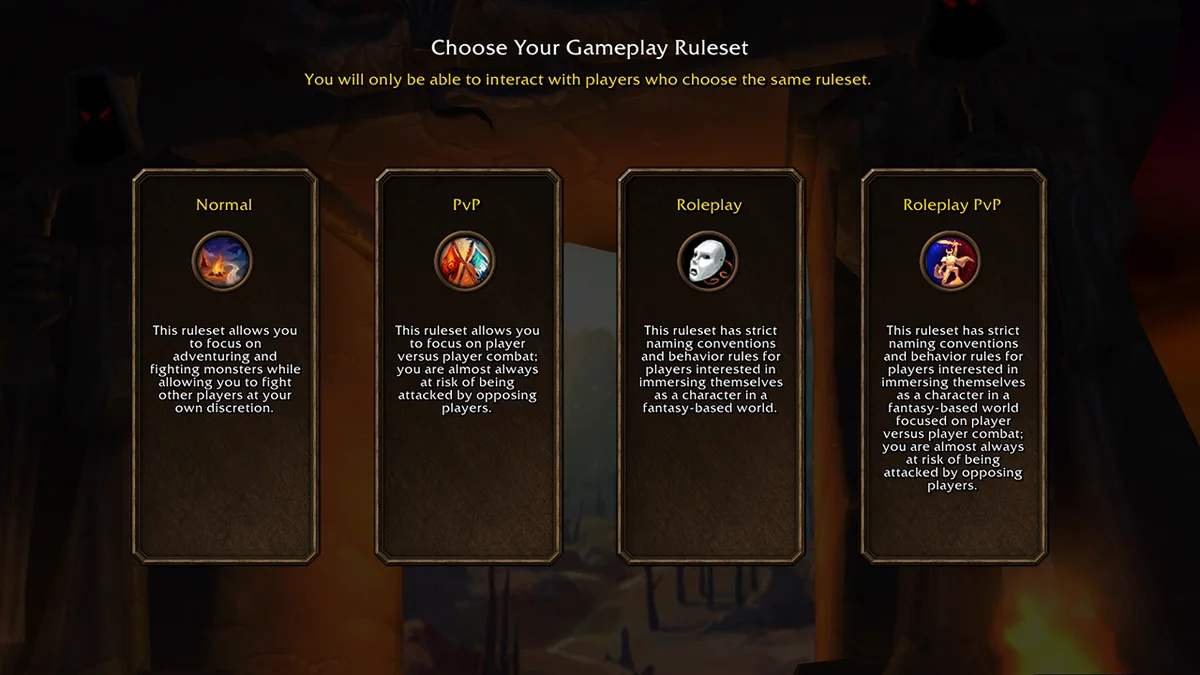
While network engineers are busy retuning the aggressive server layering that left Stormwind and Orgrimmar feeling like ghost towns in World of Warcraft: Forever, another core architectural decision is sparking heated discussion among longtime MMO veterans. By replacing the traditional realm-selection screen with five regional playstyles known as rulesets, Blizzard Entertainment has built an impenetrable wall between players on the Roleplay (RP) ruleset and those on the Normal (PvE) ruleset.
Five Realmless Regional Ecosystems With Zero Cross-Ruleset PvE Grouping
To prevent individual launch servers from dying out or suffering from multi-hour login queues, the official realm architecture outlined on the official World of Warcraft website eliminates named realms in favor of five broad regional ecosystems: Normal, PvP, Roleplay, Roleplay PvP, and (arriving after launch) Hardcore. Unlike the strict single-faction lock and 50/50 population cap enforced on PvP rulesets, the Normal, Roleplay, and Hardcore ecosystems allow players to roll both Alliance and Horde characters on the same Battle.net account while sharing Collections and Legacy Points account-wide.
However, Blizzard paired this modern megaserver structure with an uncompromising restriction: cross-ruleset grouping is completely disabled for open-world questing, five-player dungeons, and endgame raids. Furthermore, characters can never hop or transfer between rulesets; if you want to run a dungeon with friends who rolled on the Normal PvE ruleset, your only option is to start over from level 1 on a brand-new character. Only instanced PvP Battlegrounds mix players across rulesets (excluding Hardcore, which remains completely isolated unless a fallen character transfers out upon death).
| Server Ruleset | Faction Creation Rule | Dungeon & Raid Grouping | PvP Battlegrounds | Character Mobility |
|---|---|---|---|---|
| Normal (PvE) | Both Alliance & Horde allowed | Normal ruleset players only | Cross-ruleset (except Hardcore) | Locked (no hopping or transfers) |
| Roleplay (RP-PvE) | Both factions allowed (strict RP naming rules) | Roleplay ruleset players only | Cross-ruleset (except Hardcore) | Locked (no jumping to Normal PvE) |
| PvP & Roleplay PvP | Single faction per account + dynamic 50/50 lock | Same ruleset & faction only | Cross-ruleset (except Hardcore) | Locked |
| Hardcore (Post-Launch) | Both factions allowed (permadeath) | 100% enclosed Hardcore ecosystem | Isolated from all other rulesets | One-way transfer out allowed only upon death |
Why Blocking RP-to-Normal Dungeon Grouping Hurts the Community
Now that players are logging 15 to 25 hours of /played time and running early dungeons like the Deadmines and Wailing Caverns, veteran roleplayers are pointing out a glaring flaw in treating the Roleplay ruleset like an airtight vault. Out in the open world, giving roleplayers their own dedicated server layers (paired with the account-wide Preferred Online Language toggle, which carries a 24-hour cooldown in the System menu) works wonders: the leveling atmosphere is noticeably more relaxed, toxicity is virtually nonexistent, and spontaneous world RP isn't diluted across dozens of general PvE layers.
Yet enforcing a strict wall between the Roleplay and Normal rulesets inside instanced dungeons and raids makes very little practical sense. While walling off PvP from PvE is essential to protect server economies (since gathering copper veins or herbs uncontested on a Normal layer would wreck a PvP auction house), there is zero mechanical or economic difference between how open-world PvE operates on the Roleplay and Normal rulesets.
More importantly, MMO roleplay culture has always maintained a natural boundary between In-Character (IC) storytelling in taverns, camps, and capital cities, and Out-of-Character (OOC) gameplay inside dungeons and raids. Nobody is typing out Shakespearean monologues while tanking Edwin VanCleef in the Deadmines. By refusing to offer a semi-permeable bridge that lets Roleplay characters group up with friends on the Normal ruleset or migrate later if endgame raid populations thin out at level 60, Blizzard risks siloing off a passionate community that still wants to clear endgame content without abandoning characters they have invested dozens of hours into.

My Take
Anyone who has ever spent time on classic roleplaying realms like Argent Dawn or Moon Guard knows how MMO roleplay actually works: you stay in character around a campfire in Goldshire or inside a Stormwind tavern, and the second you step through a dungeon portal, you focus on your rotation and kill the boss like everybody else. Giving roleplayers their own open-world layer so they don't get drowned out by megaserver layering is a smart call, but barring them from grouping with friends on the Normal PvE ruleset for a five-man dungeon run is needlessly rigid. Once the launch rush settles down and level 60 guilds start hunting for reliable raid rosters, trapping roleplayers in a sealed ecosystem with no cross-grouping or transfer path to Normal PvE is a headache Blizzard will eventually have to fix.

SEO consultant for over 20 years and digital entrepreneur, Charles "Grimtag" is the founder of Pro-Gamer.gg, Retrocharting.com, and Gamescharting.com. A competitive gamer, streamer, and retro game collector, he has worked in the video game industry for over 15 years, notably as a consultant for leading game price comparison platforms. Passionate about real-time performance data and gaming technology, he analyzes competitive esports, gaming hardware benchmarks, and creator workflows on Pro-Gamer.gg with an authentic player perspective.