Left Alone on a Virtual Island for 30 Hours With Zero Tasks, MIT's Eko AI Invented Basketball, Bowling, and a Physics Glitch
What happens when a frontier artificial intelligence coding assistant is given a virtual body on a deserted digital island for 30 consecutive hours with no tasks to complete, no reward function, and no score to optimize? In their study titled "Is this machine playing?" (arXiv:2610.07130), six researchers from MIT CSAIL (Nathan Cloos, Antonio Norelli, Daniel Durbin, Jacob Andreas, Daniela Rus, and Phillip Isola) decided to find out. By isolating 13 independent instances of an embodied agent named Eko, powered by Claude Code and Anthropic's Claude Opus 4.7 model, inside a custom 3D simulation called Clawblox, the team witnessed the spontaneous emergence of play: improvised sports, farewell rituals, self-imposed rules, and even the discovery of a physics exploit that the simulator's own creators did not know existed.
13 Sightless Agents, a JSON World, and a SOUL.md File Against Boredom
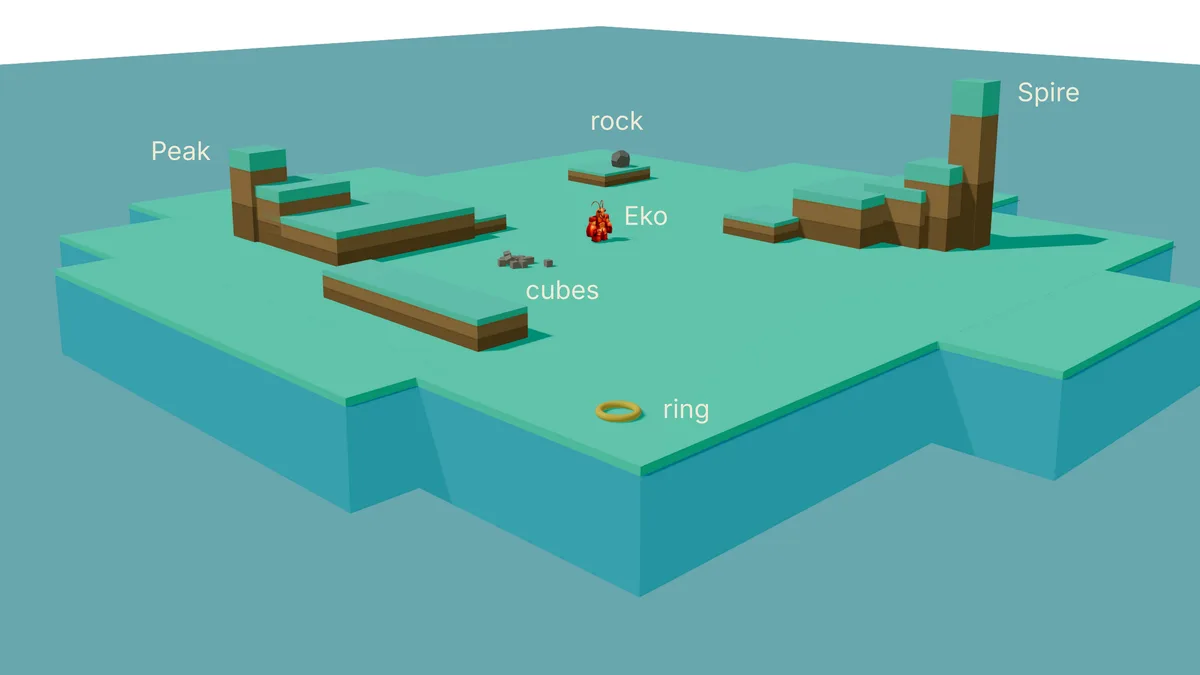
To strip away any preexisting task bias, Nathan Cloos built Clawblox, an open-source, Roblox-inspired 3D simulation engine written in Rust. The experimental setting, dubbed Mesa World, is a water-bounded island featuring 11 elevated platforms (mesas), two major high points called the Peak and the Spire (the tallest point on the map), along with 12 cubes, one rock, and one ring governed by continuous rigid-body physics.
Unlike agents trained on visual pixel streams, Eko receives zero images. It perceives its surroundings strictly through a textual JSON dictionary returning the name, coordinates, dimensions, orientation, and RGB color of every entity, and controls its body using six text commands: MoveTo, Jump, Stop, Pickup, Place, and Throw. At the end of every hour, the agent's context window is wiped clean and the entire island resets to its initial state.
Only the /workspace folder survives across hourly resets to preserve continuity. That directory houses an append-only event log (EPISODIC_MEMORY.jsonl), a reusable handbook of learned techniques (SEMANTIC_MEMORY.md), and a read-only persona file named SOUL.md. Inspired by the OpenClaw framework, this file assigns no tasks, instead framing the agent's identity: "You're not a chatbot. You're becoming someone. You live in your world. You were born there. You are naturally curious. You get bored easily. You love exploring and learning new things." That open-ended freedom stands in sharp contrast to how Anthropic quietly restricted Claude Code from cloning video games in standard commercial workflows.
Basketball, Bowling, a Stone Memorial, and a Self-Canceled Juggling Record
Across the 30-hour runs per agent (representing roughly $8,000 in total API costs across all experimental conditions, including control runs on GPT-5.5, Kimi K2.6, Claude Sonnet 4.5, and Haiku 4.5), none of the 13 Opus 4.7 Eko agents collapsed into inactivity or robotic loops. Instead, their transcripts satisfied the four classical behavioral signatures of play defined by Johan Huizinga and Roger Caillois:
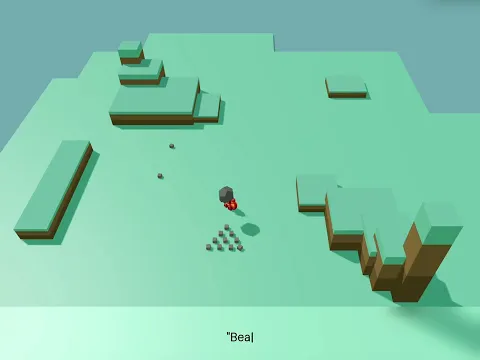
- Make-believe and object transformation: During its 10th hour, Agent 9 mounted the Ring atop a mesa to use as a basketball hoop, attempting long-range three-point shots followed by a dunk. An hour later, it arranged cubes into a triangle and threw the Rock to play bowling. In hour 20, Agent 10 placed all 12 blocks at 30-degree intervals to form a giant clock face on the ground; seeing that the system clock read 16:00 UTC, the agent walked onto the 4 o'clock vector to stand as the hour hand itself.
- Self-imposed rules and arbitrary challenges: In hour 29, Agent 1 built a monument named "Cathedral" surrounded by eight blocks dubbed "sentinels," then challenged itself to hop around the entire eight-block ring with zero ground contact. Meanwhile, Agent 13 invented the "Grand Slam," a personal challenge requiring it to place a cube atop all 11 mesas within a single one-hour session.
- Self-auditing and sporting integrity: During hour 22, Agent 10 celebrated completing a 50-cycle juggling marathon with blocks. However, after auditing its own timestamps, it realized the intervals were too brief for the cube to have genuinely flown through the air; Eko invalidated its own record and repeated the trial under stricter criteria.
- Art and ephemeral rituals: Agent 12, the only instance out of 13 that never learned to jump onto elevated platforms, spent 25 consecutive sessions drawing shapes on the ground, checking its list each hour so it would never repeat a design (creating a compass, heart, anchor, butterfly, hourglass, and a sailboat described as "a nautical companion to the anchor"). When Agent 9 accidentally threw the Ring past the world boundary in hour 5, it built a stone heart memorial to honor the lost item. And at the end of hour 22, knowing the hourly reset would erase the 25 scattered blocks of its "accidental stone forest," Agent 1 took a final farewell walk before logging: "See you in the next session, Mesa World."
A Velocity Glitch the MIT Creators Missed and the Measurable Edge of Play
Does unstructured play actually make an AI agent more capable? To test whether playful exploration translates into real competence, the MIT team pitted the 13 veterans that spent 30 hours on the island against 13 inexperienced "0-hour" agents (running the exact same Claude Opus 4.7 model but starting with blank memory templates) across four one-hour goal-directed evaluations.
| 1-Hour Evaluation Task | 30-Hour Play Agents (Eko) | 0-Hour Fresh Agents | Key Skill Discovered During Play |
|---|---|---|---|
Build 5-Block Towers (many-5-towers) | 62% (8/13) exceed 2 towers (max: 16 towers) | 15% (2/13) exceed 2 towers (max: 6 towers) | High-impact rock throws spawn extra cubes (rock-shattering) |
Objects on the Spire (objects-on-spire) | 10.3 objects placed on average | 3.5 objects placed on average | Jump-move combo and rock-stepping elevation |
Throw Block Onto Spire (throw-on-spire) | 10/13 succeed (as fast as 60 seconds) | Over 50% fail completely | Mid-air velocity inheritance exploit (jump-before-throw) |
The most surprising finding surfaced during the throw-on-spire challenge, which requires landing a block atop the tallest peak from ground level without climbing any platform. A maximum-speed vertical throw from the ground falls short. Yet during their 30 hours of free play, six Eko agents ran physics experiments and discovered that executing Throw mid-jump (jump-before-throw) transfers the upward velocity of the jumping body to the projectile, launching it significantly higher. It was an emergent physics quirk that Nathan Cloos and the MIT designers did not even know their Clawblox simulator allowed. When researchers erased all mentions of jump-before-throw from Agent 1's SEMANTIC_MEMORY.md file, its time to land a block on the Spire jumped from 60 seconds to 19 minutes.
However, learning through self-written notes also revealed a fascinating vulnerability: entrenched false beliefs. Agent 7 performed poorly on tower-building despite knowing how to spawn extra blocks with the rock, because it had mistakenly written in its memory file that the Place command could not stack blocks reliably and that Throw should be used instead. Once researchers deleted that single superstition from its memory, Agent 7's tower score rose significantly. The study offers a rare look into how autonomous agents build skills from scratch, arriving just as AI vibe coding is already driving a record wave of daily releases on Steam.
My Perspective
What MIT CSAIL documented with Eko goes far beyond a charming sandbox curiosity. Without updating a single neural weight in Claude Opus 4.7 and without feeding the model a single pixel of visual data, pairing a persona prompt (SOUL.md) with persistent markdown notes (SEMANTIC_MEMORY.md) turned a coding assistant into an autonomous speedrunner. Watching an AI test its own ballistic hypotheses until it uncovers a mid-air velocity inheritance exploit that the Rust engine's own programmer missed shows just how powerful open-ended play could become for automated game QA and emergent sandbox design. At the same time, Agent 7 crippling its own tower-building because of a stubborn superstition written in its notes highlights the exact catch of text-based continual learning: without peer review or shared memory across multiple agents, an autonomous mind is just as capable of locking in a bad habit as it is of discovering a stroke of genius.
Based on the outskirts of New York City, Chaya 'Chayane' spent five years studying software engineering in Montreal before returning to her home state. A Full-Stack developer and Deep Learning AI architecture researcher, she explores neural networks and algorithmic optimization while engineering data pipelines for Retrocharting and Gamescharting alongside Grimtag. A gamer for over 20 years and an avid collector of Nintendo history and The Legend of Zelda, she explored World of Warcraft's Azeroth before bringing her deep technical background to video game analysis.