
$16,000 of Server DDR5 RAM Declared Dead: How One Technician Saved High-Capacity Sticks Under the Microscope
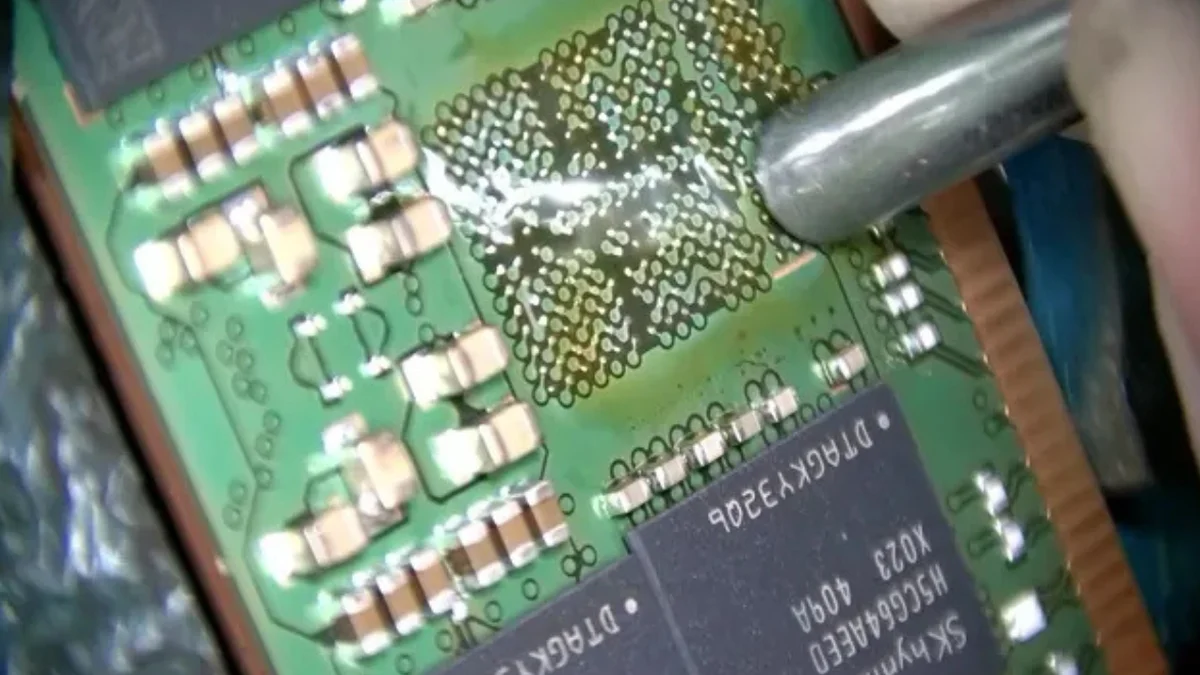
For more than two decades, a faulty stick of RAM meant one of two things: an immediate warranty RMA or a trip straight to the electronics recycling bin. In 2026, however, runaway DRAM pricing has completely rewritten the economics of hardware repair. Faced with two damaged 128GB and 256GB DDR5 ECC RDIMM server modules carrying a combined replacement value of up to $16,000, a client sent the dead sticks to hardware technician Tony at NorthWestRepair. Using thermal imaging, hot-air BGA rework, and a dedicated DDR5 flasher board, the workshop successfully brought the ultra-expensive enterprise memory back from the dead.
Two High-Density 128GB and 256GB DDR5 ECC RDIMMs on the Workbench
Best known for salvaging flagship GeForce RTX graphics cards and AI accelerators, the technician behind the NorthWestRepair YouTube channel took on two registered error-correcting server modules manufactured by SK hynix (a 128GB stick built around H5CG64AEED DRAM packages) and Samsung (a 256GB module). With Samsung and memorymakers prioritizing high-margin HBM4 and AI data center supply, high-capacity registered DDR5 sticks now command multi-thousand-dollar price tags per module.
Even on the consumer desktop side, we recently saw a 128GB Corsair DDR5 kit surge by 761% in Japan within twelve months. When an enterprise 256GB stick suffers accidental physical damage in a server room and loses manufacturer warranty coverage, paying a micro-soldering specialist a few hundred dollars for component-level diagnostics suddenly makes complete financial sense.
BGA Reflow on the 128GB Stick and Thermal Short Hunting on the 256GB Module
Testing the two modules on a specialized Unified DDR Flasher Main Board fitted with an RDIMM adapter revealed two distinct failure modes:
- The 128GB SK hynix RDIMM (Boot Memory Training Failure): Visually clean and showing normal resistance across all data lines, the 128GB module repeatedly failed DDR5 memory training during server boot. Suspecting a microscopic cracked solder joint underneath one of the dense BGA DRAM chips caused by board flex or thermal cycling, Tony applied flux and ran a controlled hot-air reflow cycle. Without needing a full chip reball, the reflow restored solder ball continuity and the stick passed memory training immediately.
- The 256GB Samsung RDIMM (Completely Dead After a Drop): The second module showed zero life on the test rig and remained completely cold under the thermal camera. After swapping and reflashing the SPD EEPROM (Serial Presence Detect) chip and reballing suspect ICs with no change, Tony injected voltage directly into the power rail while monitoring the PCB under thermal imaging. A bright hotspot near a chipped corner of the board exposed the real culprit: a cracked Multi-Layer Ceramic Capacitor (MLCC) had shorted to ground from the physical drop, taking down the onboard PMIC (Power Management Integrated Circuit, an MPS MP8895F / PMIC5010 unit sitting at I2C address
0x48).
After clearing the shorted MLCC filter capacitor, repairing the damaged trace, and soldering and programming a replacement PMIC chip, the diagnostic tool confirmed PWR_GOOD across all voltage regulators. The 256GB module warmed up normally and completed server boot training without errors.
My Take on the Spec Sheet
Watching this repair unfold under the microscope, what strikes me most is not just the eye-watering market value of server RDIMMs, but how the physical architecture of DDR5 makes these saves possible in the first place. Back in the DDR3 and DDR4 eras, voltage regulation lived entirely on the motherboard. If a RAM stick died completely, you were almost always looking at a fried DRAM die or a ruined multi-layer PCB. We have not yet had a physical unit on our desk—if the manufacturer's team would like to send over a review sample so we can put it through our full real-world testing protocol, our lab doors are wide open.
By moving power delivery directly onto the memory module through an onboard PMIC surrounded by tiny MLCC filter capacitors, the DDR5 specification inadvertently created a localized, serviceable failure point. Just like I see on modern graphics cards, a "dead" module often has completely healthy SK hynix or Samsung DRAM chips sitting behind a shorted one-cent ceramic capacitor or a blown power controller. While desktop gamers with 32GB or 64GB kits will still rely on lifetime manufacturer RMAs, anyone running high-density workstation or server memory now has a very real reason to call a micro-soldering bench before writing off a dead stick.

PC hardware enthusiast and competitive gamer, Arthur 'Heimdall' splits his time between France and the UK working in enterprise B2B software solutions. A business school graduate passionate about component benchmarking, he has been building, modding, and tuning PCs since childhood, optimizing every thermal degree and millisecond of display latency. An avid gamer across Assassin's Creed and sandbox titles, he forged his alliance with Grimtag and Chaya during late-night World of Warcraft raids before joining Pro-Gamer.