512MB RAM and 128MB VRAM: How OpenSKY Runs Skyrim Natively on PlayStation Vita in Potato Mode
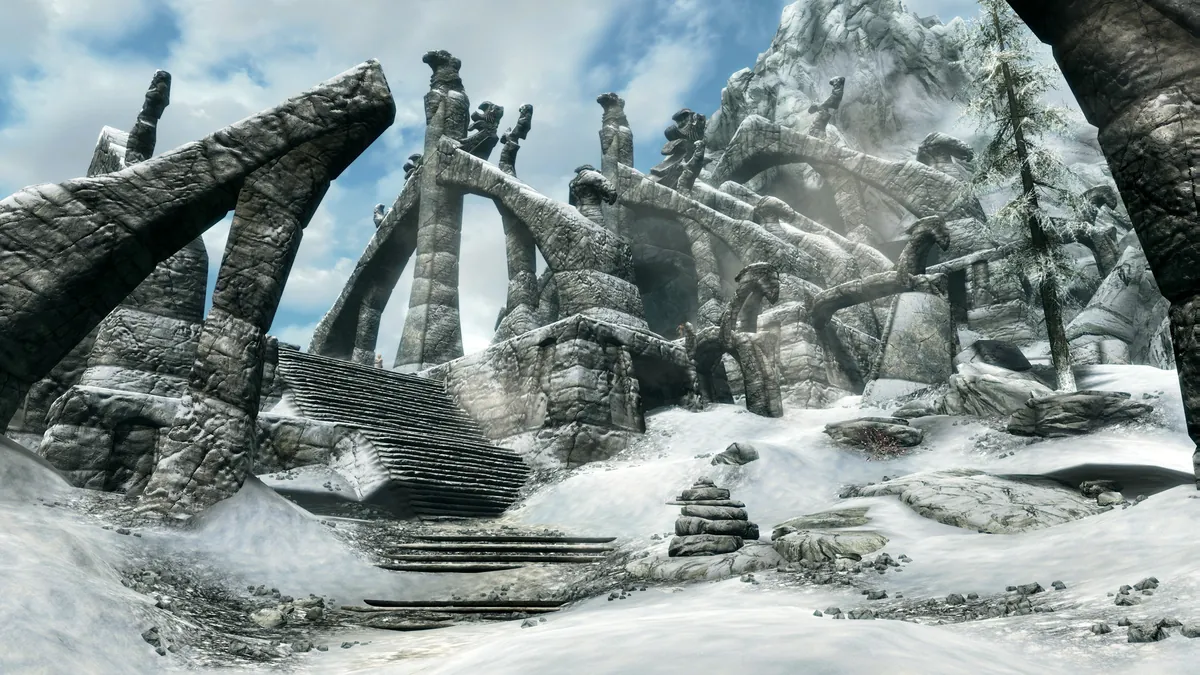
Running The Elder Scrolls V: Skyrim natively on a handheld launched in late 2011 without touching cloud streaming or Remote Play sounds impossible. Yet that is exactly what OpenSKY pulls off: an open-source game engine written from scratch in C that executes Bethesda's massive open-world RPG directly on PlayStation Vita hardware.
There is no Moonlight stream or PC offload behind the curtain. Every frame is computed locally on Sony's aging quad-core ARM Cortex-A9 CPU and PowerVR SGX543MP4+ GPU, squeezed inside a strict hardware envelope of 512MB of system RAM and 128MB of VRAM. It is a remarkable bit of homebrew engineering arriving just as players brace for the permanent PlayStation Store shutdown on PS3 and PS Vita in July 2027.
A Clean-Room C Engine Built on vitaGL, Zero Creation Engine Code
Much like OpenMW did for Morrowind, the official OpenSKY GitHub repository ships zero leaked, decompiled, or copyrighted Bethesda files. Its runtime is built across 74 custom C source files compiled with VitaSDK and hardware-accelerated through vitaGL.
Instead of trying to parse Creation Engine formats at runtime, OpenSKY strips out the heavy lifting ahead of time. There is no live .bsa archive reader, no Havok physics engine, and no Papyrus virtual machine running on the handheld. A desktop converter pre-digests the game's files into custom binary formats and lightweight text tables, while quest progression runs on hand-coded C state machines.
Inside "Potato Mode": Managing a 128MB VRAM Cliff in Real Time
Fitting all of Skyrim into mobile memory from 2011 requires ruthless compromises across the rendering pipeline. Out of the Vita's 512MB of RAM, OpenSKY locks down a 192MB application heap, leaving the rest to vitaGL and the operating system.
Video memory gets even tighter oversight. Textures are baked into a custom SKTX container holding hardware-compressed DXT1 and DXT5 mipmaps. Whenever free VRAM dips below a hard emergency threshold of 12MB, the engine automatically sweeps unused textures from memory and steps visual quality down a notch to keep the console from locking up.
That survival mechanism explains the heavily pixelated look the community quickly dubbed "Potato Mode":
- Ultra Low preset: caps textures at 128 x 128 pixels and pulls draw distance down to 120 meters, while the default Low preset allows textures up to 512 pixels.
- Aggressive internal resolutions: seven options spanning 424 x 240 and 480 x 272 (classic PSP resolution) up to a default dynamic 544 x 352 target and a 720 x 448 ceiling.
- Bilinear scaling only: frames upscale to the Vita's 960 x 544 screen via simple bilinear filtering. Source code comments reveal the developer tested AMD FSR 1.0 before ripping it out, because it ate a brutal 70 ms per frame on the PowerVR GPU.
- Frame pacing options: players can pick a 30 FPS lock, uncapped 60 FPS, or the default Smoothed 22-60 FPS mode.
A Legitimate Skyrim Special Edition Copy and 11GB on SD2Vita
Because the opensky.vpk package contains no game assets, users must supply their own legally purchased, unmodded English copy of The Elder Scrolls V: Skyrim Special Edition (or Anniversary Edition) from Steam or GOG. The companion converter for Windows and Apple Silicon Macs explicitly checks for valid storefront files before running.
Converting the game takes roughly 35GB of temporary disk space and one to two hours on a computer to process terrain, meshes, animations, and mono ADPCM voice audio. The finished ux0:data/opensky/ folder weighs around 11GB, making an SD2Vita microSD adapter practically mandatory alongside HENkaku/Ensō, VitaShell, and the libshacccg.suprx shader compiler.
What Already Works in Beta 2 and What Is Still Missing
Even as an early work in progress, the sheer scope of Beta 2 (released November 13, 2026) is startling. According to the repository's own audit, the entire province is mapped out: 11,186 exterior land cells, all 340 map markers, and 561 interiors, including Blackreach, Skuldafn, and Sovngarde.
The full 19-quest main storyline plays from the opening Helgen cart ride to the final showdown, with Beta 2 fixing progression blockers in Ustengrav and Skuldafn Temple as well as intro voice cut-outs. Core questlines for the Companions (complete with werewolf Beast Form), the College of Winterhold, and the Thieves Guild are also in place, alongside 110 spells, all 20 base Shouts, 251 perks, 6,123 items, crafting, lockpicking, and 343 creature and NPC variants.
Major caveats remain. Only 31 of roughly 380 side and faction quests exist so far, radiant quests are absent, dialogue trees drop complex Papyrus conditions, and community expansions such as Beyond Skyrim: Bruma 2.0 are unsupported because the converter requires an unmodded base install. Real-hardware performance optimization is also still ongoing.
My Test Bench
On paper, stuffing a sprawling 2011 open-world RPG into 512MB of RAM and 128MB of VRAM should end in an instant out-of-memory crash. That is why OpenSKY's engineering catches my eye: rather than brute-forcing an emulator, the developer attacked the real bottlenecks by pre-baking assets, streaming DXT mipmaps with a 12MB VRAM panic valve, and dropping down to PSP-era pixel counts whenever the GPU chokes.
Nobody is going to abandon a modern PC or handheld to play Skyrim at 128-pixel textures in 2026. Still, as a feat of low-level optimization and hardware preservation on a fifteen-year-old ARM chip, watching Tamriel boot natively on a PS Vita is nothing short of thrilling.
PC hardware enthusiast and competitive gamer, Arthur 'Heimdall' splits his time between France and the UK working in enterprise B2B software solutions. A business school graduate passionate about component benchmarking, he has been building, modding, and tuning PCs since childhood, optimizing every thermal degree and millisecond of display latency. An avid gamer across Assassin's Creed and sandbox titles, he forged his alliance with Grimtag and Chaya during late-night World of Warcraft raids before joining Pro-Gamer.