GeForce RTX 5090 Hits 430 FPS in Where Winds Meet: What NVIDIA's 4K DLSS 5 Chart Actually Shows

Up to 430 frames per second at 4K Ultra on a GeForce RTX 5090: that is the headline number NVIDIA is putting forward to mark the arrival of DLSS 5 in Where Winds Meet. Available now alongside the GeForce Game Ready Driver v621.24, the update brings 3D-Guided Neural Rendering to Everstone Studio's open-world Wuxia RPG. Behind that eye-catching peak, however, NVIDIA's own performance charts tell a far more nuanced story about internal rendering resolution and how many of those frames are actually synthesized by AI.
Inside NVIDIA's Official RTX 50 Series Benchmarks
In its official GeForce news post, NVIDIA details benchmark figures captured on a desktop rig powered by an AMD Ryzen 7 9800X3D and 64 GB of RAM running Windows 11 x64 on the Ultra preset. One detail stands out immediately: while the announcement copy cites peaks up to 430 FPS at 4K, the official average bar on NVIDIA's chart sits at exactly 415 FPS for the RTX 5090.
More importantly, those frame rates require turning on the entire Blackwell software stack at once: DLSS 5 (3D-Guided Neural Rendering), Ray Reconstruction, 6X Multi Frame Generation, and DLSS Super Resolution set to Performance mode at 4K or Quality mode at 1440p and 1080p. Here is the full breakdown of NVIDIA's official desktop averages:
| Desktop GPU | 4K Ultra (SR Performance + 6X MFG) | 1440p Ultra (SR Quality + 6X MFG) | 1080p Ultra (SR Quality + 6X MFG) |
|---|---|---|---|
| GeForce RTX 5090 | 415 FPS (up to 430 FPS) | 579 FPS | 704 FPS |
| GeForce RTX 5080 | 273 FPS | 413 FPS | 555 FPS |
| GeForce RTX 5070 Ti | 226 FPS | 363 FPS | 506 FPS |
| GeForce RTX 5070 | Not listed | 313 FPS | 451 FPS |
| GeForce RTX 5060 Ti (16 GB) | Not listed | 220 FPS | 320 FPS |
| GeForce RTX 5060 | Not listed | Not listed | 296 FPS |
Laptop configurations are covered as well. Tested on an Intel Core Ultra 9 275HX system with 64 GB of RAM using the High preset, an RTX 5090 Laptop GPU (175W) averages 321 FPS at 1440p (Balanced Super Resolution, 6X MFG) and 430 FPS at 1080p (Quality mode). The RTX 5080 Laptop GPU follows at 275 FPS in 1440p and 392 FPS in 1080p, while the 115W RTX 5060 Laptop still reaches 258 FPS at 1080p.
What DLSS 5 Visually Changes in Where Winds Meet
Following NBA 2K27, Hogwarts Legacy, and War Thunder, Where Winds Meet adopts NVIDIA's October 2026 neural rendering model. That streamlined network trims model size by 24% down to roughly 118 million parameters, lowers 4K VRAM consumption by 20%, and runs twice as fast as the previous revision. NVIDIA reports a 10X efficiency jump over seven months, moving from early dual-RTX 5090 demos to full support across desktop and laptop GeForce RTX 50 Series GPUs, RTX Spark hardware, and GeForce NOW Ultimate.
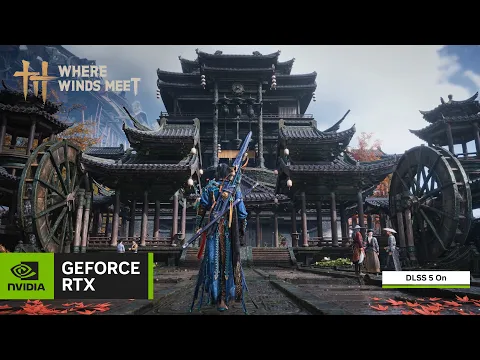
Running as the final pass of the rendering pipeline, DLSS 5 reads the engine's color buffer and motion vectors without overwriting core geometry. In practice, it adds translucent subsurface scattering to candle wax and sunlit bamboo leaves, grounds environments with deeper ambient occlusion, reins in blown-out highlights, and sharpens surface distinctions across cloth, leather, metal, and weathered stone.
To avoid the heavy-handed look that fueled the recent DLSS 5 controversy, art director Muzi Li and engine tech lead Cory Zhou dialed in NVIDIA's Structure Intensity, Tone Intensity, and semantic AI masking controls. In its official announcement, Everstone Studio confirms that facial proportions and the game's poetic Wuxia atmosphere remain intact, with customizable visual tuning and a straightforward on/off toggle left in players' hands.
My Test Bench
Putting 415 to 430 FPS at 4K Ultra on a slide grabs attention instantly, yet anyone watching frametimes and real input latency needs to read the fine print. With 6X Multi Frame Generation active, five out of every six frames are AI-interpolated, and running Super Resolution in Performance mode drops internal rendering down to 1080p before reconstruction and neural shading kick in.
Divide 415 FPS by six and you are looking at a base rendering cadence closer to 65 to 70 real frames per second. That is still plenty playable for an open-world Wuxia action RPG, but it does not feel anything like native 400 Hz responsiveness during tight parry windows. The real win here is not the inflated frame counter; it is the 20% VRAM cut on the October 2026 neural model and Everstone Studio's restraint with art direction. On an RTX 5080 or RTX 5090, I would test DLSS 5 with Frame Generation dialed back to 2X or 3X to keep input latency crisp while enjoying the upgraded lighting.

Where Winds Meet
Explore official trailers, technical specs and all latest coverage for Where Winds Meet.

PC hardware enthusiast and competitive gamer, Arthur 'Heimdall' splits his time between France and the UK working in enterprise B2B software solutions. A business school graduate passionate about component benchmarking, he has been building, modding, and tuning PCs since childhood, optimizing every thermal degree and millisecond of display latency. An avid gamer across Assassin's Creed and sandbox titles, he forged his alliance with Grimtag and Chaya during late-night World of Warcraft raids before joining Pro-Gamer.