New Motherboard Yet Same LCD Panel: Revised Nintendo Switch 2 Teardown Confirms No Sharp Screen Upgrade
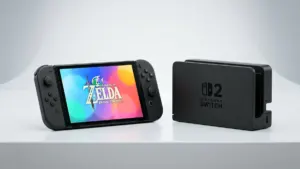
Players hoping that the first hardware revision of the Nintendo Switch 2 would quietly cure the handheld’s motion blur will want to hold onto their wallets. A complete internal teardown of the newly released European console revision confirms that Nintendo has retained the original launch LCD display rather than switching over to the redesigned Sharp panel spotted in supply chain leaks earlier this year.
An OSM-CPU-01 Motherboard Built for Battery Repairs, Not Display Upgrades
The hardware inspection comes straight from Polish console technician modyfikatorcasper (known on X as Modyfikator89), who disassembled the updated retail unit to compare its layout side by side against the launch hardware. Identified by the regulatory OSM box code and the BEE-001(-01) designation in FCC filings, this revision introduces a reworked OSM-CPU-01 motherboard in place of the original BEE-CPU-01 board.
As we covered when Nintendo first revealed the adhesive-free removable battery revision for the Switch 2, the primary purpose of this internal redesign is to comply ahead of schedule with European Union Right to Repair mandates taking effect in 2027. The updated BEE-003(-01) 5,172 mAh battery sits inside a rigid tray secured by nine standard Phillips screws and gold spring-loaded contacts, nudging the bare tablet’s weight from roughly 400 grams to 410 grams (around 544 grams with the Joy-Con 2 controllers attached).
Check Availability Nintendo Switch 2 Availability on Amazon→
Why the Innolux ZD079KA-03A Panel Remains Under Scrutiny
Once the chassis was opened to inspect the display assembly, the technician confirmed that the OSM-CPU-01 unit still shipped with the original 7.9-inch 1080p 120Hz VRR LTPS LCD panel assembled by Innolux (using Sharp glass substrate) under part number ZD079KA-03A. Back in late June, hardware trackers at Nintendo Patents Watch uncovered listings on Chinese parts marketplaces for a revised 7.9-inch 1080p panel assembled directly by Sharp under model numbers LS079T1SX10P and LS0DAS7081.
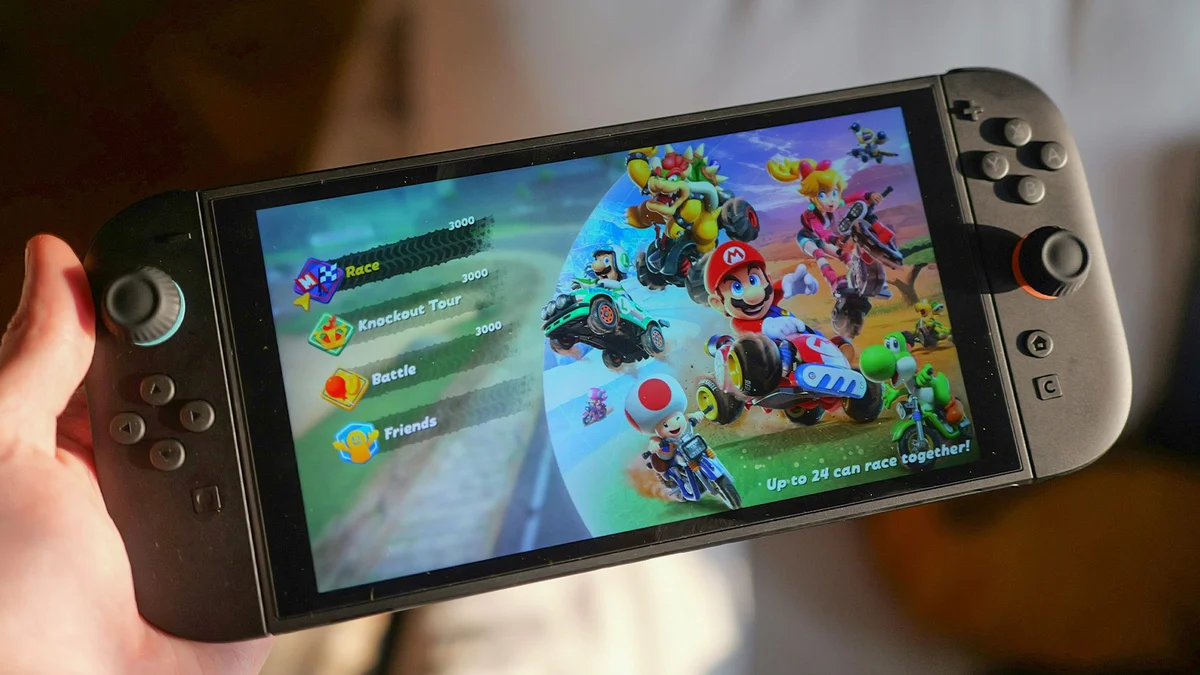
Because the leaked Sharp component featured a reworked driver board and a non-interchangeable ribbon cable layout (labeled by parts wholesalers as a "V2" screen), enthusiasts speculated that Nintendo was preparing a hardware fix for the launch screen’s slow pixel response. Without aggressive panel overdrive, the launch ZD079KA-03A display averages roughly 17.06 ms in gray-to-gray (GtG) response times at 60Hz, with slower dark transitions stretching between 27.46 ms and 33 ms. Because those transitions exceed both the 16.67 ms frame window at 60Hz and the 8.33 ms window at 120Hz, fast-scrolling scenes exhibit noticeable ghosting and motion smear.
Same NVIDIA SoC, Reworked Cooling Fan, and Rotating RAM Suppliers
Beyond the battery enclosure and the unchanged display, inspecting the OSM-CPU-01 board confirms that gaming performance remains identical to launch units. The custom NVIDIA system-on-chip (SoC) uses the exact same silicon stepping and clock speeds. The console still pairs that chip with 12GB of LPDDR5X RAM sourced from an alternate memory vendor as Nintendo rotates between SK Hynix, Samsung, and Micron, alongside a slightly reshaped cooling fan.
With manufacturing lines running at high volume and over 151,000 Switch 2 units sold in Japan during September alone, the existence of the Sharp LS079T1SX10P panel points to multi-sourcing across different factory lines or a separate batch rather than a guaranteed upgrade tied to the European chassis. The technician noted that he will continue inspecting additional retail bundles to see whether the Sharp-assembled screen appears in other production lots.
My Benchmark Take: Why Panel Lotteries Will Never Replace Proper Overdrive Tuning
Having opened and benchmarked portable hardware across multiple console generations, this teardown outcome makes complete manufacturing sense. From the Dual-Screen era’s random TN and IPS panel draws to the original Switch mixing Innolux, JDI, and AU Optronics displays, Nintendo has always used secondary panel suppliers to protect assembly yields and keep component pricing in check rather than to hand out silent mid-cycle visual upgrades.
More importantly, the 17 ms average response time on the Switch 2 screen is not just a physical quirk of the glass: it is a conservative power-budget decision. Pushing higher overdrive voltages through an LTPS LCD panel to force sub-8 ms transitions at 120Hz noticeably increases power draw in handheld mode. If you already own a launch Switch 2, hunting down an OSM-CPU-01 box in hopes of winning a screen lottery is a waste of time and money; for first-time buyers, however, getting a glue-free battery tray that opens with nine standard screws is still a massive win for long-term hardware longevity.

PC hardware enthusiast and competitive gamer, Arthur 'Heimdall' splits his time between France and the UK working in enterprise B2B software solutions. A business school graduate passionate about component benchmarking, he has been building, modding, and tuning PCs since childhood, optimizing every thermal degree and millisecond of display latency. An avid gamer across Assassin's Creed and sandbox titles, he forged his alliance with Grimtag and Chaya during late-night World of Warcraft raids before joining Pro-Gamer.