60 FPS in Super Mario 64 and a 130 dB Speaker: How Bringus Studios Turned a Used Motorola Police Bodycam Into an Android Handheld
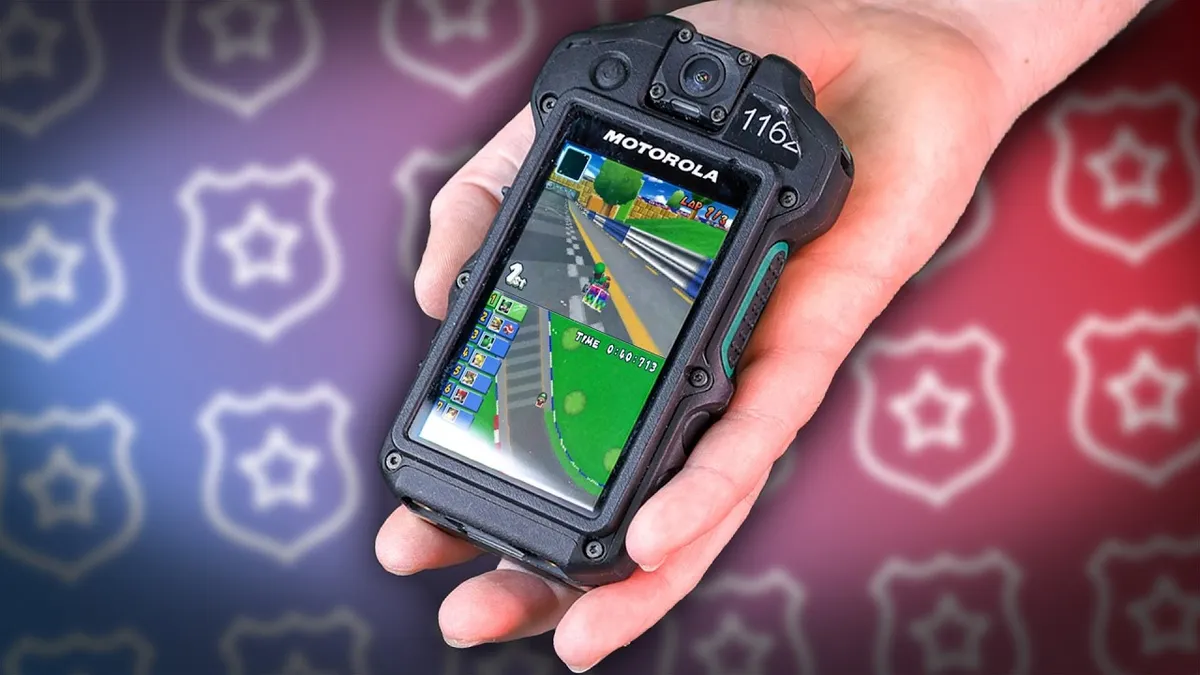
Running classic video games on heavily locked enterprise hardware remains one of the most entertaining corners of the modding scene. Shortly after watching a hardware tinkerer build a foldable PlayStation 2 DUO portable from a trimmed console motherboard, YouTube creator Bringus Studios has taken an actual surplus Motorola Solutions police bodycam and turned it into a functional portable gaming device.
Bypassing the Motorola N701A Lock Screen Over ADB
The decommissioned unit arrived with clear wear and tear from years of active patrol shifts clipped to a vest. Identified as a Motorola N701A (part of Motorola's rugged Si500 Video Speaker Microphone lineup), the hardware features a rotating wide-angle camera lens, a compact outward-facing capacitive touchscreen, a red recording rocker switch, a green push-to-talk (PTT) side button, and dedicated keys for photo capture and covert operation.
Beneath its weatherproof IP67 shell, the bodycam runs a mid-2010s embedded Android build labeled Motorola Incident Plus 17. Upon booting up, residual thumbnails from past patrol footage briefly appeared behind a PIN prompt before the unit switched into an independent testing mode. While attempts to unlock the bootloader or gain root access failed against Motorola's security locks, plugging a micro-USB cable into a PC immediately exposed active Android Debug Bridge (ADB) access.
By sideloading a standard third-party Android launcher over ADB, Bringus Studios bypassed the restrictive law enforcement interface without needing root privileges. Because the rugged chassis lacks physical Home or Back navigation keys, he paired a wireless Bluetooth controller and mapped one of its buttons to act as a system back key. Although system partitions consume most of the internal 64 GB storage, enough free space remained to sideload game APKs and tweak the display resolution over ADB to a readable 540 x 960 pixels.
60 FPS in Super Mario 64, GTA Vice City Stories, and Steam Link Streaming
Despite relying on an embedded mobile chipset from the mid-2010s, the bodycam delivered surprisingly smooth frame rates across native Android ports and lightweight emulators:
- Super Mario 64 and Minecraft: A native decompilation port of Super Mario 64 and an older build of Minecraft: Pocket Edition both ran at a locked 60 frames per second, handling block placement and 3D platforming without frame drops.
- GTA Vice City Stories and 2D Classics: Running on PSP emulation, Grand Theft Auto: Vice City Stories also hit 60 FPS, even though tricky directional mapping made driving in a straight line challenging. Meanwhile, the mobile version of Assassin's Creed Revelations and Donkey Kong Country 2 proved fully playable after remapping jump actions to the unit's physical utility buttons.
- Dolphin Emulation Limits: Pushing into GameCube and Wii territory with the Dolphin emulator proved too heavy for the aging silicon, topping out around 60% of full speed alongside missing screen elements and motion-control roadblocks.
- Left 4 Dead 2 via Steam Link: Using the bodycam's local wireless connection to stream PC gameplay through Steam Link worked remarkably well, running Left 4 Dead 2 with low enough input latency for genuinely playable zombie sessions.
An Ear-Splitting 130 dB Built-In Speaker
The biggest hazard during testing had nothing to do with thermal throttling or battery drain, but rather Motorola's industrial-grade speaker array. Engineered to cut through traffic noise, sirens, and chaotic street environments, the front-facing speaker is vastly louder than anything fitted inside a consumer smartphone.
While testing rhythm games like Patapon, audio output surged past 125 decibels and peaked near 130 dB when measured against a tone generator. At one point, an application crash trapped a blasted audio signal in a loop at dangerous volume levels, forcing Bringus to put on noise-canceling headphones and issue an emergency system reboot over ADB to silence the unit.
My Bench Take: Why Embedded Android Hardware Never Stops Surprising
What stands out to me in this experiment goes beyond the sheer novelty of playing Super Mario 64 on retired police gear. It highlights just how adaptable embedded Android hardware becomes the moment a manufacturer leaves USB debugging accessible. Whenever enterprise or industrial devices rely on a standard AOSP foundation without permanently fusing ADB shut, a simple launcher swap and Bluetooth controller pairing can turn almost any rugged terminal into an impromptu handheld.
Obviously, a tiny screen attached to a 130-decibel siren speaker will never replace a dedicated PC handheld like the upcoming Intel Arc G3 Extreme-powered Acer Predator Atlas 8 or a proper mobile telescopic controller. Still, watching eight-year-old field equipment lock 60 FPS in native ports and handle local Steam Link streaming is a great reminder that clean software optimization can breathe life into the most unlikely silicon.

PC hardware enthusiast and competitive gamer, Arthur 'Heimdall' splits his time between France and the UK working in enterprise B2B software solutions. A business school graduate passionate about component benchmarking, he has been building, modding, and tuning PCs since childhood, optimizing every thermal degree and millisecond of display latency. An avid gamer across Assassin's Creed and sandbox titles, he forged his alliance with Grimtag and Chaya during late-night World of Warcraft raids before joining Pro-Gamer.