Lilvo DS Micro Unveiled: A Bank Card-Sized Dual-Screen Clamshell Handheld With 1:1 IPS Displays and Custom Linux OS
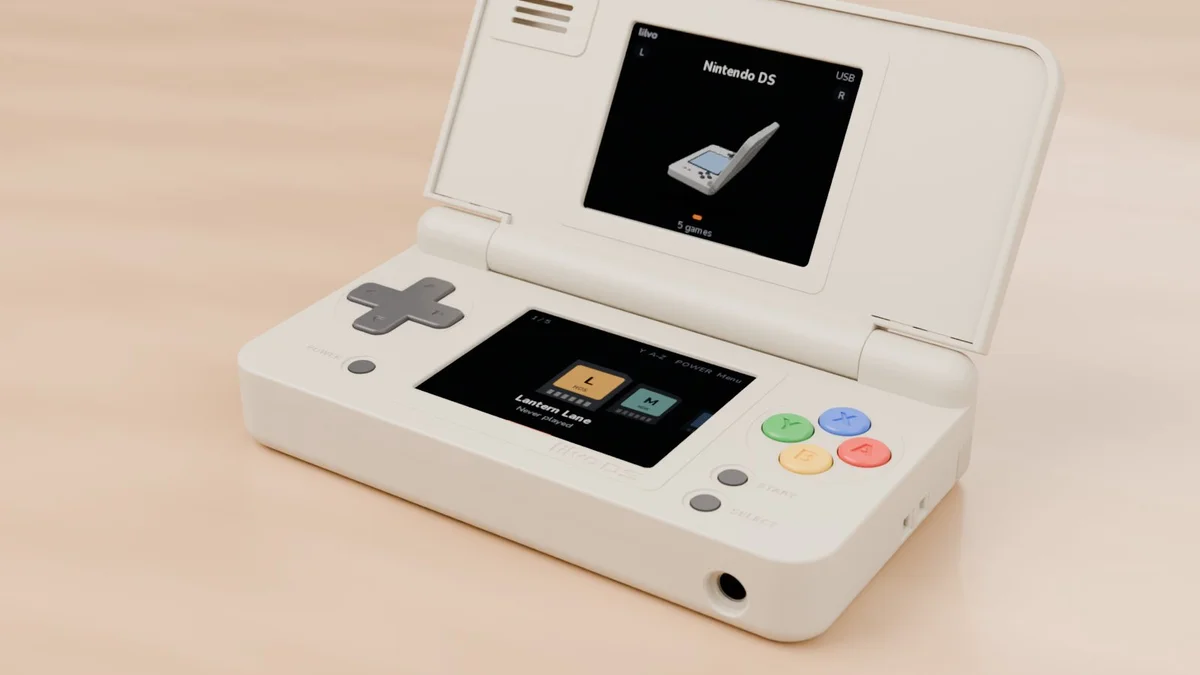
Cramming a fully functional dual-screen retro handheld into a shell narrower than a standard bank card is a serious mechanical puzzle. Yet that is exactly what independent hardware creator lilvo has achieved with the Lilvo DS Micro, revealing the first fully working prototype (board revision RevD.8) on the project's official engineering build log. Measuring just 85 × 46 × 18 mm when closed (compared to 85.6 × 54 mm for a credit card), this miniature clamshell takes inspiration from the keychain-sized FunKey S while packing two IPS displays, a capacitive touch screen, a steel mechanical hinge, and a custom mainline Linux operating system.
Dual 1:1 Pixel-Perfect IPS Screens and a Mechanical Steel Hinge
While many ultra-compact micro handhelds compromise visual clarity with awkward non-integer scaling, the Lilvo DS Micro solves the problem at the hardware level. The creator sourced two 2.01-inch IPS panels originally manufactured with rounded corners for smartwatches. The custom shell masks the outer edges so that the system only frames and illuminates an exact 256 × 192 pixel active window on each panel. Because that matches the native resolution of the original Nintendo DS pixel for pixel, DS games render in crisp 1:1 native resolution with zero scaling blur.
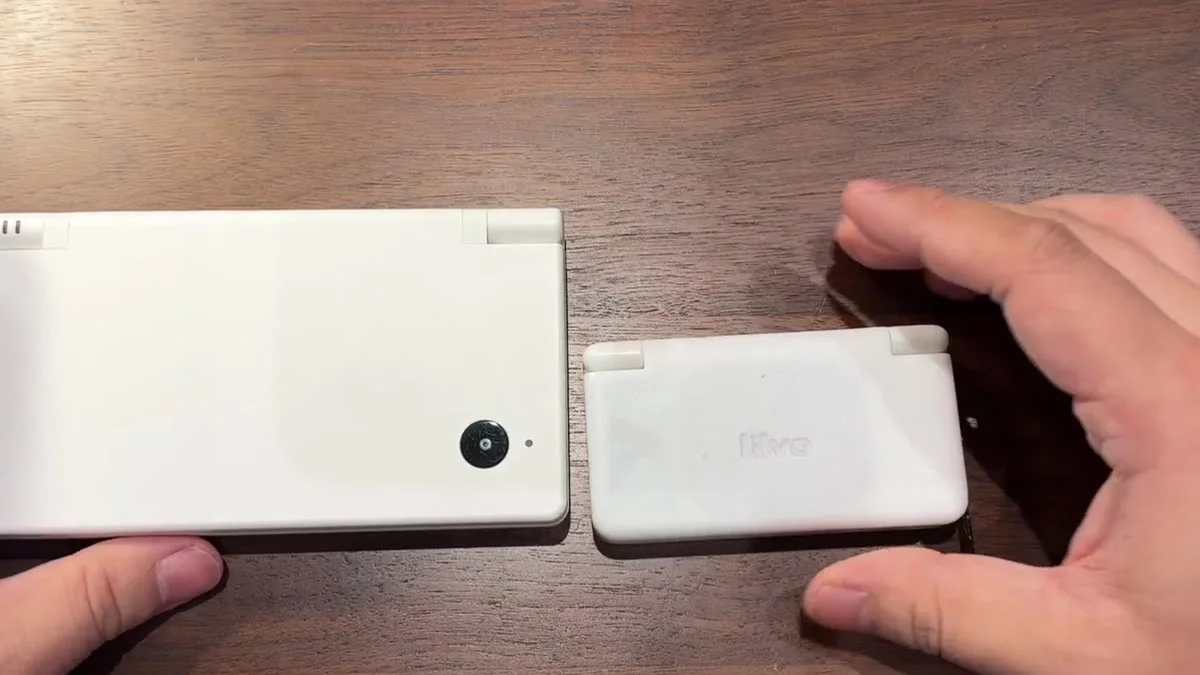
Faithful to Nintendo's dual-screen architecture, the bottom panel features a capacitive touch layer so players can tap moves in DS titles and navigate system menus with a finger. Under the hood, each display is driven by its own dedicated SPI controller, an independent tearing-effect sync signal, and built-in frame memory. Both panels refresh in parallel, ensuring the screens never flicker or go black when the processor is under load.
Mechanically, every tenth of a millimeter inside the 18 mm vertical stack is accounted for. A 1.5 mm stainless steel pin runs the full width of the hinge, paired with a spring-loaded plastic cam that provides a tactile snap when closed and holds the lid open at up to 170°. To prevent the display cable from creasing over thousands of cycles, a thin 0.11 mm flex cable carrying 15 traces is coiled 2.25 turns around the hinge pin inside the left ear, gently loosening as the lid opens rather than folding sharply.
An internal Hall sensor also monitors the lid position. Closing the clamshell signals the operating system to immediately write an automatic save state and cleanly exit the game before the power management chip cuts power a few seconds later. Opening the lid boots the handheld straight back into your progress.
Allwinner T113 SoC, 12 Emulated Systems on Lilvo System, and SD-Free Web Management
To keep the upper lid as light and simple as possible, all active electronics reside in the base on a 6-layer mainboard measuring 82 × 43 mm (0.8 mm thick) populated with 213 components on both sides. Processing is handled by an Allwinner T113 SoC featuring a dual-core ARM Cortex-A7 CPU clocked at 1.2 GHz. Crucially, the T113 bundles its RAM inside a leaded System-in-Package (SiP), eliminating the need to route a separate BGA memory chip on the compact circuit board.
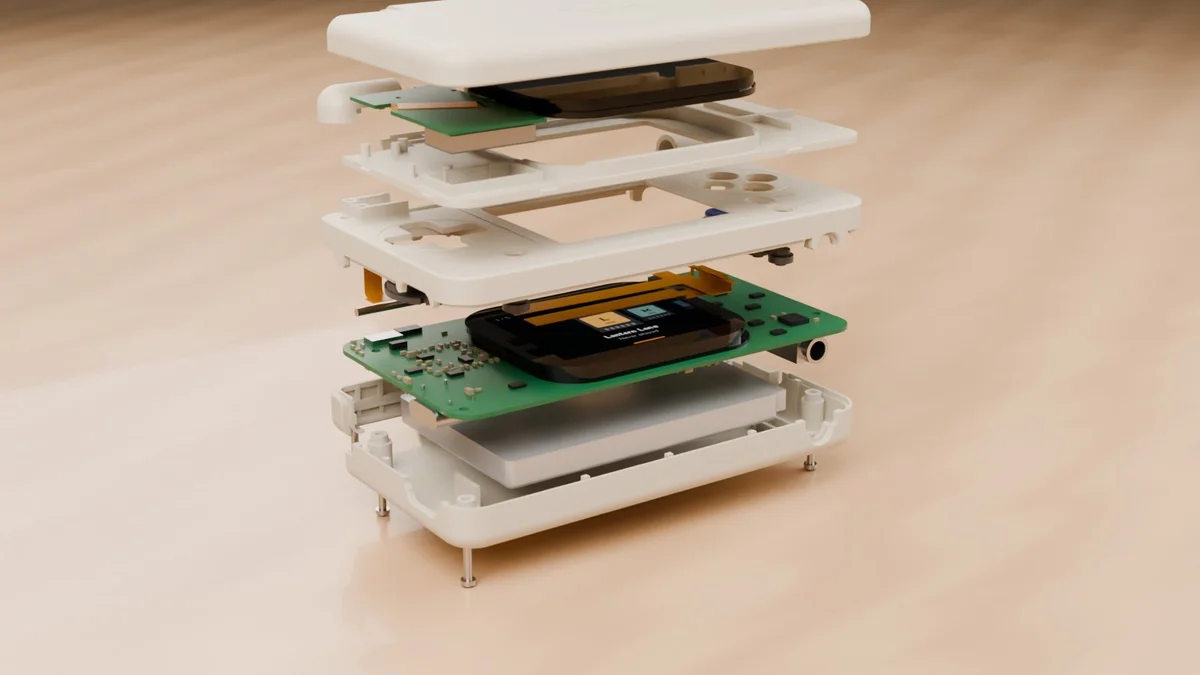
Power comes from a 1,200 mAh Li-Po battery (59 × 37 × 5 mm). Hardware testing shows that running a Nintendo DS game across both screens draws between 0.7 W and 1.1 W, translating to an estimated 3.5 to 4 hours of battery life. A USB-C port sits on the left flank, a 3.5 mm headphone jack sits on the right, and Wi-Fi has been intentionally omitted to save space and battery. The microSD card slot is tucked inside the four-screw snap-fit shell so the card can never accidentally pop out in your pocket.
Because the microSD card lives inside the enclosure, the custom mainline Linux operating system (dubbed the Lilvo System) includes a built-in browser interface. Plugging the handheld into a computer via USB-C lets you open lilvo.local in a web browser, where the console serves its own management dashboard. From there, users can drag and drop ROMs and box art, rename games (automatically migrating all associated save files and save states), download a full ZIP backup of their saves, read the on-device manual, or drop in a single-file firmware update.
Out of the box, the Lilvo System supports 12 retro platforms across four visual themes (lilvo 3D shelf, cyberpunk NEON wheel, four-shade green DMG, and high-contrast PAPER). Nintendo DS emulation runs through DraStic, targeting full-speed performance on 2D titles, while 11 classic single-screen systems (Game Boy Advance, Game Boy, Game Boy Color, NES, PlayStation 1, PC Engine, Master System, Game Gear, Neo Geo Pocket, WonderSwan, and Atari Lynx) run on open-source libretro cores using the bottom touch screen as a quick-action panel for save states and 2× fast-forward. (SNES and Sega Genesis emulators are currently excluded due to non-commercial core licenses.) Much like the recent VMX project that turned an original Xbox memory card into a 64×64 OLED mini handheld, the developer plans to open-source both the CAD shell files and the Lilvo System software once the upcoming RevE.1 board and refined shell are ready for a production run.
Lilvo DS Micro Full Prototype Specifications
| Component | Official Prototype Specs (RevD.8 / RevE.1) |
|---|---|
| Form Factor & Size | Dual-screen clamshell, 85 × 46 × 18 mm closed (170° opening, 1.5 mm stainless steel hinge pin) |
| Processor (SoC) | Allwinner T113 (Dual-Core ARM Cortex-A7 @ 1.2 GHz with integrated SiP memory) |
| Displays | 2 × 2.01-inch IPS panels masked to 256 × 192 pixels each (1:1 Nintendo DS native, dual SPI buses) |
| Touch Input | Capacitive touch on bottom screen |
| Physical Controls | 13 keys: D-pad, A, B, X, Y, L / R shoulder levers, Start, Select, Power + magnetic Hall lid sensor |
| Battery & Power | 1,200 mAh Li-Po (59 × 37 × 5 mm), ~0.7 W to 1.1 W draw (~3.5 to 4 hours estimated DS play) |
| Storage & I/O | Internal microSD slot, USB-C (charging, lilvo.local web manager, updates), 3.5 mm audio jack, speaker (no Wi-Fi) |
| OS & Emulation | Custom Lilvo System on mainline Linux (4 themes); 12 platforms (DS via DraStic + 11 retro consoles via libretro) |
| Status & Price | Working prototype revealed (moving toward production & open-source release); price TBA |
My Test Bench
To be completely transparent, because the Lilvo DS Micro is currently a hand-assembled prototype on its creator's workbench, I have not tested a physical unit in our hardware lab yet. Looking strictly at the PCB layout and mechanical documentation, however, the engineering restraint on display is impressive. Instead of forcing a high-resolution panel that would drain the battery and blur low-res sprites, masking two 2.01-inch smartwatch IPS panels to an exact 256 × 192 pixel window driven by independent SPI buses is a clever solution for 1:1 Nintendo DS emulation. Pairing that with a 2.25-turn coiled flex cable around a steel hinge pin, instant Hall-sensor save states when you snap the lid shut, and the SD-free lilvo.local web interface solves almost every daily annoyance of micro handhelds. If the upcoming RevE.1 revision delivers the promised louder speaker amp and deeper L/R shoulder button travel, this could easily become one of the most desirable pocket clamshells in the retro scene.

PC hardware enthusiast and competitive gamer, Arthur 'Heimdall' splits his time between France and the UK working in enterprise B2B software solutions. A business school graduate passionate about component benchmarking, he has been building, modding, and tuning PCs since childhood, optimizing every thermal degree and millisecond of display latency. An avid gamer across Assassin's Creed and sandbox titles, he forged his alliance with Grimtag and Chaya during late-night World of Warcraft raids before joining Pro-Gamer.