Game Development: Can You Still Make a Living on Steam in 2026?
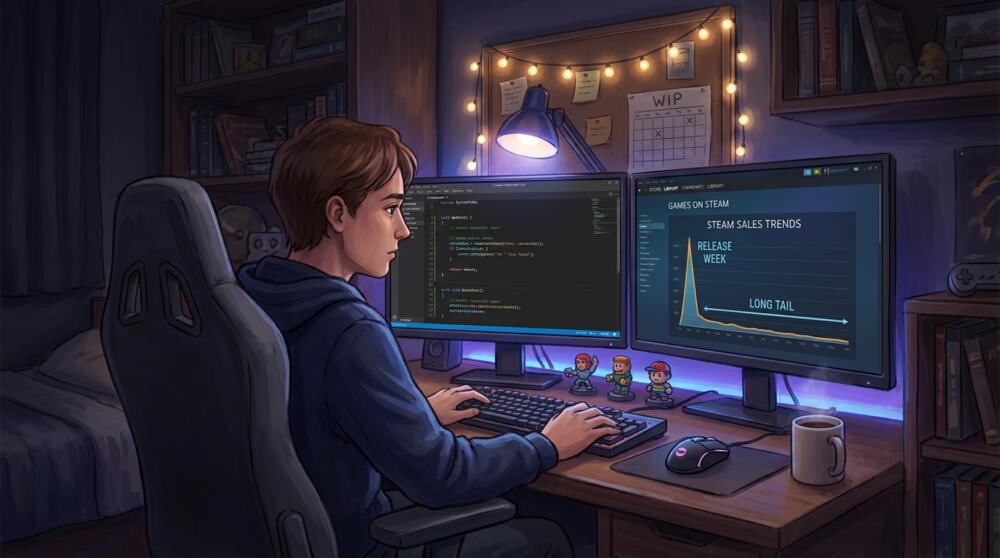
Launching your own game on Steam is the ultimate dream for countless developers and gaming enthusiasts. However, the PC ecosystem has evolved into one of the most fiercely competitive and saturated marketplaces on earth. For indie studios, staying profitable is a relentless, uphill battle. Recent industry reports provide cold, hard numbers detailing the economic realities of selling on Steam.
The Back-Catalog Chasm: Are Players Shunning New Releases?
The first major indicator comes from the Alinea Analytics biannual report released in July 2026. The full study, highlighted by industry outlet GamesIndustry.biz in its report Alinea: Steam revenue reaches $11.1bn, marking highest half-year on record (with in-depth analysis available on The Alinea Insight newsletter), reveals that Steam generated a record gross revenue of $11.1 billion, representing a 14.5% year-over-year increase.
Yet, very little of this windfall reaches new developers. Games launched in 2026 account for merely 21% of total platform revenue. The remaining 79% is swallowed by the "back-catalog" - older evergreen titles (like Counter-Strike 2, Baldur's Gate 3, or Elden Ring) that command players' attention and wallets during seasonal sales. This revenue slice for new releases has been steadily shrinking: it sat at 29% in 2024, dipped to 27% in 2025, and plunged to 21% in 2026.
Median Revenue: Steam's Brutal Power Law
On average, more than 70 new games launch on Steam every single day. In the face of this relentless deluge, the platform's visibility algorithm ruthlessly separates the wheat from the chaff.
Market research conducted by analytics firm VG Insights and analyzed by industry veteran Simon Carless (in his essential newsletter GameDiscoverCo) shines a light on a heavily skewed power-law revenue distribution. While an elite fraction of titles pulls in millions, the median lifetime revenue for an indie game hovers between $5,000 and $15,000. Even more sobering: a vast majority of games (frequently shipped without prior marketing) never cross the $250 lifetime gross sales threshold.
Viral Hits and Returning Titans: Unpacking 2026's Success Stories
While the vast majority of small teams struggle to break through, 2026 has witnessed breakout successes and market dynamics that offer crucial lessons for anyone trying to carve out a living in game development:
- The Blockbusters of the Year: Several 2026 releases reached stratospheric heights. According to Alinea Analytics, top performers include heavyweights like Forza Horizon 6 (~$197.7M), Resident Evil Requiem (~$194.5M), and the indie phenomenon Slay the Spire 2 (~$141.7M).
- The Meccha Chameleon Playbook: Summer 2026's surprise sensation was undeniably Meccha Chameleon, an indie multiplayer hide-and-seek game. Its high-concept visual hook (camouflaging into the environment by painting your character) was built from the ground up for streamability. Propelled virally by creators across Twitch and TikTok, it shifted millions of copies in mere weeks, proving that streamer-friendly design remains one of the most potent marketing weapons in 2026.
- The Return of the Giants: The staggering weight of the back-catalog also stems from a strategic pivot by major publishers (Ubisoft, EA Activision). After years of trying to force proprietary launchers onto players, virtually all of them retreated back to Steam, re-listing their extensive historical catalogs. Flooding the storefront with heavily discounted AAA staples has further suffocated organic discovery for new indie titles.
- Player Pickiness: With standard AAA pricing firmly anchored at $70 or $80, gamers have grown far more calculating with their spending. They either stick to deeply discounted sure bets in the back-catalog or take a flyer on standout, inventive indie games priced under $20.
Survival Strategies for Indie Developers
Despite these daunting statistics, finding success on Steam is still achievable if you align your development pipeline with current market realities:
- Embrace Premium Pricing: For smaller teams, a straightforward buy-to-play model without predatory microtransactions remains the healthiest, most player-friendly approach. Aim for an attractive sweet spot, usually between $10 and $20, to spark impulse buys.
- Design for Content Creators: Co-op gameplay and creative sandbox mechanics (emergent physics, hilarious chaos) hold a distinct edge. They actively encourage streamers on Twitch and TikTok to broadcast your game, unlocking massive, free organic reach.
- Build a Fortress of Wishlists: Steam's algorithm is heavily front-loaded. Launching a game without securing at least 5,000 to 10,000 pre-launch wishlists virtually guarantees your title will disappear into the digital void upon arrival.
The bottom line: building a great game simply is not enough anymore. Mastering digital storefront discovery and marketing algorithm dynamics has become just as vital as writing rock-solid code.

SEO consultant for over 20 years and digital entrepreneur, Charles 'Grimtag' Ronchain is the founder of Pro-Gamer.gg, Retrocharting.com, and Gamescharting.com. A competitive gamer, streamer, and retro game collector, he has worked in the video game industry for over 15 years, notably as a consultant for leading game price comparison platforms. Passionate about real-time performance data and gaming technology, he analyzes competitive esports, gaming hardware benchmarks, and creator workflows on Pro-Gamer.gg with an authentic player perspective.