720Hz at $1,099 vs. 540Hz at $699: ASUS Launches the ROG Swift OLED PG259QWS Ace and Strix XG259QWPG Ace Esports Monitors
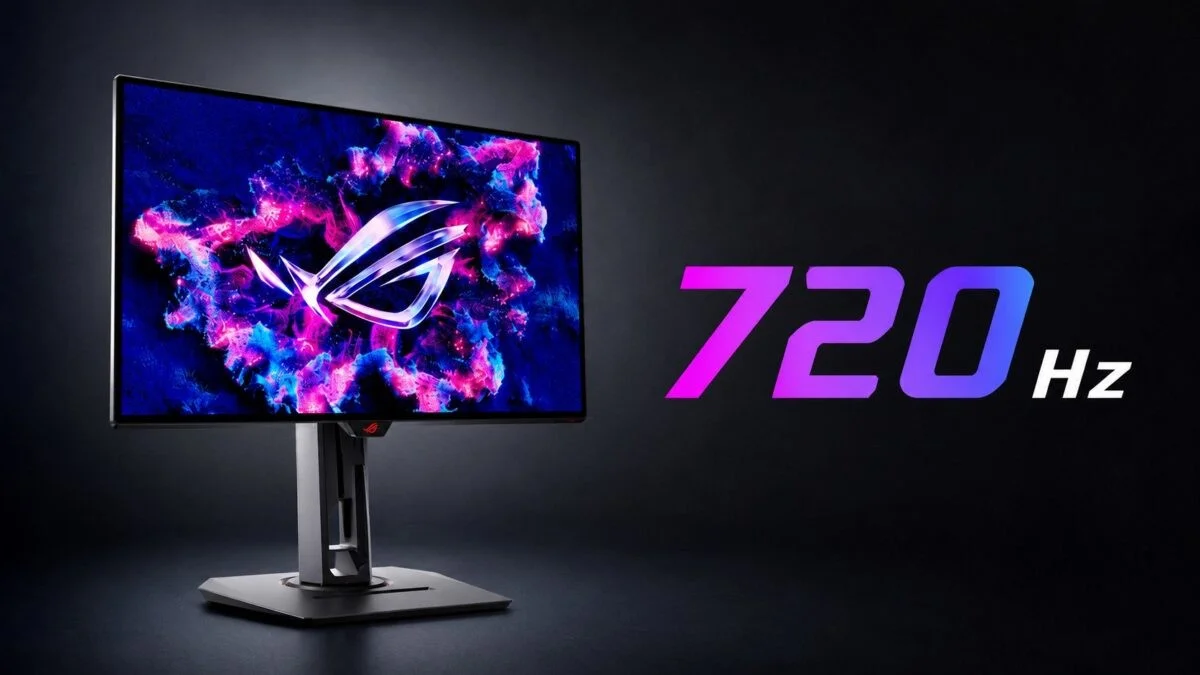
Following their initial showcase at major summer hardware events, ASUS Republic of Gamers (ROG) has officially opened retail availability for its two flagship 24.5-inch esports OLED monitors. Competitive players can now order the record-breaking 720Hz ROG Swift OLED PG259QWS Ace at $1,099 USD (€1,149 in Europe / £999 in the UK) alongside its more approachable sibling, the 540Hz ROG Strix OLED XG259QWPG Ace, priced at $699 USD (around €724 including VAT in Europe / £629 in the UK).
24.5-Inch Tandem WOLED and TrueBlack Glossy Coating: The Shared Esports Foundation
Rather than forcing competitive shooter players onto 27-inch screens that require wider eye movement to track radar and peripheral corners, ASUS built both Ace models around the tournament-standard 24.5-inch diagonal paired with a native Full HD (1920 x 1080) resolution. Both monitors utilize LG Display's latest Tandem WOLED panel architecture, which stacks two organic light-emitting layers to boost sustained brightness while extending pixel lifespan under heavy daily workloads.
To maximize visual clarity, ASUS pairs the Tandem WOLED stack with its TrueBlack Glossy panel finish. Unlike conventional matte anti-glare coatings that introduce a subtle crystalline haze over fine crosshair details, the TrueBlack Glossy surface preserves ink-deep blacks (with a 1,500,000:1 contrast ratio) even under bright studio or arena lighting. Both displays deliver an instantaneous 0.02 ms gray-to-gray (GtG) response time, up to 1,700 nits peak HDR brightness (roughly 390 nits full-screen SDR), true 10-bit color depth, and 99.5% DCI-P3 coverage factory-calibrated to Delta E < 2.
Because static health bars and minimaps represent a constant risk during ten-hour practice grinds, both monitors integrate the ASUS OLED Care Pro protection suite. Central to this system is the Neo Proximity Sensor, which detects when the user steps away from the desk and immediately switches the display to a black screen, backed internally by high-efficiency GaNFET power circuitry and a custom passive heatsink to keep panel temperatures in check.
ROG Swift OLED PG259QWS Ace (720Hz) vs. Strix XG259QWPG Ace (540Hz): What the $400 Price Gap Buys You
While both monitors share the same core optical specs, the flagship ROG Swift OLED PG259QWS Ace justifies its premium with three tournament-focused upgrades. First, it runs at a native 720Hz refresh rate in Full HD 1080p, without relying on a resolution-halving Dual-Mode toggle like the one seen on the triple-mode ASUS ROG Strix XG27ACMSR. Second, to feed 720 uncompressed frames per second, the PG259QWS Ace features a full-bandwidth DisplayPort 2.1a UHBR20 input rated at 80 Gbps, alongside dual HDMI 2.1 ports and a 3.5mm audio jack. Third, selected as the official tournament monitor of the PGL Major Singapore 2026, it includes an exclusive hardware Position Sensor that digitally records stand height, tilt, swivel, and viewing distance directly inside the OSD so pros can replicate their exact physical setup on any stage.

ASUS ROG Swift OLED PG259QWS Ace (24.5-Inch - 720Hz Tandem WOLED)
- 24.5-inch 1080p Tandem WOLED TrueBlack Glossy Panel
- Native 720Hz & 0.02ms GtG Response
- DisplayPort 2.1a UHBR20 (80 Gbps) + 2x HDMI 2.1
- OSD Position Sensor & Neo Proximity Sensor
Meanwhile, the ROG Strix OLED XG259QWPG Ace targets competitive players who want Tandem WOLED motion clarity without crossing the four-figure mark. By capping the native refresh rate at 540Hz in 1080p, omitting the stand Position Sensor, and swapping the UHBR20 interface for a DisplayPort 1.4 input with DSC (Display Stream Compression) alongside two HDMI 2.1 ports, ASUS brings the MSRP down to $699 USD. It retains full support for NVIDIA G-SYNC, AMD FreeSync Premium, ELMB motion blur reduction, and 6-axis Hue Optimizer color tuning, saving buyers a full $400 over the 720Hz flagship.
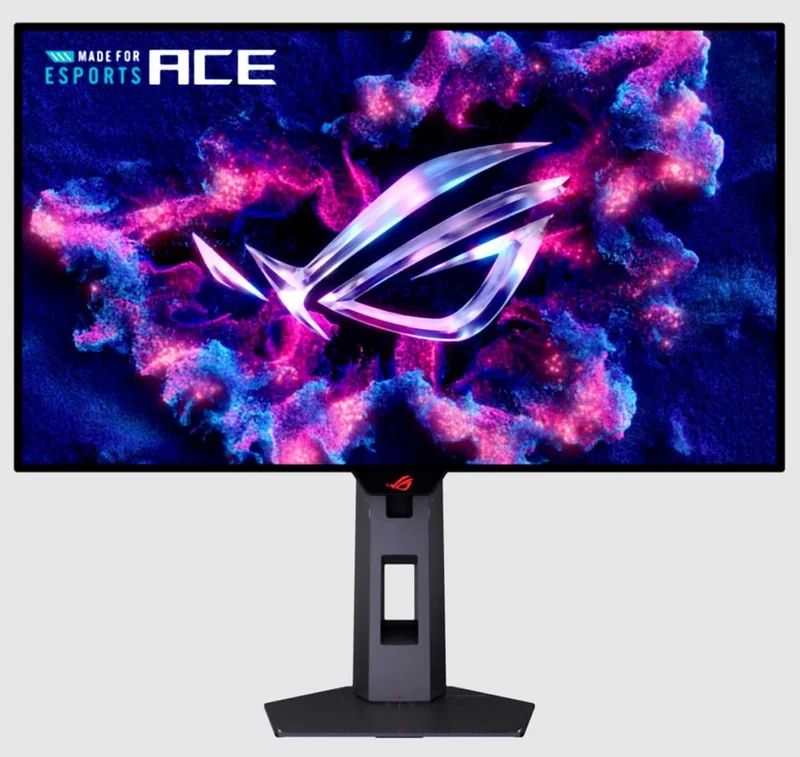
ASUS ROG Strix OLED XG259QWPG Ace (24.5-Inch - 540Hz Tandem WOLED)
- 24.5-inch 1080p Tandem WOLED TrueBlack Glossy Panel
- Native 540Hz & 0.02ms GtG Response
- 1,700 Nits Peak HDR & 99.5% DCI-P3 (10-bit)
- DisplayPort 1.4 (DSC) + 2x HDMI 2.1 & OLED Care Pro
Full Specifications Comparison: ROG Swift OLED PG259QWS Ace vs. ROG Strix OLED XG259QWPG Ace
| Specification | ASUS ROG Swift OLED PG259QWS Ace | ASUS ROG Strix OLED XG259QWPG Ace |
|---|---|---|
| Size & Resolution | 24.5-inch / Full HD (1920 x 1080) | 24.5-inch / Full HD (1920 x 1080) |
| Panel Technology | Tandem WOLED (LG Display) / TrueBlack Glossy | Tandem WOLED (LG Display) / TrueBlack Glossy |
| Refresh Rate | 720Hz native (1.38 ms frametime) | 540Hz native (1.85 ms frametime) |
| Response Time | 0.02 ms (GtG) | 0.02 ms (GtG) |
| Brightness & Contrast | Up to 1,700 nits (HDR peak) / ~390 nits (SDR) / 1,500,000:1 | Up to 1,700 nits (HDR peak) / ~390 nits (SDR) / 1,500,000:1 |
| Color Accuracy | True 10-bit, 99.5% DCI-P3, Delta E < 2, 6-axis Hue Optimizer | True 10-bit, 99.5% DCI-P3, Delta E < 2, 6-axis Hue Optimizer |
| Display Inputs | 1x DisplayPort 2.1a UHBR20 (80 Gbps), 2x HDMI 2.1 | 1x DisplayPort 1.4 (with DSC), 2x HDMI 2.1 |
| Hardware Extras | Ergonomic OSD Position Sensor, OLED Care Pro, Neo Proximity Sensor | OLED Care Pro, Neo Proximity Sensor, ELMB |
| Official Pricing | $1,099 USD / €1,149 (EU) / £999 (UK) | $699 USD / approx. €724 (EU) / £629 (UK) |
My Take on the Spec Sheet
From a pure frametime standpoint, jumping from 540Hz (1.85 ms per frame) to 720Hz (1.38 ms per frame) shaves just 0.47 ms off each refresh cycle. For the vast majority of competitive players, that sub-half-millisecond delta is far less transformative than the panel chemistry itself: by combining Tandem WOLED brightness with a 0.02 ms GtG pixel transition in a compact 24.5-inch footprint, both monitors deliver sample-and-hold motion clarity that rivals strobed esports TN panels without sacrificing contrast or color saturation.
There is also a serious PC hardware bottleneck to consider before spending an extra $400. Sustaining a locked 720 frames per second in 1080p during heavy utility executes with overlapping smoke and molotov effects requires an elite X3D-class processor, tightly tuned low-latency DDR5 memory, and a flagship GPU equipped with a native DisplayPort 2.1 UHBR20 output. At $699, the 540Hz ROG Strix OLED XG259QWPG Ace is the smarter value pick for 95% of ranked grinders, while the $1,099 ROG Swift OLED PG259QWS Ace stands as an uncompromising showcase for uncompressed 80 Gbps bandwidth and tournament ergonomics. We have not yet had the ROG Swift OLED PG259QWS Ace or Strix XG259QWPG Ace on our test bench to measure colorimeter delta-E drift, sustained HDR luminance, and end-to-end signal latency: if the team at ASUS Republic of Gamers would like to send over a review sample so we can put it through our full hardware protocol, our lab doors are wide open.

PC hardware enthusiast and competitive gamer, Arthur 'Heimdall' splits his time between France and the UK working in enterprise B2B software solutions. A business school graduate passionate about component benchmarking, he has been building, modding, and tuning PCs since childhood, optimizing every thermal degree and millisecond of display latency. An avid gamer across Assassin's Creed and sandbox titles, he forged his alliance with Grimtag and Chaya during late-night World of Warcraft raids before joining Pro-Gamer.