3x Faster Pressure Calculations: How Game Freak's New Water Simulation Tech Sets Up Pokémon Winds and Waves on Switch 2
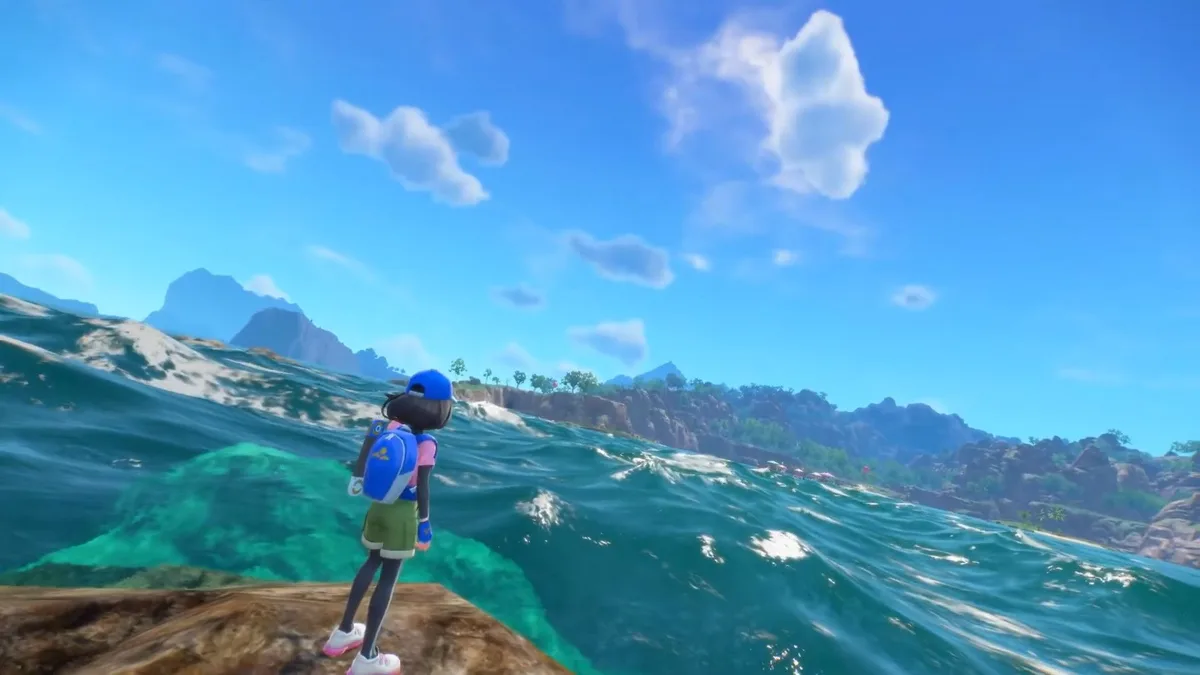
Ever since the tenth generation of the franchise revealed its sun-drenched tropical archipelago and coral reefs, one technical question has dominated community discussions: how will Game Freak render a massive, ocean-centric open world without tanking frame rates? A compelling clue has just surfaced from the academic graphics circuit. Fumiya Narita, a programmer at Game Freak, co-authored a breakthrough fluid simulation study alongside Professor Takashi Kanai of The University of Tokyo (full research paper hosted by the University of Tokyo), presented at the Pacific Graphics 2026 international conference in Singapore.
Extended Quadtree Tall Cells: Solving the Surface Bottleneck
Titled "Beyond Horizontal Refinement: Extending Quadtree Tall Cells with Adaptive Optical Layers" and published in Computer Graphics Forum, the paper targets the single heaviest bottleneck in 3D liquid physics: the sky-high computational cost of solving pressure equations when complex ripples, splashes, and waves spread across a wide water surface.
In modern computer graphics, hybrid grid-particle frameworks such as FLIP (Fluid-Implicit-Particle) and APIC (Affine Particle-in-Cell) deliver lifelike splashes and turbulent currents, but their performance scales poorly across expansive bodies of water. Since 2006, researchers have relied on Tall Cell grids to ease the load: the solver maintains fine, high-resolution grid cells strictly near the visible water surface (known as the optical layer) while stretching cells vertically in deeper water where fine detail goes unnoticed.
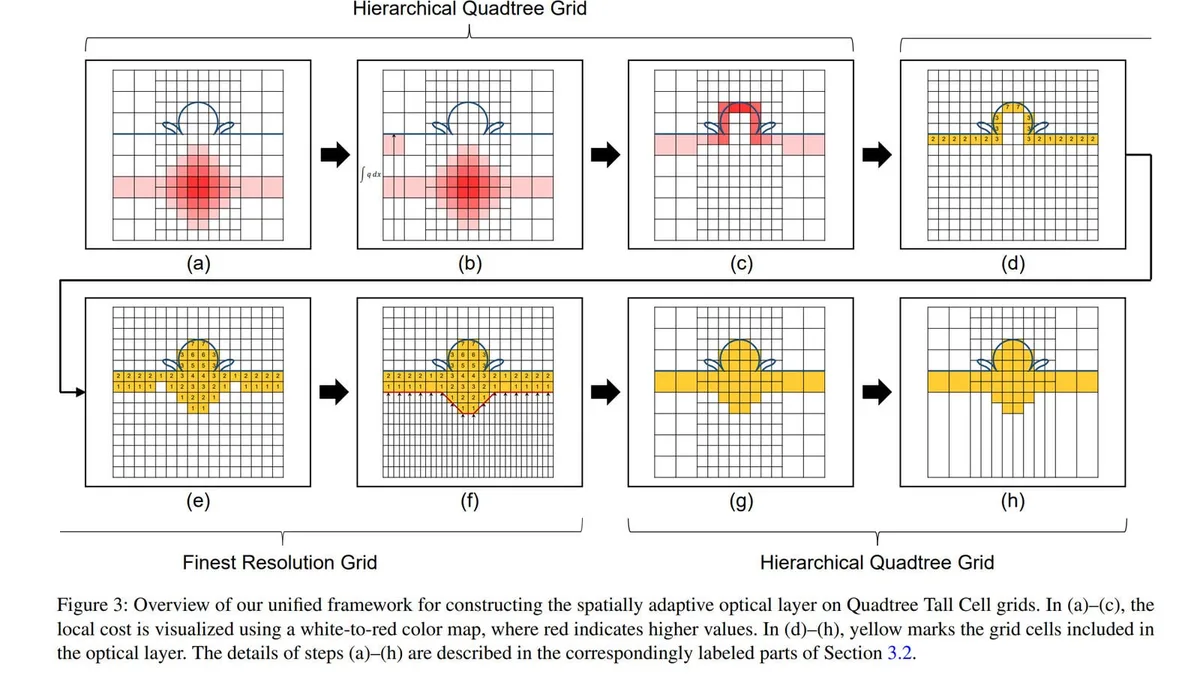
Building upon their 2025 work on Quadtree Tall Cells (which dynamically adjusts horizontal grid resolution based on local surface complexity) and their early 2026 findings on Adaptive Optical Layers, Fumiya Narita and Takashi Kanai combined both concepts into a unified framework called Extended Quadtree Tall Cells. Instead of relying solely on horizontal subdivision, the algorithm simultaneously adapts horizontal grid resolution and the vertical thickness of the surface optical layer according to fluid motion, while applying spatial smoothing to the tall-cell heightfield to prevent numerical instability.
Pressure Calculations Up to 3x Faster Across Complex Water Surfaces
Presented in Singapore on October 6, 2026, the benchmark suite tested scenarios where traditional adaptive grids lose their efficiency: heavy rainfall pelting a broad water surface with high-frequency ripples, and continuous pouring scenes where water depth steadily rises. Whereas uniform grids suffer from escalating computation times as water volume increases, the new method keeps frame-step calculation times nearly flat while slashing total active cell counts without degrading visual fidelity.
| Technical Parameter | Standard Grid / Quadtree Tall Cells | Extended Quadtree Tall Cells (Narita & Kanai, 2026) |
|---|---|---|
| Grid Adaptation | Horizontal quadtree subdivision only | Horizontal refinement + dynamic optical-layer thickness |
| Pressure Solve Speed | Baseline (1x) | 2.5x to 3.0x faster across wide, turbulent surfaces |
| Overall Simulation Speed | Slows down heavily under high-frequency waves | Roughly 1.5x faster across full benchmark scenes |
| Static Solid Boundaries | Reverts to fine uniform cells around solid objects | Preserves vertically stretched Tall Cells against static obstacles |
| Hardware Trade-Off | Standard memory footprint | Higher RAM usage (maximum resolution grid retained in memory) |
What This Means for Pokémon Winds and Waves on Nintendo Switch 2
While the academic paper does not directly reference commercial software and evaluates high-precision offline simulations (requiring roughly ten to twenty seconds per calculation step), the timing aligns closely with the studio's production pipeline. Having just wrapped up post-launch support for its action RPG as Game Freak ended Beast of Reincarnation updates earlier this month, the studio is now fully focused on Pokémon Winds and Pokémon Waves, slated for a 2027 exclusive launch on Nintendo Switch 2.
As seen in the debut reveal trailer alongside all 54 confirmed Pokémon for the Switch 2 Gen 10 roster and the new starter trio (Browt, Pombon, and the aquatic gecko Gecqua), the tenth generation revolves around island hopping, rolling ocean swells, and deep-sea diving across a Southeast Asia-inspired region. Even though a raw offline APIC fluid solver is not meant to run unassisted at 60 frames per second during live gameplay, internal R&D of this caliber directly feeds into precomputed ocean animations, adaptive surface meshes, and lightweight physics approximations tailored for the Nintendo Switch 2's expanded memory bandwidth.
While we wait to set sail in 2027, you can check out the best deals on the latest mainline entries currently available:
My Perspective
After all the criticism Game Freak faced over the flat, repetitive water textures and frame rate dips in Pokémon Scarlet and Violet, seeing one of its programmers publish peer-reviewed fluid dynamics research at Pacific Graphics 2026 is a breath of fresh air. Of course, it is important to keep expectations grounded in reality: Fumiya Narita and Takashi Kanai's algorithm is a high-precision simulation technique that takes over ten seconds per step and trades extra RAM for faster pressure math. You are not going to see an uncompromised offline film solver running raw on a handheld GPU.
Still, this research proves that Game Freak is actively investing in fundamental water rendering technology behind the scenes. In a generational leap literally titled Pokémon Winds and Waves,where tropical rainstorms, coastal surf, and underwater reefs form the backbone of exploration,having internal tools that compute complex surface waves up to three times faster is exactly the kind of technical foundation that can make the Switch 2 archipelago feel genuinely alive in 2027.

Based on the outskirts of New York City, Chaya 'Chayane' spent five years studying software engineering in Montreal before returning to her home state. A Full-Stack developer and Deep Learning AI architecture researcher, she explores neural networks and algorithmic optimization while engineering data pipelines for Retrocharting and Gamescharting alongside Grimtag. A gamer for over 20 years and an avid collector of Nintendo history and The Legend of Zelda, she explored World of Warcraft's Azeroth before bringing her deep technical background to video game analysis.