40-CU Radeon 8060S and a 165Hz OLED Display in 1.71 kg: How the Lenovo Yoga Pro 7 15ASH11 Rivals Discrete Gaming GPUs
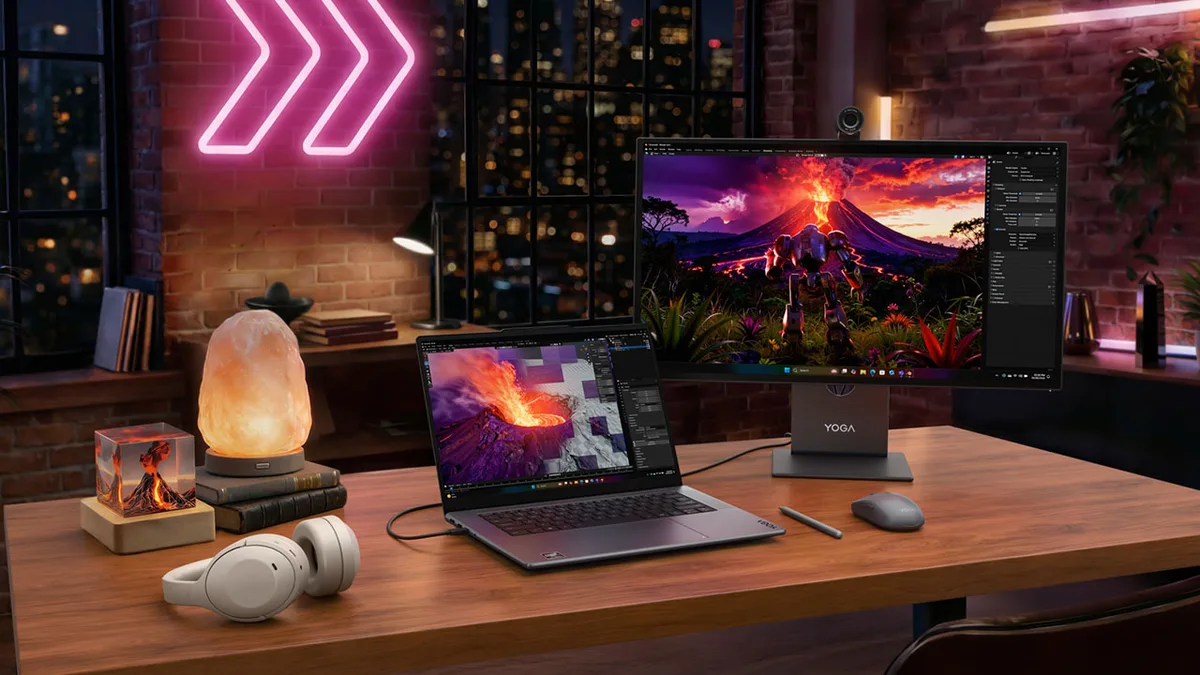
Packing desktop-class 1440p gaming and 3D rendering muscle into a 1.71 kg aluminum laptop without sacrificing battery life has long been a thermal impossibility. With the new Lenovo Yoga Pro 7 15ASH11 (also marketed as the Yoga Pro 7a Gen 11, machine type 83W5), Lenovo brings AMD's high-end Strix Halo architecture and its full-fat Radeon 8060S integrated GPU to a sleek 15.3-inch chassis.
Where traditional creator ultrabooks hit a wall in modern AAA titles or heavy viewport workloads, this configuration pairs quad-channel unified memory bandwidth with a 165Hz PureSight Pro OLED panel built for both competitive responsiveness and color-critical production.
Ryzen AI Max+ 388 and Radeon 8060S: Full 40-CU RDNA 3.5 Graphics Without the 16-Core Tax
At the heart of the Lenovo Yoga Pro 7 15ASH11 lies a smart silicon pairing confirmed by AMD's official processor specifications: the 4nm AMD Ryzen AI Max+ 388 APU. Unlike standard mobile tiers that cut down GPU compute units whenever core counts drop, the "Plus" designation here unlocks the complete 40-CU AMD Radeon 8060S graphics engine built on the RDNA 3.5 architecture and clocked up to 2,900 MHz.
This design philosophy mirrors the upcoming 8-core Ryzen AI 7 HX 455 with a full 16-CU Radeon 890M, scaled up to enthusiast Strix Halo silicon. You get 8 Zen 5 cores and 16 threads (3.6 GHz base, up to 5.0 GHz boost, 32 MB L3 cache) alongside AMD's largest mobile iGPU and an XDNA 2 NPU delivering 50 TOPS for local Copilot+ AI workflows.

256-Bit LPDDR5X-8000 Unified Memory and 90W Lenovo X Power Cooling
Forty RDNA 3.5 compute units would starve on a standard 128-bit laptop memory bus. To keep the Radeon 8060S fed, the Yoga Pro 7 15ASH11 features 32GB, 64GB, or up to 128GB of soldered LPDDR5X-8000 unified memory across a 256-bit interface, delivering roughly 256 GB/s of memory bandwidth that scales dynamically between system RAM and VRAM.
According to Lenovo's official PSREF documentation, the dual-fan, four-heat-pipe Lenovo X Power thermal system sustains up to a 90W TDP under heavy load. Storage expansion is equally practical thanks to dual M.2 PCIe 4.0 x4 NVMe SSD slots (one M.2 2242 and one M.2 2280), avoiding the single-drive bottleneck common on thin 15-inch laptops.

15.3-Inch PureSight Pro 2.5K 165Hz OLED Display With Full Adobe RGB Coverage
Visual output is anchored by a touch-enabled 15.3-inch PureSight Pro OLED display in a 16:10 aspect ratio, running at a 2.5K (2560 x 1600) resolution with a smooth 165Hz refresh rate.
For 3D artists, colorists, and streamers, the panel covers 100% of the Adobe RGB, DCI-P3, and sRGB color spaces with factory-calibrated Delta E under 1 (Pantone Validated). In HDR games and grading timelines, peak brightness reaches 1,100 nits with VESA DisplayHDR True Black 1000 and Dolby Vision certifications.
- Processor (APU): AMD Ryzen AI Max+ 388 (8 Zen 5 cores / 16 threads up to 5.0 GHz, 50 TOPS XDNA 2 NPU)
- Graphics: Integrated AMD Radeon 8060S (40 RDNA 3.5 CUs up to 2,900 MHz, dynamic unified VRAM)
- Memory: 32GB, 64GB, or 128GB soldered LPDDR5X-8000 unified memory (256-bit bus, ~256 GB/s)
- Display: 15.3-inch PureSight Pro OLED 2.5K (2560 x 1600), 165Hz, 100% Adobe RGB / DCI-P3, 1,100 nits HDR peak
- Storage: Dual M.2 PCIe 4.0 x4 NVMe slots (M.2 2242 + M.2 2280)
- Connectivity & Ports: Wi-Fi 7 (802.11be 2x2), Bluetooth 5.4, 2x USB4 (40Gbps, PD, DisplayPort 2.1), 2x USB-A 10Gbps, 1x HDMI 2.1 (8K 60Hz), full-size UHS-II SD card reader
- Battery & Chassis: 84Wh battery (140W USB-C rapid charge, up to 12 hours rated runtime), MIL-STD-810H aluminum build, 1.71 kg
Full Workstation I/O, 12-Hour Battery Life, and Pricing Reality
Unlike ultrabooks that force you to carry USB-C dongles everywhere, the Yoga Pro 7 15ASH11 keeps a full port selection: two 40Gbps USB4 ports, two 10Gbps USB-A ports, a full-size HDMI 2.1 output, a UHS-II SD card reader, and Wi-Fi 7. Its 84Wh battery is rated for up to 12 hours of mixed use because there is no discrete PCIe GPU drawing idle board power, while the haptic Force Pad doubles as a drawing surface with optional Yoga Pen Gen 2 support.
That unified engineering comes at a steep premium, with US configurations starting around $2,569.99 and European retail listings ranging between €1,950 and €3,399.99 depending on RAM capacity. Gamers who strictly prioritize raw frame-per-dollar performance over thin-and-light portability or massive unified VRAM pools will still find stronger rasterization value in a dedicated GPU laptop like the Lenovo Legion Pro 5 with an RTX 5070 Ti.
Check Availability Lenovo Yoga Pro 7 Availability on Amazon→
My Bench Take: Why the Ryzen AI Max+ 388 Is the Real Strix Halo Sweet Spot
Looking closely at the power scaling of AMD's Strix Halo platform, pairing the 8-core Ryzen AI Max+ 388 with a 90W thermal envelope inside the Yoga Pro 7 15ASH11 makes a lot more sense for gaming and 3D viewport work than the flagship 16-core Ryzen AI Max+ 395. Within a 90W power budget, feeding eight Zen 5 cores leaves generous thermal and electrical headroom for all 40 RDNA 3.5 compute units in the Radeon 8060S to hold their boost clocks near 2.9 GHz without throttling.
The second game-changer is the unified LPDDR5X-8000 memory pool: while an 8GB laptop RTX 4060 or 4070 hits a hard VRAM ceiling in heavy Unreal Engine 5 scenes or local LLM workflows, dynamically allocating 16GB, 32GB, or more straight from 64GB or 128GB of fast quad-channel system memory gives mobile creators and gamers headroom no mid-range discrete GPU can match.

PC hardware enthusiast and competitive gamer, Arthur 'Heimdall' splits his time between France and the UK working in enterprise B2B software solutions. A business school graduate passionate about component benchmarking, he has been building, modding, and tuning PCs since childhood, optimizing every thermal degree and millisecond of display latency. An avid gamer across Assassin's Creed and sandbox titles, he forged his alliance with Grimtag and Chaya during late-night World of Warcraft raids before joining Pro-Gamer.