"Eternal Star / We Hope So": How a 1.2-Million-Word Computational Analysis Just Solved Super Mario 64's 30-Year-Old "L Is Real 2401" Plaque Mystery
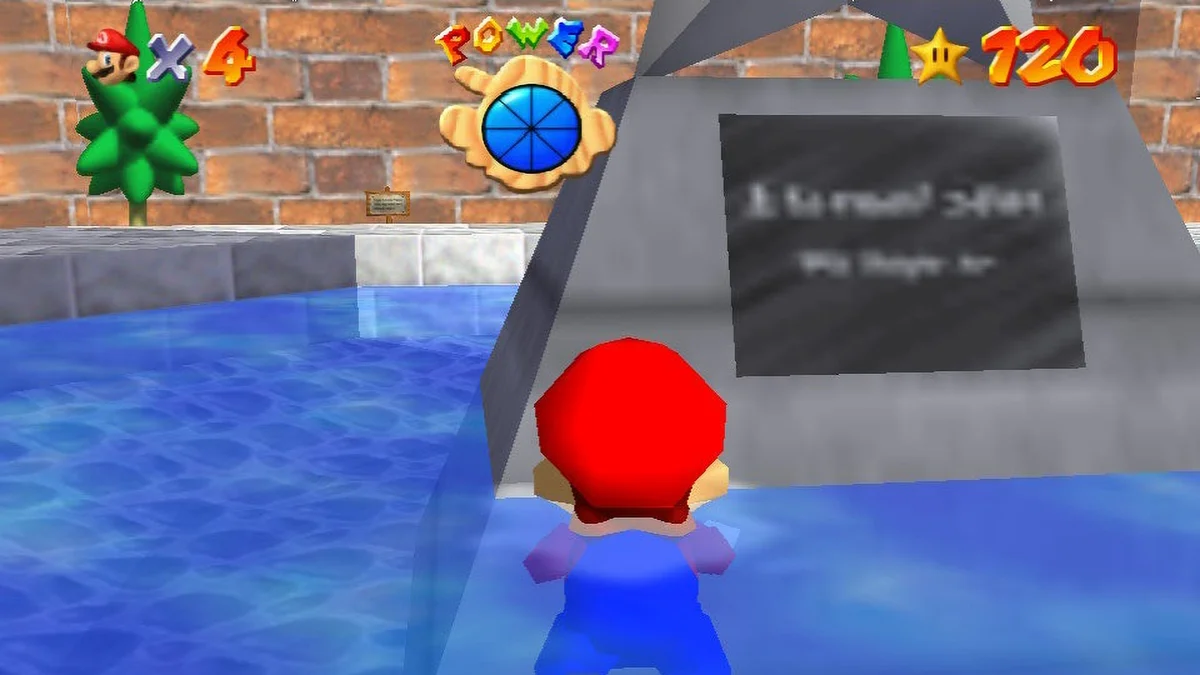
It is arguably the most famous urban legend in video game history. Ever since Super Mario 64 launched alongside the Nintendo 64 in 1996, millions of players have squinted at the small stone pedestal on the fountain in Princess Peach's castle courtyard. Beneath the star statue sits a tiny engraved plaque whose blurry characters have defied the human eye for three decades. Generation after generation of fans convinced themselves the inscription read "L is Real 2401," sparking a worldwide hunt to unlock Mario's brother Luigi. Nearly thirty years later, independent programmer and researcher mochi64 (via their open-source GitHub repository) has tackled the enigma through brute-force mathematics: the plaque isn't a secret clue about Luigi at all, but actually reads "Eternal Star / We hope so."
Why AI Upscaling Failed Against a 32×32 Nintendo 64 Texture
Understanding why this mystery endured for nearly three decades requires looking back at the strict hardware limits of the Nintendo 64. In 1996, Nintendo's 64-bit console featured only 4 KB of texture memory (TMEM) available to the graphics chip at any given moment. As a result, the entire courtyard plaque is stored as a single 32 × 32 pixel grayscale image (just 1,024 pixels in total, byte-for-byte identical across the Japanese, North American, European, and 1997 Shindou ROM releases). Within that tiny tile, the two lines of text stand a mere 3 to 5 pixels tall.
At that microscopic resolution, modern re-releases and generative AI upscalers are completely useless: asking an AI image enhancer to sharpen 4-pixel-tall letters simply causes it to hallucinate details that were never there. At a time when retro-engineering classic Nintendo 64 codebases demands strict mathematical integrity, mochi64 flipped the problem on its head. Instead of trying to "read" or upscale the blurry plaque, the researcher built a forward model that simulates the exact 1995-1996 workstation pipeline used by Nintendo's artists on Silicon Graphics (SGI) systems running IRIX 5.3.
Adobe Palatino Bold Italic (1990) and 1.23 Million GPU-Scored Candidates
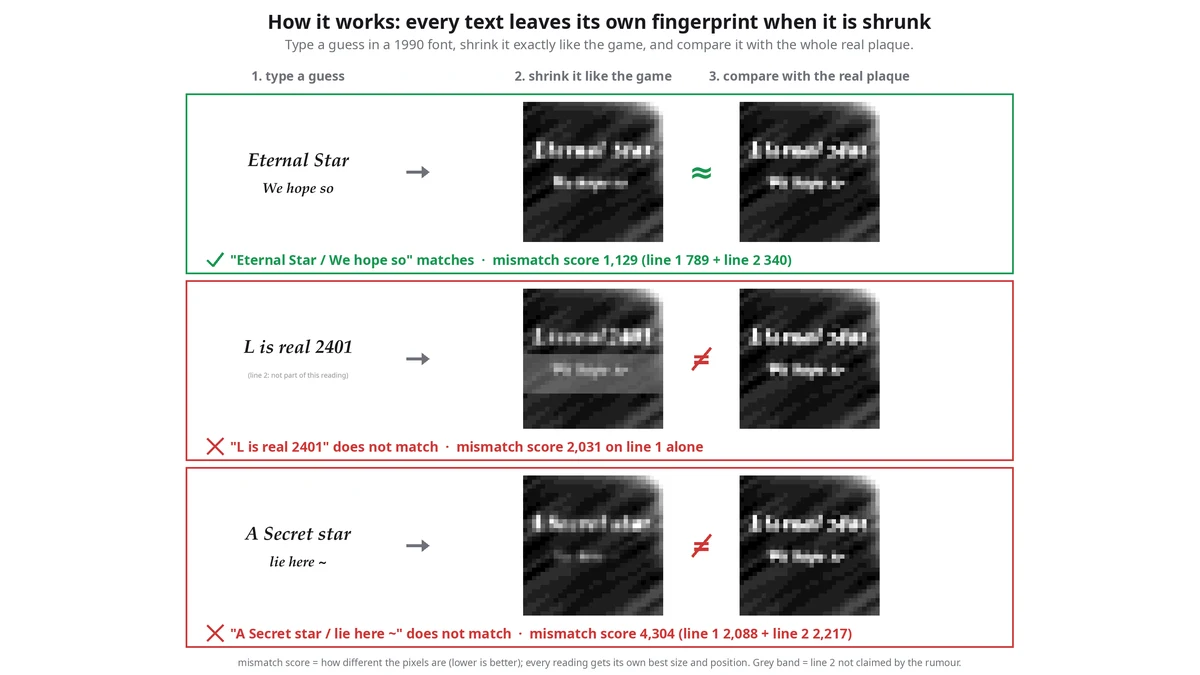
Detailed in a comprehensive 52-page scientific report, the methodology relies on a fundamental physical property: when a word is shrunk down to a handful of pixels, individual letters vanish, yet every specific string leaves behind a unique pattern of gray blocks, acting like a fingerprint. The software first isolates the underlying stone slab texture (traced by the Render96 community to a brushed-metal stock photograph, image SC003 from the 1990s Japanese Sozaijiten CD-ROM collection, rotated by roughly 30 degrees). Using a CUDA GPU, the pipeline types millions of candidate strings in period fonts onto a full-size canvas, resizes them to 32×32 via bilinear filtering, applies blur and gamma correction, and calculates the exact pixel-by-pixel error against the original Super Mario 64 texture.
The quantitative findings from this exhaustive search leave virtually no room for doubt:
- Pinpointing the Exact 1990 Font: Across roughly 470 period fonts from the 1990s sourced from SGI IRIX 5.3, Adobe Illustrator 5.5 for IRIX, KanjiTalk 7.5, and Windows 3.1/95 JP archives (plus a control group of 4,583 modern Google Fonts styles), one typeface beat every contender: Adobe's original 1990 PostScript Type 1 Palatino Bold Italic, which was installed on SGI workstations via Adobe's Type On Call disc.
- Reconstructing the Artist's Exact Settings: The best-fitting model shows the artist typed the two lines onto a 190×160 pixel canvas at 26 px (line 1) and 19 px (line 2) with
+2tracking and manual letter-by-letter hand kerning, shrank the artwork to 32×32 with bilinear filtering,0.3 pxblur, andgamma 1.4, and manually cleaned up about a dozen pixels so adjacent strokes wouldn't bleed together. Inside the text region, the reconstructed model differs from the real plaque by an average of just 1 gray level out of 31. - Blind Search Across 1,237,405 Strings: To prove the pipeline wasn't biased toward expecting "Eternal," mochi64 ran an unconstrained search across 1,237,405 candidate strings (both dictionary words and raw 4-to-10-letter combinations) before the word "Star": "Eternal" ranked #1 overall, while "Star" ranked #1 out of 27,122 words for the second word. On line 2, an open search over 17,700 English words returned "We hope so" as the top match (with "hope" ranking #1 out of 12,556 middle words).
- 50/50 Blind Validation Test: When 50 secret random English words (sealed with SHA-256 hashes prior to decoding) were planted onto the stone texture, the unchanged pipeline successfully recovered the true word as the #1 real English word 50 out of 50 times.
Why "L Is Real 2401" Fails the Pixel Test by a Factor of 2.6x
When the scoring algorithm evaluates the classic fan readings proposed since 1996 (where a lower mismatch score represents a closer fit to the ROM's pixels), the gap is dramatic. On the first line alone, "Eternal Star" achieves a mismatch score of 789, compared to 2,031 for "L is real 2401", making the famous rumor 2.6 times worse. Across both lines combined, "Eternal Star / We hope so" scores 1,129 (dropping to 850.95 with hand kerning), whereas the 2019 community reading "A Secret star / lie here ~" scores 4,304 (3.8 times worse).
Geometrically, the reason is straightforward: "L is real 2401" requires a short capital "L," a tiny "is" flanked by word spaces, and four wide numerals at the end. In reality, the plaque's pixel columns show one long, evenly inked first word (Eternal) with no gap after its initial capital, followed by the unmistakable rhythm of italic Latin ascenders (the tall strokes of the E, t, l, and S).
What does "Eternal Star / We hope so" actually mean in context? As mochi64 points out, the two lines read just like a Japanese memorial plaque translated into textbook school English by Nintendo EAD's Japanese developers: a title (Eternal Star, corresponding to Eien no hoshi) followed by a collective wish (We hope so, reflecting the Japanese phrasing Sō de atte hoshii: "An eternal star, and we hope it truly is one"). It was a heartfelt, slightly tongue-in-cheek wish from the developers for their landmark 3D platformer (an asset Nintendo later reused inside Dodongo's Cavern in the legendary The Legend of Zelda: Ocarina of Time), matching Nintendo of America's 1998 letter stating the plaque was simply a developers' joke.
Still, the legend of Luigi retains a poetic twist of fate. As director Shigeru Miyamoto confirmed in a 1996 strategy guide and a 2009 Iwata Asks interview, Luigi truly was playable in split-screen multiplayer until the final year of Super Mario 64's development before being cut due to memory constraints. And when Luigi's official 3D model finally surfaced in Nintendo's internal archive leak in July 2020, it happened almost 24 years and 1 month (2401) after the game's original launch.
Where to Find Super Mario 64 at the Best Price
Looking to revisit Princess Peach's castle courtyard and inspect the iconic star statue for yourself? Check out the current best deals for Nintendo's 3D platforming classic below:
Check Super Mario 64 deals on Allkeyshop→
My Perspective: When Mathematics Reverse-Engineers 1996 Magic
As a developer deeply passionate about signal processing and Nintendo history, I find mochi64's approach genuinely inspiring. Instead of feeding a 32×32 pixel smudge into a generative AI upscaler that would inevitably invent false letters, this study treats the 1996 texture as a rigorous inverse problem in optical physics. Rebuilding the SGI IRIX 5.3 environment, isolating the exact 1990 Adobe Palatino Bold Italic font file, validating the solver with a 50-for-50 SHA-256 blind test, and releasing the entire MIT-licensed codebase on GitHub with an open leaderboard challenge is a masterclass in computational archaeology. Knowing that Nintendo's artists didn't hide a cryptic cheat code, but instead quietly wished for their creation to become an "Eternal Star," makes this thirty-year-old mystery even more special.

Based on the outskirts of New York City, Chaya 'Chayane' spent five years studying software engineering in Montreal before returning to her home state. A Full-Stack developer and Deep Learning AI architecture researcher, she explores neural networks and algorithmic optimization while engineering data pipelines for Retrocharting and Gamescharting alongside Grimtag. A gamer for over 20 years and an avid collector of Nintendo history and The Legend of Zelda, she explored World of Warcraft's Azeroth before bringing her deep technical background to video game analysis.