Everyone Thinks GTA 6 Will Be the Best-Selling Game in History: Why It Will NEVER Surpass This 15-Year-Old Classic
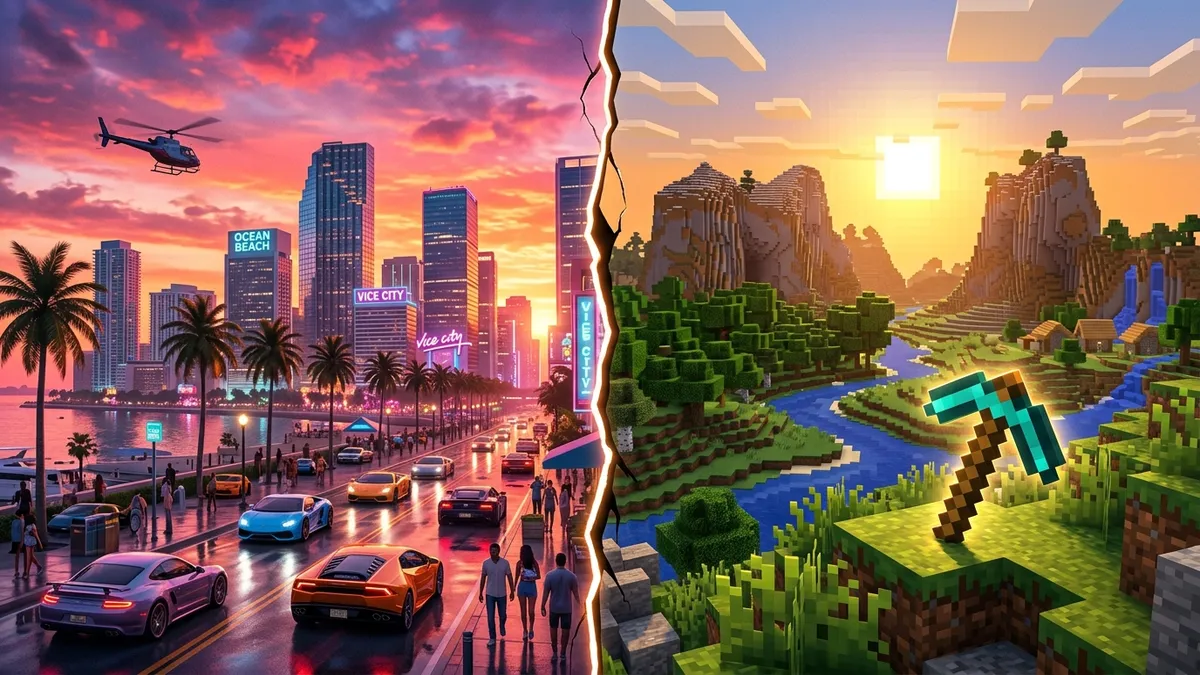
The collective frenzy surrounding Grand Theft Auto 6 has reached unprecedented heights across the gaming industry. Across financial forecasts and community speculation, a unanimous consensus has taken root: Rockstar Games is destined to deliver the best-selling video game in human history.
Yet, a straightforward look at commercial arithmetic shatters this illusion. Even with a record-shattering launch, GTA 6 will never dethrone the undisputed king of gaming: Minecraft and its 425 million copies sold over the past fifteen years.
The Arithmetic Chasm: Confronting Minecraft's 425 Million Copies
To measure the sheer height of the mountain facing Rockstar, one only needs to look in the rearview mirror. Released in 2013, Grand Theft Auto 5 climbed to second place in all-time rankings with over 225 million copies sold globally.
Achieving that legendary milestone required thirteen years of continuous market presence, three console generations, and countless PC discounts. Meanwhile, atop the mountain, Minecraft has officially surpassed 425 million units according to Mojang and Microsoft.
The arithmetic is unforgiving: the blocky sandbox has sold nearly twice as much as its runner-up. For GTA 6 to match that total, it would need to double GTA 5's lifetime volume, an impossible task under current distribution conditions.
The Hardware Install Base: An Unforgiving Bottleneck
Rockstar's first structural barrier lies in the hardware required to play the game. Minecraft runs on virtually any electronic display equipped with a microchip: a 100-dollar entry-level smartphone, a Nintendo Switch, a classroom Chromebook, a tablet, or an aging office PC.
In stark contrast, gamers analyzing the industry landscape know that Lucia and Jason's adventure demands immense graphical computing power. At its late 2026 release, GTA 6 will be strictly locked to PlayStation 5 and Xbox Series X and S consoles.
The combined global install base of these two platforms hovers around 90 to 100 million systems. Even if an unprecedented one out of every two console owners purchased the game on day one, Rockstar hits a physical glass ceiling.
With no Switch version, zero mobile compatibility, and a PC edition delayed by at least a full year, this hardware bottleneck completely rules out the universal distribution reach enjoyed by Mojang.
The Price Gap: Impulse Purchase vs. Luxury Investment
Beyond hardware access, unit economics create an insurmountable barrier. Minecraft retails comfortably between 20 and 30 dollars depending on the digital storefront.
That modest price point makes it the quintessential impulse gift, easily purchased for birthdays or scholastic rewards. Financial friction is virtually non-existent across every socio-economic demographic.
GTA 6 will launch at the exact opposite end of the spectrum, with standard retail pricing commanding 70 to 80 dollars. For the price of a single Rockstar disc, a family can purchase up to four distinct Minecraft licenses.
The Demographic Divide and the Mature Rating Barrier
The final immovable hurdle for Rockstar is demographic reach. Minecraft enjoys an ESRB Everyone 10+ and PEGI 7 rating, making it universally accessible and culturally accepted across generations.
The title engages elementary school children, teenagers, university students, and forty-year-old parents without moral hesitation. Most importantly, its audience renews automatically: every school year introduces millions of fresh children picking up their first wooden pickaxe.
GTA 6 carries an ESRB Mature and PEGI 18 rating. Built around narcotics trade, weaponized conflict, and sharp cultural satire, the game intentionally excludes the tens of millions of younger gamers who form Mojang's permanent audience engine.
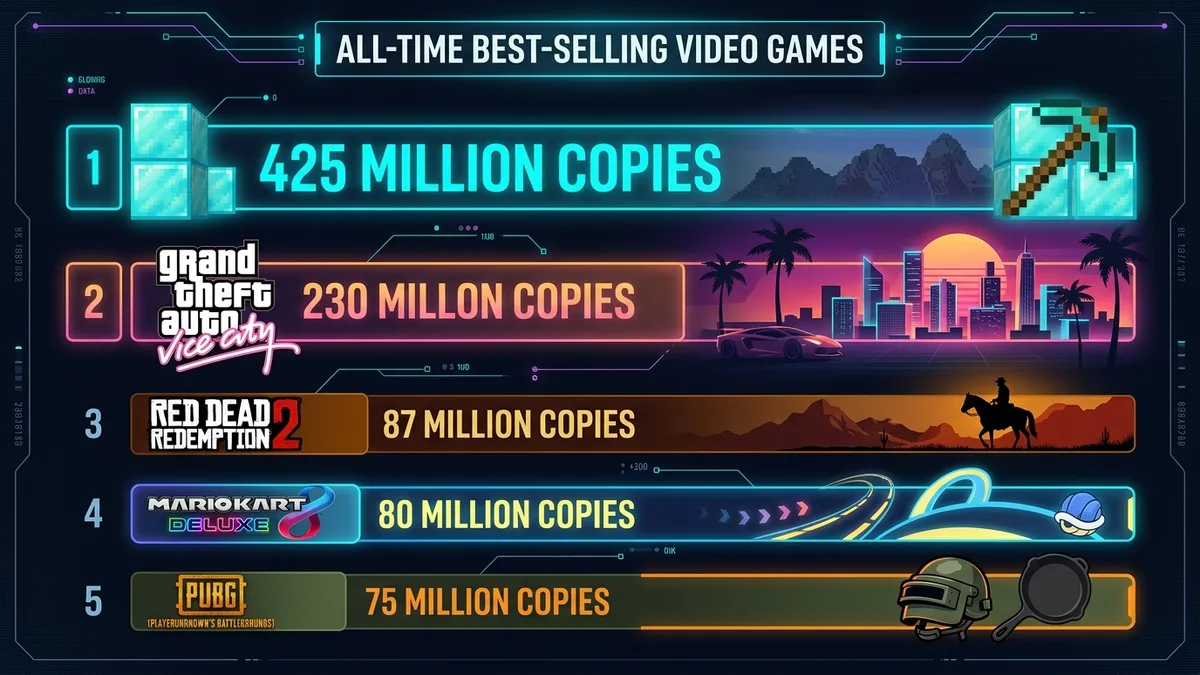
All-Time Leaderboard: The Top 10 Best-Selling Video Games in History
To grasp the sheer scale of these figures and observe the rarity of the summit, here is the official ranking of the ten best-selling video games across industry history:
| Rank | Game Title | Publisher | Year | Copies Sold |
|---|---|---|---|---|
| 1 | Minecraft | Mojang / Microsoft | 2011 | 425 million |
| 2 | Grand Theft Auto V | Rockstar Games | 2013 | 230 million |
| 3 | Red Dead Redemption 2 | Rockstar Games | 2018 | 87 million |
| 4 | Wii Sports | Nintendo | 2006 | 82.9 million |
| 5 | Mario Kart 8 / Deluxe | Nintendo | 2014 | 80 million |
| 6 | PUBG: Battlegrounds | Krafton | 2017 | 75 million |
| 7 | Terraria | Re-Logic | 2011 | 70 million |
| 8 | The Elder Scrolls V: Skyrim | Bethesda | 2011 | 65 million |
| 9 | The Witcher 3: Wild Hunt | CD Projekt Red | 2015 | 65 million |
| 10 | Super Mario Bros. | Nintendo | 1985 | 58 million |
This hierarchy demonstrates an undeniable reality: only two games in gaming history have ever passed the mythical 100 million copies milestone. Even if GTA 6 achieves the astronomical feat of doubling Red Dead Redemption 2 with 170 million sales, it would still remain light-years away from catching Mojang.
Volume Leadership vs. Financial Supremacy
One must not misread this industrial dynamic. While Minecraft will permanently retain its crown for raw units sold, Rockstar Games will unchallenged reign atop the revenue pyramid.
Backed by premium pricing, collectors editions, and the monetization juggernaut of GTA Online 2, Take-Two will generate billions of dollars within months. But on the battlefield of raw sales volume and universal adoption, Minecraft's throne remains completely out of reach.

SEO consultant for over 20 years and digital entrepreneur, Charles 'Grimtag' Ronchain is the founder of Pro-Gamer.gg, Retrocharting.com, and Gamescharting.com. A competitive gamer, streamer, and retro game collector, he has worked in the video game industry for over 15 years, notably as a consultant for leading game price comparison platforms. Passionate about real-time performance data and gaming technology, he analyzes competitive esports, gaming hardware benchmarks, and creator workflows on Pro-Gamer.gg with an authentic player perspective.