11-Year-Old Japanese Prodigy Stuns Asian Games With Esports Gold in Puyo Puyo
Traditional athletics enforce rigid physiological barriers that prevent children from competing against prime adults. In high-stakes esports, cognitive wiring and reaction speed completely overturn biological advantages.
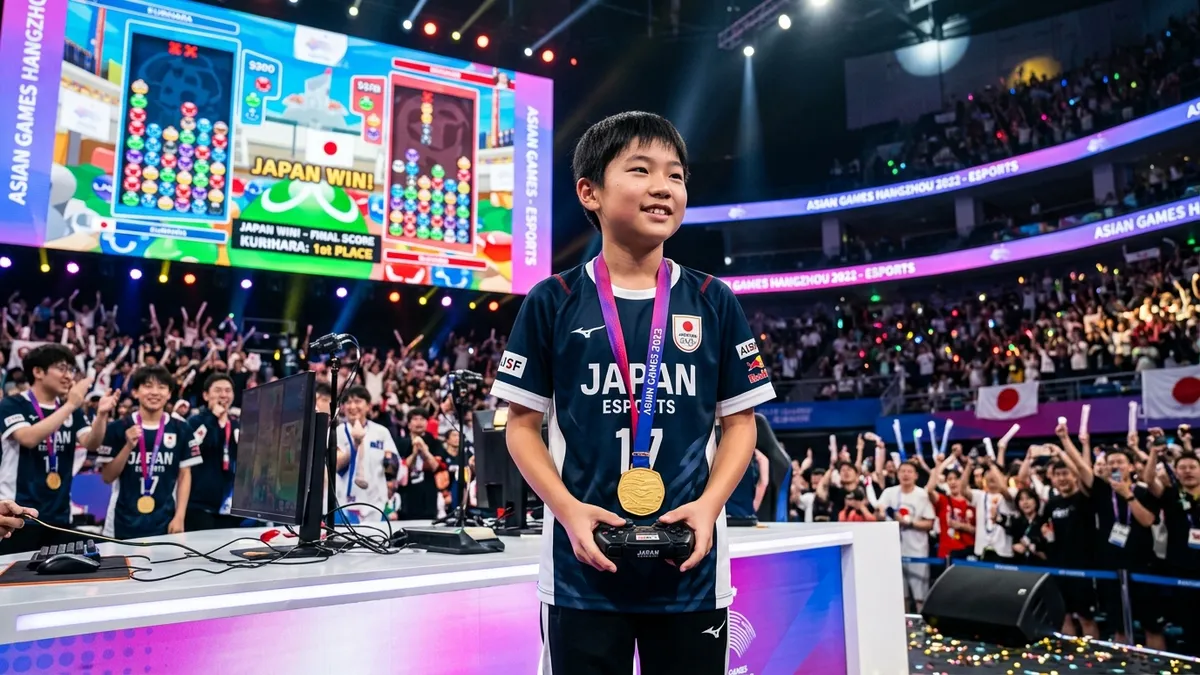
At just 11 years old, Japanese elementary school student Yuki Kurihara made international competitive history by capturing the gold medal at the 2026 Asian Games in Aichi-Nagoya. Competing in the official medal event for Sega's iconic puzzle title Puyo Puyo Champions, he became the youngest athlete in Japanese history to compete at the Asian Games, and one of the youngest gold medalists in tournament history.
A Decisive 10-2 Rout Against a 24-Year-Old Veteran
The gold medal match opened with an immediate test of nerves for the young prodigy. His 24-year-old South Korean opponent secured the opening round, capitalizing on a brief tactical miscalculation from Kurihara.
That initial victory proved to be South Korea's only momentum of the final. Kurihara adjusted instantly in round two, resetting his defensive stack with ice-cold precision.
The 11-year-old Japanese standout rattled off ten straight game victories, closing out the championship series with an overwhelming 10-2 scoreline. In the semifinals, Kurihara had already dispatched a 28-year-old Thai veteran in similarly dominant fashion, leaving the seasoned international competitor visibly stunned by the child's speed.
Spectators inside the arena witnessed a level of composure rarely seen in competitors twice his age. Rather than panicking when falling behind early, Kurihara methodically constructed game-winning counter-attacks while remaining completely unfazed by the roaring arena crowd.
How Childhood Brain Plasticity Outpaced Decades of Experience
The inclusion of Puyo Puyo Champions as a medal discipline highlights the cognitive intensity of competitive puzzle gaming. Unlike conventional shooters or fighting games, the title does not test physical strength, but instant spatial awareness and lightning-fast combinatorial calculations.
Players must stack falling jelly blobs while visualizing cascading combo chains known as rensa several steps ahead. Any hesitance under pressure results in garbage blocks burying the grid within milliseconds.

In this specialized mental arena, an 11-year-old's peak neuroplasticity provides a decisive edge over adult competitors who rely on more rigid problem-solving patterns. Kurihara processed incoming garbage blocks and constructed counter-chains with effortless spontaneity.
While his adult opponents struggled to anticipate his offensive transitions, the Japanese prodigy executed complex clearing sequences without displaying a single hint of stage fright under tournament arena lights.
His ability to read the opponent's board state while managing his own falling pieces in under a quarter of a second neutralized every strategic trap set by the South Korean finalist.
Redefining Age and Athletic Longevity in Competitive Gaming
Kurihara's historic triumph illustrates how competitive gaming dismantles conventional athletic timelines. While traditional sports demand years of physical conditioning, mental sports reward raw synaptic processing and adaptive pattern recognition.
The young student has proven that world-class excellence in tactical puzzle esports is not reserved for seasoned industry veterans with decades of tournament mileage. With dedicated practice and innate spatial genius, an elementary school gamer can triumph on the continental Olympic stage.
Holding his gold medal on the Asian Games podium, the 11-year-old gave a modest bow while clutching his controller. For the veteran competitors watching from the sidelines, his victory serves as an undeniable reminder of the neural speed driving gaming's next generation.

SEO consultant for over 20 years and digital entrepreneur, Charles 'Grimtag' Ronchain is the founder of Pro-Gamer.gg, Retrocharting.com, and Gamescharting.com. A competitive gamer, streamer, and retro game collector, he has worked in the video game industry for over 15 years, notably as a consultant for leading game price comparison platforms. Passionate about real-time performance data and gaming technology, he analyzes competitive esports, gaming hardware benchmarks, and creator workflows on Pro-Gamer.gg with an authentic player perspective.