AI Cheating in CS2 and Valorant: Why Anti-Cheat Systems Have Already Lost the War
Cheating has always been the cancer of competitive online gaming, but we have officially crossed a point of no return. Sluggish aimbots coded on the fly are relics of the past.
In 2026, artificial intelligence, machine learning, and compromised hardware peripherals have joined forces with cheat developers, rendering even the most sophisticated anti-cheat systems on the market virtually obsolete.
Hardware Cheats: The Ghost in the Machine
To understand the scale of the crisis, you have to look under the hood of how this new generation of undetectable cheats operates. The cheat payload no longer runs on the gaming PC at all.
The undisputed king of modern exploit architecture relies on DMA (Direct Memory Access) cards. A physical PCIe card is slotted directly into the gaming PC motherboard. It reads host RAM in real time without passing through the operating system or triggering system API calls, transmitting raw player coordinates to a secondary computer.
"Anti-cheats based on local software detection are dead. The future belongs to server-side AI behavioral analysis, or an exclusive return to physical LAN tournaments."
- Anonymous statement from a Riot Games security engineer.
Another rapidly spreading variant harnesses external video capture cards. These cards clone the display signal coming from the monitor and route it to a secondary rig running a computer-vision model (such as YOLO) trained specifically to identify enemy character models.
Once an enemy silhouette is locked in, the secondary PC calculates the exact firing coordinates and feeds micro-corrections back to the primary gaming rig via an external USB microcontroller (such as an Arduino or Raspberry Pi). This device mimics the physical electrical handshake of an ordinary gaming mouse. To the host PC anti-cheat software, all it sees is a legitimate USB input device.

Why Vanguard and Ricochet Are Powerless
Kernel-level anti-cheat engines like Vanguard (Valorant) or Ricochet (Call of Duty) draw their power from scanning host system memory (RAM). In these hardware-isolated setups (DMA and external capture cards), there is simply zero malicious code residing in the host memory for them to detect.
To push back against DMA exploits, Riot Games recently upgraded Vanguard (see the full breakdown of Riot Vanguard updates) by enforcing strict IOMMU (Input-Output Memory Management Unit) security policies, effectively blacklisting the majority of unauthorized DMA card firmwares.
However, computer-vision cheating powered by external capture cards remains completely invisible to host-level memory scans.
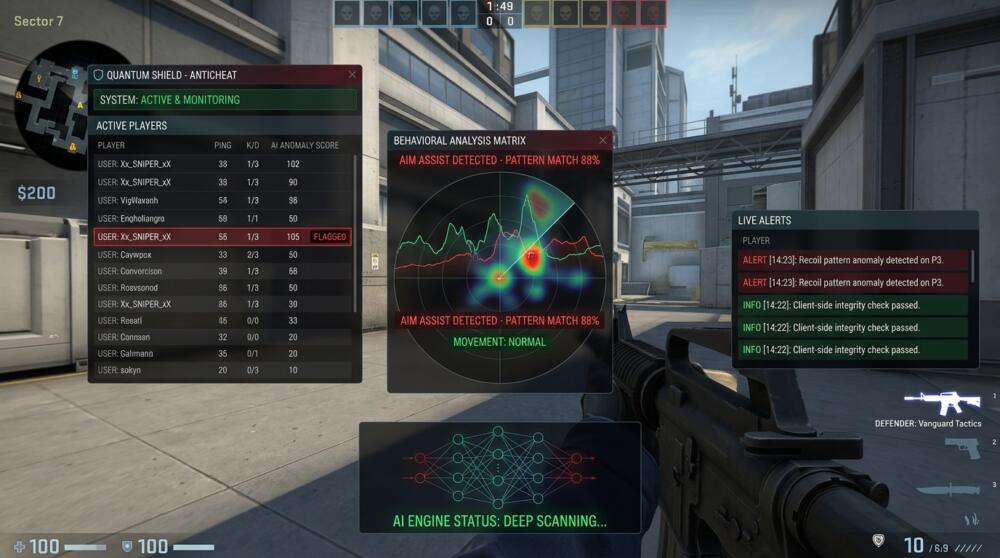
Developers like Valve are attempting to fight back with server-side AI solutions such as VACnet: deep neural networks (see recent research on AI behavioral detection) analyze metrics like Time-to-Damage (pure reaction latency) and Mouse Pathing (the geometric trajectory of crosshair movement).
Legacy aimbots trace unnatural straight lines or mathematically flawless bezier curves. Cheat creators have already countered by integrating sophisticated human smoothing algorithms and simulated physiological muscle noise.
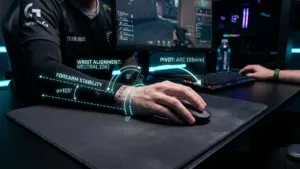
Even when paired with the best ultra-lightweight gaming mice available, the AI generates undetectable, human-like micro-oscillations.
The End of Online Esports Competitions?
This asymmetrical warfare raises an existential crisis for the future of online esports. If any ranked player can set up undetectable hardware-level assistance for around $50, how can tournament organizers guarantee competitive integrity in remote qualifiers?
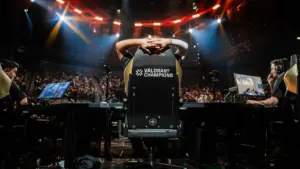
Voices across the industry are increasingly calling for a return to physical LAN events for all major tournament stages, allowing organizers to physically inspect competitor hardware rigs.
One reality is undeniable: in 2026, trust on public ranked servers is completely shattered.
Play clean, stay sharp, and see you on the servers,
Grimtag
Valorant
Explore official trailers, technical specs and all latest coverage for Valorant.

SEO consultant for over 20 years and digital entrepreneur, Charles 'Grimtag' Ronchain is the founder of Pro-Gamer.gg, Retrocharting.com, and Gamescharting.com. A competitive gamer, streamer, and retro game collector, he has worked in the video game industry for over 15 years, notably as a consultant for leading game price comparison platforms. Passionate about real-time performance data and gaming technology, he analyzes competitive esports, gaming hardware benchmarks, and creator workflows on Pro-Gamer.gg with an authentic player perspective.