Consumer NAND Flash Spot Prices Drop 20% and 512Gb Wafers Plunge 32%: When Will NVMe SSD Prices Actually Fall?
After nearly twelve months of relentless price hikes that saw certain memory components surge up to fivefold on the back of data center demand, the tide is finally turning for PC builders and console owners. On the industrial spot market, where memory chips are traded short-term before being assembled into retail drives, consumer NAND flash prices have dropped by roughly 20% in a single month. While this marks a major break from the upward cycle of 2026, the timeline for lower retail SSD tags depends heavily on inventory turnover and diverges sharply from the ongoing DDR5 RAM crunch.
512Gb Wafers Down 32% to $14.30 and 1Tb Chips Down 19%: Inside the Spot Market Correction
Market tracking figures highlighted by TrendForce and DRAMeXchange alongside financial estimates from Bank of America reveal a steep pullback across mainstream silicon wafers used in consumer storage. On the spot market, 512Gb (64GB) NAND wafers have plunged 32% quarter-over-quarter to settle around $14.30. At the same time, higher-density 1Tb (128GB) NAND products, which form the backbone of popular 1TB, 2TB, and 4TB M.2 NVMe drives, have dropped 19% over the quarter to roughly $24.90.
| Memory Segment | Recent Change | Price / Market Trend | Impact on PC & PS5 Gamers |
|---|---|---|---|
| Consumer NAND Flash (Spot Market) | -20% in 1 month | Sharp cooling in industrial trading | Halts the upward price spiral on M.2 SSDs |
| 512Gb NAND Wafers (64GB) | -32% QoQ | Approx. $14.30 per unit | Lower production costs for 500GB and 1TB drives |
| 1Tb NAND Products (128GB) | -19% QoQ | Approx. $24.90 per unit | Eases BOM costs on 2TB and 4TB NVMe SSDs |
| Q1 2027 NAND Contracts (Bank of America) | -5% to -10% forecast | Shift toward consumer oversupply in 2027 | Gradual retail SSD discounts in early 2027 |
| Enterprise SSDs (AI Server eSSDs) | +15% to +20% in Q4 2026 | AI infrastructure demand remains hot | Fabs may shift capacity toward server lines |
Two primary forces are driving this consumer NAND reversal. First, demand destruction has hit the retail market: once SSD and system prices crossed a critical threshold, everyday buyers and PC gamers simply delayed their storage upgrades. At the same time, laptop and smartphone OEMs began scaling back default storage capacities on mainstream configurations to keep retail price points intact, choosing to burn through existing warehouse inventory rather than placing fresh wafer orders.
Second, aggressive competition from China has disrupted commodity TLC and QLC pricing. While Samsung, SK hynix, Micron, and Kioxia prioritized high-margin enterprise storage, Chinese memory maker YMTC (Yangtze Memory Technologies) ramped up output and captured an estimated 14% of global NAND revenue in the second quarter, putting heavy downward pressure on general-purpose consumer flash.
2027 Outlook: 5% to 10% Lower Contract Prices in Q1 2027, While Enterprise SSDs and DDR5 Stay Tight
A 20% drop on the spot market does not mean retail M.2 drives will fall by a fifth overnight. Spot pricing reflects immediate B2B component trades, and it typically takes several weeks for lower wafer costs to filter into quarterly contract negotiations, module assembly, and retail distribution. According to Bank of America projections, consumer NAND contract prices are set to decline by another 5% to 10% in the first quarter of 2027, tipping the consumer segment back into oversupply and bringing more normalized retail SSD pricing as 2027 unfolds.
However, the broader memory industry remains split in two. On the data center side, TrendForce still projects a 15% to 20% surge in enterprise SSD (eSSD) contract prices during the fourth quarter of 2026 as AI server deployments absorb massive storage volumes. SK hynix's leadership has even cautioned that tight supply conditions across high-end server memory could persist toward the end of the decade if fabs continue reallocating cleanroom space.
More importantly for PC builders, DDR5 system RAM is not experiencing any comparable relief. Because DRAM wafer capacity is heavily tied up producing HBM stacks for AI accelerators, 32GB and 64GB DDR5 kits remain expensive, prompting unusual hardware workarounds such as ORICO's FlashMem FM9800 PCIe 5.0 SSD dedicating 256GB of fixed pSLC cache to back up GPU VRAM and DDR5.
My Test Bench
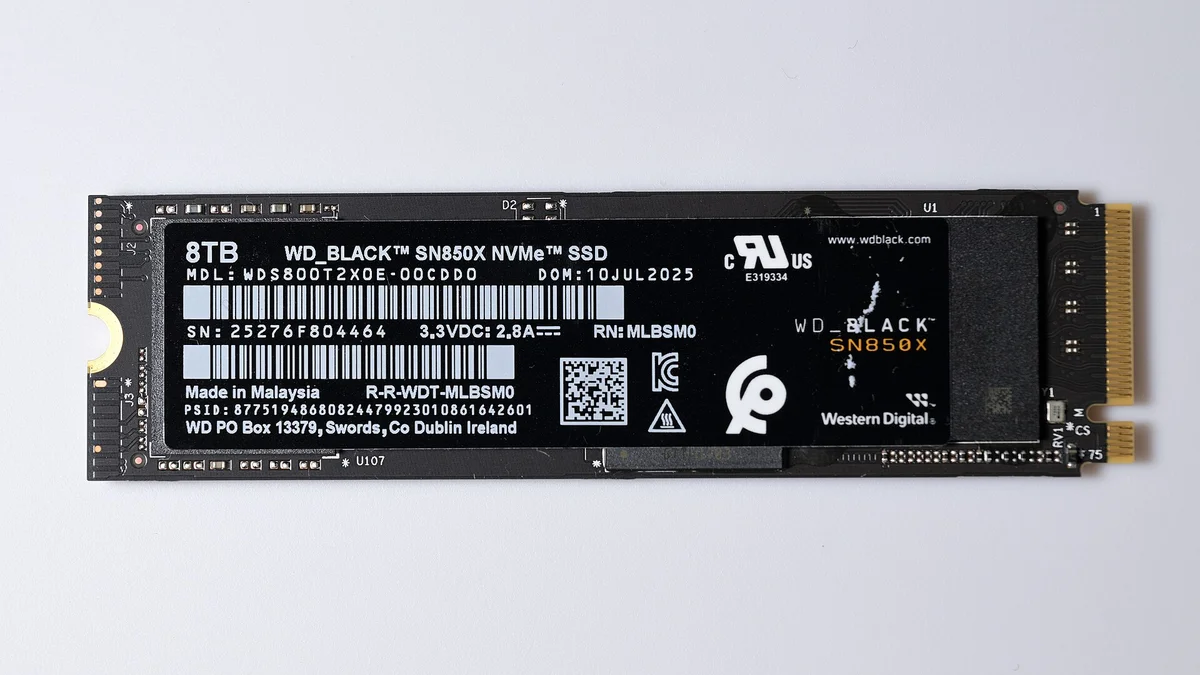
Looking closely at the DRAMeXchange wafer numbers and the bill of materials for a modern M.2 drive, my advice is straightforward: if your PS5 or gaming PC is already choking on 150GB to 210GB game installs right now, there is no reason to put off buying a 2TB drive for three months just to save 5% to 10% in Q1 2027. On a $140 to $160 PCIe 4.0 SSD, a 10% retail dip translates to roughly $12 to $15. What this 20% spot market drop and the 32% plunge on 512Gb wafers actually accomplish is killing off the panic-buying cycle that threatened to push mainstream 2TB NVMe drives past $250 this winter. Keep an eye on flagship PCIe 4.0 models with dedicated DRAM cache (such as the WD_BLACK SN850X, Samsung 990 PRO, or Crucial T500) during year-end sales, as storage brands finally have the component margin to offer real discounts again.

PC hardware enthusiast and competitive gamer, Arthur 'Heimdall' splits his time between France and the UK working in enterprise B2B software solutions. A business school graduate passionate about component benchmarking, he has been building, modding, and tuning PCs since childhood, optimizing every thermal degree and millisecond of display latency. An avid gamer across Assassin's Creed and sandbox titles, he forged his alliance with Grimtag and Chaya during late-night World of Warcraft raids before joining Pro-Gamer.