Glowing 'A' Emblem and a January 5 Las Vegas Keynote: Jack Huynh Teases AMD's CES 2027 Showcase and RDNA 5 Alpha Trion
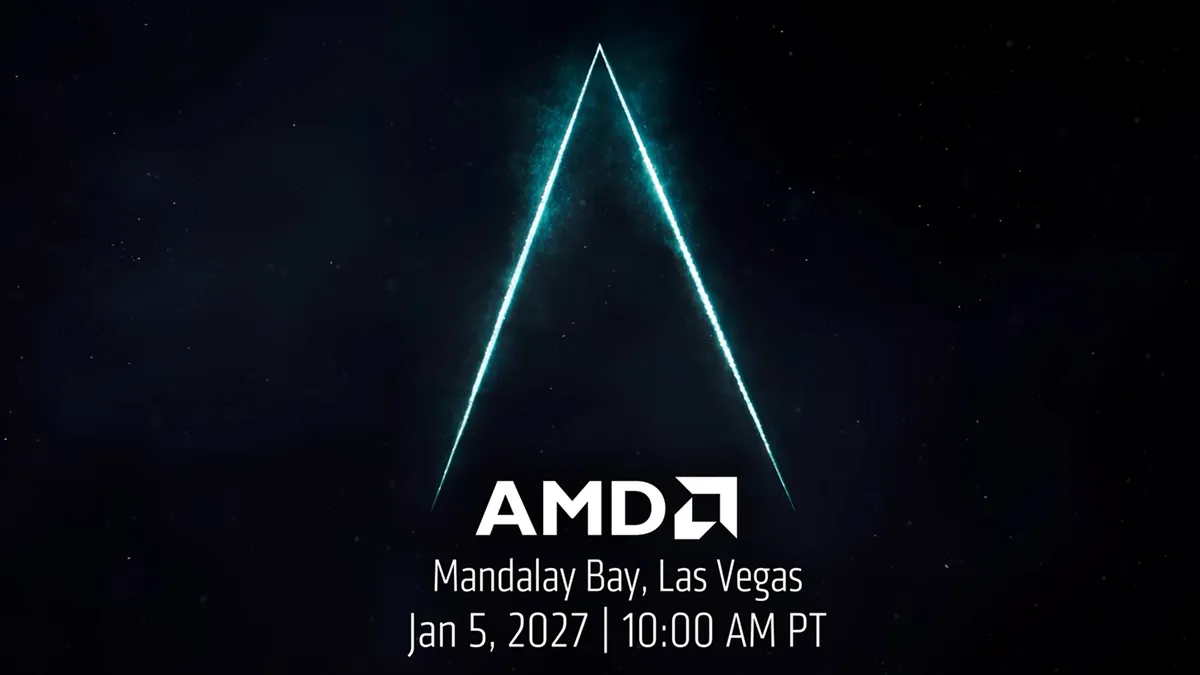
The countdown to Las Vegas is officially underway for Team Red. Jack Huynh, Senior Vice President and General Manager of the Computing and Graphics Group at AMD, has shared a cryptic first teaser scheduling the company's major keynote for Monday, January 5, 2027, at 10:00 AM PT at the Mandalay Bay Convention Center. Front and center against a starfield backdrop sits a glowing cyan emblem shaped like the letter "A", accompanied by a bold promise to kick off the new year by unveiling "the next era of computing."
Why the Glowing "A" Emblem Points Straight to RDNA 5 "Alpha Trion"
Posting on X, the executive leading AMD's Ryzen and Radeon divisions made it clear that January's showcase will go beyond minor clock-speed bumps: "The next era of computing is going to be something special. We're reimagining what's possible, pushing beyond today's boundaries, and creating a future filled with possibilities we once only dreamed of. I can't wait to share a glimpse of what's coming at @CES."
While the stylized "A" naturally nods to AMD's own branding and its expanding artificial intelligence ecosystem, hardware enthusiasts immediately connected the angular emblem to the internal codenames of AMD's next-generation graphics architecture. Following the midrange-focused Radeon RX 9000 series built on RDNA 4, AMD's engineering teams have been developing the unified RDNA 5 / UDNA architecture under a naming scheme inspired by Transformers lore. Crucially, the flagship family codename for RDNA 5 silicon is Alpha Trion (tracked internally under "AT" chip designations alongside Ultra Magnus and Orion Pax).
Offering an architectural preview of Alpha Trion on the Las Vegas stage would signal AMD's return to the enthusiast graphics tier, pairing redesigned ray tracing and tensor hardware with machine-learning upscaling upgrades under the FSR Redstone and FSR Diamond initiatives.

Ryzen Zen 6 "Olympic Ridge" Desktop CPUs and "Medusa Point" APUs on Deck
On the processor front, the January 5 keynote is poised to bridge AMD's enterprise momentum with its client PC roadmap. With 2nm TSMC-built EPYC Venice server processors already rolling out, PC builders are waiting for their first official look at consumer Zen 6 silicon. We have already spotted early signs of this mobile transition in GIGABYTE's next-gen AORUS Master 16 Gen 3 gaming laptop filings combining AMD Zen 6 and Intel Nova Lake, and the desktop side looks even more transformative.
- 12-Core CCDs on Socket AM5: Codenamed Olympic Ridge, next-generation desktop Ryzen processors are expected to retire the long-standing 8-core chiplet layout in favor of a dense 12-core CCD, scaling dual-CCD flagship chips up to 24 cores and 48 threads while keeping single-CCD gaming latency to a minimum.
- TSMC 2nm (N2) and 3nm (N3P) Silicon: Advanced node shrink targets higher sustained boost clocks past the 6 GHz barrier alongside stronger performance-per-watt efficiency.
- Expanded L3 Cache and CUDIMM DDR5 Support: A reworked client I/O die designed to drive high-frequency CUDIMM DDR5 memory kits, laying the groundwork for next-generation 3D V-Cache gaming processors.
- Medusa Point and Gorgon Point APUs: Next-wave mobile processors combining Zen 6 CPU cores, high-throughput local AI NPUs, and upgraded integrated Radeon graphics for thin-and-light laptops and handheld gaming PCs.
Check Availability for AMD Ryzen X3D CPUs and Radeon GPUs on Amazon→
A Direct Vegas Showdown Against Intel's 18A-P Nova Lake Lineup
Huynh's early teaser sets the stage for an all-out silicon clash in Nevada. AMD's January 5 presentation will go head-to-head with Intel's Nova Lake 18A-P desktop CPU plans for CES 2027. While Intel is preparing its new LGA 1954 socket and high-capacity bLLC cache tiles to challenge the gaming dominance of the Ryzen 7 9800X3D, AMD is banking on drop-in AM5 socket longevity and Zen 6's 12-core chiplets to stay out in front.
My Field Notes
When Jack Huynh drops a CES 2027 teaser in mid-November, it tells me AMD has zero intention of letting Intel or NVIDIA control the early January narrative. From my test bench perspective, moving from an 8-core to a 12-core CCD on the existing AM5 platform is the single biggest architectural leap for PC builders in years. A single-CCD Ryzen X3D chip packing 12 cores and stacked 3D V-Cache without cross-chiplet scheduling quirks would be an absolute monster for gaming and heavy workloads alike. If that glowing "A" also delivers our first concrete look at Alpha Trion and RDNA 5, January 5 is going to be a massive day for PC hardware.

PC hardware enthusiast and competitive gamer, Arthur 'Heimdall' splits his time between France and the UK working in enterprise B2B software solutions. A business school graduate passionate about component benchmarking, he has been building, modding, and tuning PCs since childhood, optimizing every thermal degree and millisecond of display latency. An avid gamer across Assassin's Creed and sandbox titles, he forged his alliance with Grimtag and Chaya during late-night World of Warcraft raids before joining Pro-Gamer.