540 Bytes of Flash Memory Inside a $45 USB-C Hub: How Engineer Michał Kopeć Unlocked Nintendo Switch 2 TV Mode and HDR
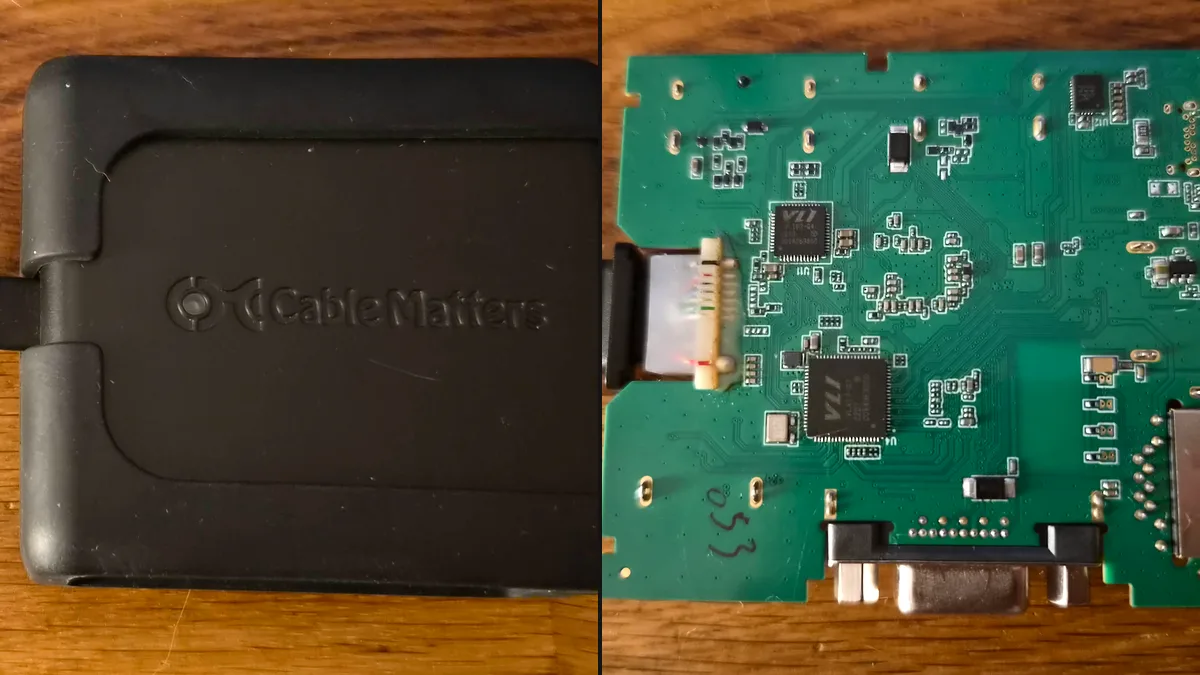
Plugging a generic third-party USB-C dongle into the Nintendo Switch 2 almost always leads to the same dead end: the battery charges normally, yet the television screen remains completely blank. Even though the official cradle relies on standard DisplayPort Alt Mode signaling under the hood, Nintendo gated TV output behind a proprietary authentication check. Tired of packing the bulky stock cradle for travel, hardware engineer Michał Kopeć (known online as mkopec) bypassed the restriction by squeezing just 540 bytes of custom code into an off-the-shelf $45 (€40) Cable Matters USB-C hub, paired with a 108-byte patch to restore accurate HDR colors.
Why Generic USB-C Hubs Leave the Nintendo Switch 2 Stuck on a Black Screen
On paper, the Cable Matters 7-in-1 Triple Display USB-C Hub (model 201031-BLK, featuring HDMI, DisplayPort, VGA, Ethernet, USB-A, and up to 60W USB Power Delivery) already carries every silicon building block required to drive an external monitor. Opening the shell reveals a VIA Labs VL103 USB-PD controller, a VL817 USB hub IC, and a Realtek RTD2142 DisplayPort MST-to-HDMI converter chip.
In the technical write-up published on his blog, Michał Kopeć notes that on stock firmware, the handheld actually gets surprisingly far through the connection handshake. The Nintendo Switch 2 negotiates power delivery, enters DisplayPort Alt Mode, and even configures pin assignment D with clean acknowledgments from the hub. Still, TV mode refuses to trigger. Coming hot on the heels of security researcher Matthew KuKanich's recent CAN bus hack to steer a Tesla with a Nintendo Switch 2, this deep dive exposes how Nintendo's hardware checks operate at the wire level.
By placing a WITRN K2 USB-PD protocol analyzer inline between the console and an official Nintendo dock (and decoding the traffic on Linux with a custom CLI built around usbpdparser), Kopeć mapped out the exact Vendor-Defined Messages (VDMs) the console demands before outputting video:
- Full dock identity and 15V/2.8A power profile: In response to
Discover Identity, the official dock reports Nintendo's Vendor ID (0x057E), product ID0x2062, and a specific five-word VDO identity payload alongside a 15V at 2.8A (42W) power capability. - Entering Nintendo's proprietary SVID first: During
Discover SVIDs, the cradle advertises Nintendo's own SVID (0x057E) alongside DisplayPort (0xFF01). The Switch 2 insists on entering the Nintendo mode before initializing the DisplayPort mode. - Unstructured VDM version queries: Once DisplayPort lanes are assigned, the handheld fires a sequence of unstructured vendor packets (header
057E0001followed by commands20,01,02,06, and04). The dock replies with header057E0041and version strings matching the layout of Cypress/Infineon CCGx firmware records.
Squeezing 540 Bytes Into the VIA Labs VL103 USB-PD Controller
What makes the Cable Matters hub such an appealing target is its serviceability. The VIA Labs VL103 USB-PD controller runs on an 8051 microcontroller backed by 32 KiB of firmware, which Linux's fwupdtool (via its vli plugin) can dump and reflash directly over USB through the companion VL817 hub without soldering. Using Ghidra for 8051 disassembly, the SDCC assembler, and the uCsim simulator to replay captured PD logs, Kopeć hooked roughly 540 bytes of custom 8051 assembly into unused padding just ahead of the image's CRC-16/USB checksum.
Testing seven incremental firmware builds revealed how strict the console's check really is. Simply spoofing Nintendo's Vendor ID (build v4) still produced no picture; TV mode only came alive in build v5 once the hub returned the official dock's complete identity VDO array. Adding canned responses for commands 02, 06, and 04 in build v7 eliminated a three-second timeout pause during docking, making the switch to the big screen just as snappy as first-party hardware.

Fixing Washed-Out HDR With a 108-Byte Realtek RTD2142 Patch
Getting a picture on the television uncovered a second hurdle: enabling HDR caused colors to look severely desaturated and washed out. Unlike the HDR calibration quirks already spotted on Nintendo Switch 2 at the software level, this issue stemmed from the hub's Realtek RTD2142 DisplayPort-to-HDMI converter chip.
Using flashrom's realtek_mst_i2c_spi programmer over the USB-C cable's I²C-over-DP-AUX channel, Kopeć dumped the chip's unsigned 2 MiB firmware (another 8051 core split across eight 64 KiB code banks). Analysis showed that while the Switch 2 outputs wide-gamut BT.2020 video, it does not flag it using the specific DisplayPort signaling method the Realtek chip expects. Consequently, the RTD2142 passed HDR brightness metadata to the TV while mislabeling the HDMI AVI InfoFrame colorimetry packet as BT.709 (SDR). Tellingly, Kopeć found that commercial third-party dock makers had quietly shipped firmware updates containing the debug string switch2 color space patch to work around the exact same quirk.
Instead of hardcoding a console check, Kopeć wrote a clean 108-byte patch inside one bank of the RTD2142 firmware: whenever outgoing HDR metadata uses a PQ or HLG transfer function, the hook marks every HDMI AVI InfoFrame as BT.2020 and updates its checksum on the fly. However, while masquerading as an official dock causes the Switch 2 to expose its VRR (Variable Refresh Rate) toggle, the RTD2142 firmware lacks HDMI VRR packet support and drops to a black screen if variable timing is forced, meaning VRR must remain turned off in the console settings. The offline firmware builder is now available on mkopec's switch2-hub-patcher GitHub repository.
My Take on the Spec Sheet
While we have not flashed or tested this modified Cable Matters hub on our own lab bench yet, Michał Kopeć's breakdown is a masterclass in clean hardware reverse-engineering. Fitting the entire Nintendo USB-PD responder into 540 bytes and solving the BT.2020 AVI InfoFrame mismatch in just 108 bytes across two separate 8051 controllers is remarkably elegant. More importantly, it proves that Nintendo's Switch 2 dock lockout does not rely on cryptographic silicon,just a rigid sequence of vendor-defined messages and version strings that Nintendo could theoretically tweak in a future system update. We have not yet had a physical unit on our desk,if the manufacturer's team would like to send over a review sample so we can put it through our full real-world testing protocol, our lab doors are wide open.

PC hardware enthusiast and competitive gamer, Arthur 'Heimdall' splits his time between France and the UK working in enterprise B2B software solutions. A business school graduate passionate about component benchmarking, he has been building, modding, and tuning PCs since childhood, optimizing every thermal degree and millisecond of display latency. An avid gamer across Assassin's Creed and sandbox titles, he forged his alliance with Grimtag and Chaya during late-night World of Warcraft raids before joining Pro-Gamer.