2.4 GHz Wireless, XLR, and 32-Bit Float on 32 GB: Maono Launches the $399 PD500W Hybrid Audio Hardware
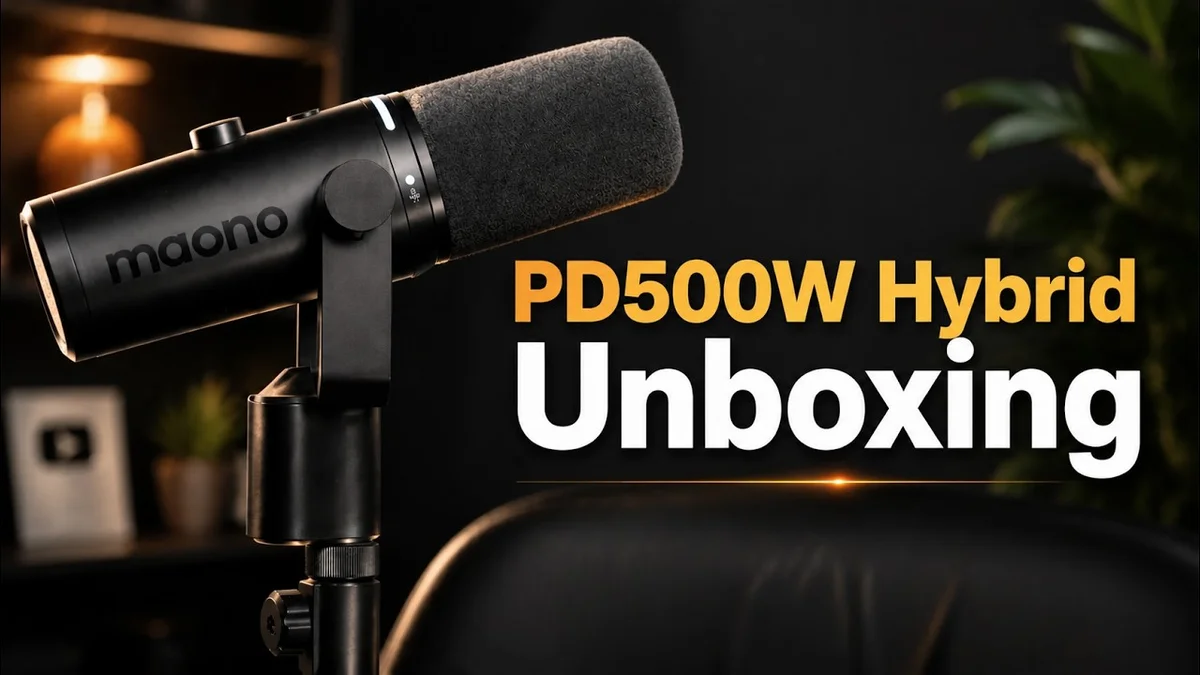
Backed by 279 contributors who pledged $100,124 during its 60-day Kickstarter campaign that wrapped up on August 30, 2026 (more than double its initial $50,000 target), the Maono PD500W Hybrid Microphone is officially available starting November 9, 2026, priced at $399 for the Basic Version and $429 for the Desk Stand Bundle.
Built to keep creators from tearing down their audio chain when moving from a desktop PC or PS5 setup to a two-person interview or on-camera shoot, the dynamic microphone combines three physical and wireless connection paths with standalone internal backup recording.
30mm Cardioid Dynamic Capsule and Tri-Mode 2.4 GHz, USB-C, and XLR Connectivity
At the core of the PD500W is a 30mm dynamic capsule with a cardioid polar pattern tuned to isolate close-range vocals while rejecting room echo and mechanical keyboard clatter in untreated spaces. When wired over traditional analog XLR into an external preamp or mixer, the capsule handles a maximum sound pressure level (SPL) of 147 dB.
For plug-and-play digital setups across PC, Mac, PS5, and mobile devices, the rear USB-C port and low-latency 2.4 GHz wireless link deliver 24-bit/48 kHz audio with a line-of-sight wireless range rated up to 100 meters. That cord-cutting studio approach mirrors recent moves in broadcast peripherals such as the Audio-Technica ATH-M50xSTS-WL StreamSet 2.4 GHz wireless studio headset.
Where Maono pushes its wireless receiver further is dual-microphone pairing: two PD500W units can link simultaneously to a single receiver without an external sound card, outputting independent left and right stereo tracks while supporting timecode synchronization with compatible cameras.
For zero-latency vocal checks, the rear I/O hub also houses a 3.5mm headphone jack capable of mixing your own microphone feed, computer audio, and a co-host's PD500W unit through lightweight monitoring cans like Sony's revived MDR-3R headphones.
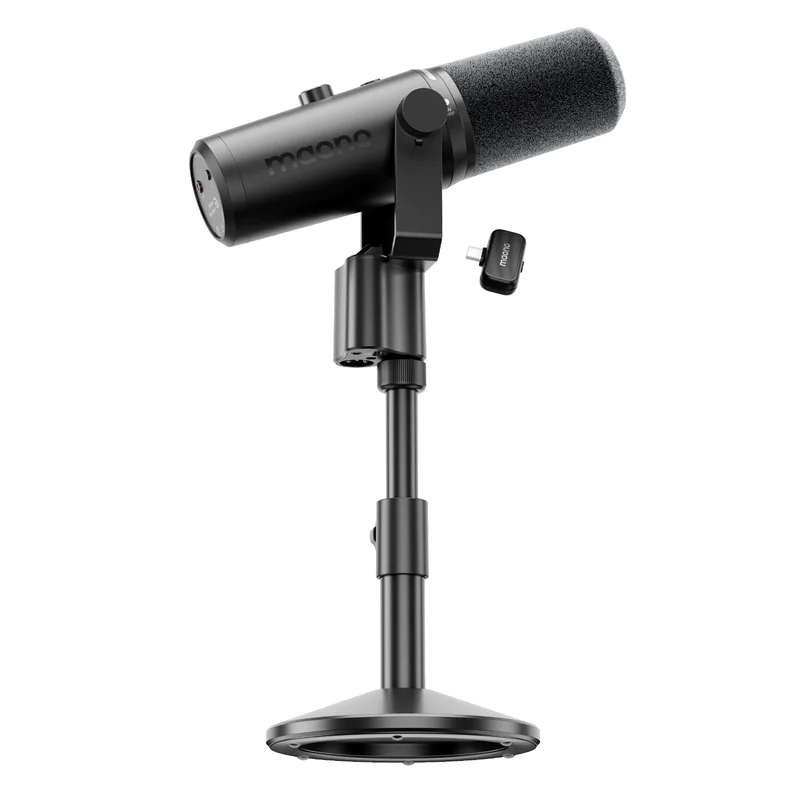
Maono PD500W Hybrid Microphone
- 30mm Cardioid Dynamic Capsule (147 dB Max SPL via XLR)
- Tri-Mode 2.4 GHz Wireless (100m Range), USB-C, and Analog XLR
- 32 GB Onboard Storage: 32-Bit Float (45.2h) or 24-Bit WAV (55.3h) + -9 dB Safety Track
- Up to 60h Battery Life & Maono Link DSP (10-Band EQ, AI Noise Reduction)
32 GB Onboard Storage With 32-Bit Float Recording and -9 dB Safety Track
To prevent wireless interference or software crashes from ruining an irreplaceable take, the PD500W integrates 32 GB of internal flash memory directly inside the microphone body. Creators can capture uncompressed mono WAV files locally at the same time they transmit audio to a PC or camera.
Two bit-depth modes are available for internal storage: standard 24-bit WAV (up to 55.3 hours of recording capacity) and 32-bit float WAV (up to 45.2 hours), providing enough dynamic headroom to rescue sudden vocal peaks or quiet passages in post-production without clipping.
A selectable -9 dB Safety Track also records a parallel attenuated backup channel to guard against unexpected volume spikes. Users can configure Startup Auto Recording upon power-on, Low Power Auto Recording that kicks in automatically when receiver battery drops to 10%, and a 5-second long-press on the recording button that switches the mic into USB drive mode for direct file transfers.
Zinc-Alloy Build, 60-Hour Battery Life, and Maono Link DSP Suite
Externally, the PD500W uses a zinc-alloy chassis with an internal air-cushion shock mount, a flocked windscreen, and concealed cable routing built into its U-shaped yoke. Following beta-tester feedback after the Kickstarter run, Maono upgraded the dual-function metal control knob (mic gain and headphone volume), added an extension adapter for broader boom arm clearance, and introduced a Mute Lock toggle that disables the touch-mute strip during live sessions to prevent accidental muting. Battery life reaches up to 60 hours with RGB lighting turned off.
On the software side, the Maono Link app unlocks onboard DSP tuning across four preset scenes (Original, Stream, Recording, and Podcast), a 10-band graphical EQ with high-pass and low-pass filters, a compressor, a limiter, a de-esser, an electronic pop filter, Adaptive Auto Gain Control (AGC), and multi-level AI noise cancellation (three presets or a 0-to-20 manual slider), alongside AI-assisted transcription, translation, and summarization tools.
| Specification | Maono PD500W Details |
|---|---|
| Capsule & Polar Pattern | 30mm Dynamic, Cardioid (147 dB Max SPL via XLR) |
| 4-in-1 Connectivity | 2.4 GHz Wireless (100m range, dual-mic receiver support), USB-C (24-bit/48 kHz), Analog XLR |
| Onboard Recording | 32 GB Internal Storage: 32-Bit Float WAV (45.2h) or 24-Bit WAV (55.3h) + -9 dB Safety Track |
| DSP & Maono Link App | 10-Band EQ (HPF/LPF), Compressor, Limiter, De-Esser, Electronic Pop Filter, AI Noise Reduction (0-20), Timecode |
| Battery & Hardware | Up to 60 hours (RGB off), Zinc-Alloy Body, 3.5mm Zero-Latency Monitoring, Mute Lock Switch |
| Official Pricing | $399.00 (Basic Version) / $429.00 (Desk Stand Bundle) / $239.00 (PD500W Lite) |
The Strategist's Take
Packing a 147 dB SPL analog XLR output, dual-transmitter 2.4 GHz wireless, and 32 GB of onboard 32-bit float recording into a single zinc-alloy dynamic shell solves a real headache for multi-device setups. Anyone who has ever lost an hour-long recording to a silent Windows audio driver reset or a clipped preamp knows just how valuable local 32-bit float WAV files and a -9 dB safety track are when you sit down to edit.
At $399 ($429 with the desk stand), however, Maono is stepping directly into serious broadcast territory where acoustic fundamentals matter just as much as feature checklists. This initial breakdown is based on the manufacturer's official spec sheet and architecture: we will need to measure the internal preamp's self-noise floor, test how aggressively the AI noise suppression colors low-end vocal warmth, and verify 2.4 GHz packet stability in congested Wi-Fi rooms. We have not yet had a physical unit on our desk, so if Maono's team would like to send over a review sample so we can put it through our full real-world testing protocol, our lab doors are wide open.

Born and based in Montreal's Mile End district, Maëlle "Kaelen" became close friends with Chaya during their university software engineering years, bonding over late-night coding labs, campus LANs, and World of Warcraft raids alongside Grimtag and Heimdall. A game systems balancing consultant and lifelong theorycrafter, she cut her teeth in the early 2010s writing boss walkthroughs, frame-data breakdowns, and competitive meta guides for specialized French-language MMORPG and esports portals, including Mondes Persistants, as well as North American strategy collections. On Pro-Gamer, she leads in-depth walkthroughs, build optimization, and tactical esports coverage.