Nearly 1 in 2 Games Released on Steam Last Month Disclosed Generative AI: Why the Flood Still Fails to Convert Players

A symbolic milestone has just been reached on Valve's storefront. According to a cross-referenced analysis of SteamDB metadata and developer disclosures tracked across roughly 63,600 games released since January 2024, the share of new monthly releases carrying an official AI-Generated Content Disclosure hit 49.9% across October 2026, crossing the 50% threshold during late-month daily cohorts. Today, literally one out of every two games launching on Steam openly declares some form of generative AI usage.
From 1.7% to 1 in 2 Games: An Exponential Climb in Under Three Years
When Valve first introduced its mandatory disclosure questionnaire inside the Steamworks partner portal back in January 2024, generative tooling still looked like an outlier on the storefront. During that opening month, only 1.7% of newly published titles carried the disclosure banner on their store page. Across the full calendar year of 2024, the average settled at 13.2% of new releases.
Since then, the curve has steepened dramatically. While early industry tracking by Ichiro Lambe (founder of Totally Human Media and former Steam Labs consultant) highlighted that AI-disclosed titles had reached roughly 7% to 8% of the active library and 20% of new launches in early 2025, the full-year average for 2025 climbed to 24.0% (hitting 26.4% in October 2025). Across the first ten months of 2026, the year-to-date average reached 40.1% (representing more than 9,200 games out of roughly 23,000 yearly releases tracked by SteamDB) before surging to one in two games in October 2026.
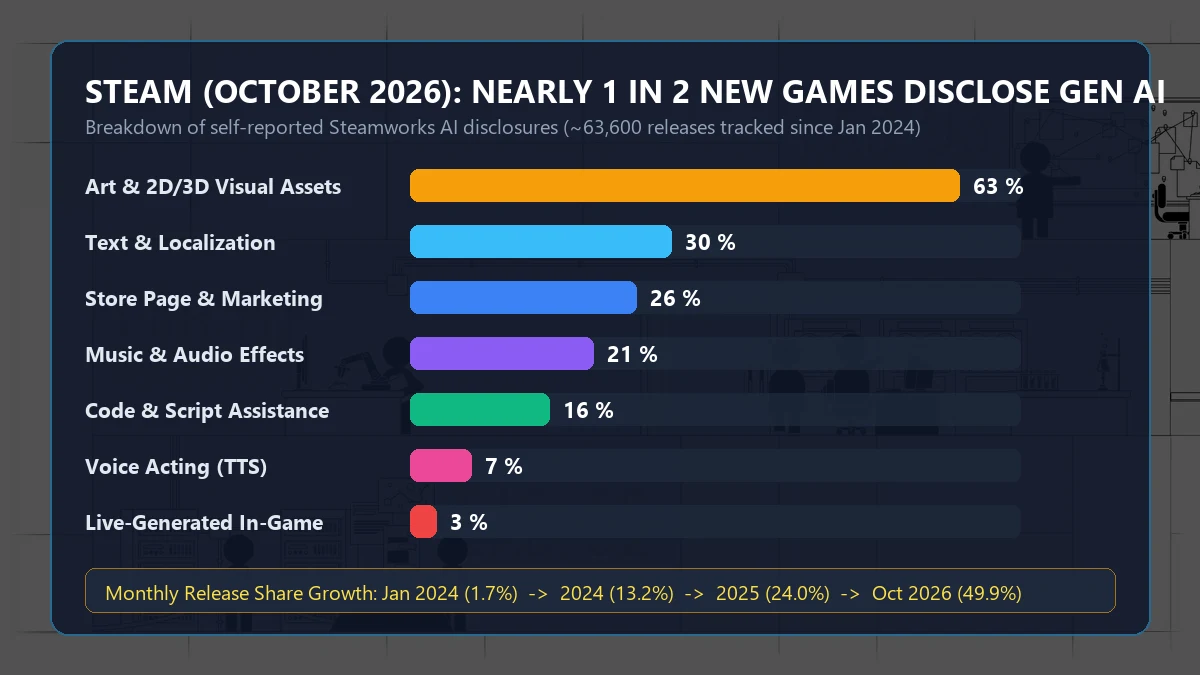
2D/3D Visuals, Localization, Code, and Voice: What Are Studios Actually Generating?
Under Valve's storefront rules, developers must categorize their AI usage into two distinct buckets: Pre-Generated content (any art, code, sound, or text created with AI tools during development and baked into the shipped files or store page) and Live-Generated content (material created dynamically by algorithms while the game is actively running). Breaking down the October 2026 disclosures reveals that static asset production dominates the numbers:
- Art and Visual Assets (63%): nearly two-thirds of all AI disclosures involve 2D illustrations, UI icons, character portraits, textures, backgrounds, or 3D models.
- Text, Narrative, and Localization (30%): roughly three in ten flagged titles rely on large language models to draft background lore or automate multi-language translations on a tight budget.
- Store Page and Marketing Materials (26%): more than a quarter of disclosures apply to store capsules and promotional banners. Remarkably, 8% of all AI-labeled games use generative tools exclusively for their Steam store page without shipping a single AI-generated asset inside the game build itself.
- Music and Audio Effects (21%): just over one-fifth of disclosed titles incorporate algorithmically generated background tracks or sound effects.
- Code and Script Assistance (16%): even after Valve refined its Steamworks guidelines to focus disclosures on player-facing content rather than internal back-end efficiency helpers, 16% of disclosures still cite code generation.
- Voice Acting (7%) and Live-Generated Gameplay (3%): synthetic text-to-speech voiceovers remain a small slice of the pie, while games generating real-time content during active gameplay account for just 3% of disclosures.
The Commercial Reality Check: High-Volume Shovelware Stalls at 13% of Player Reviews
Looking solely at raw release counts might suggest that generative pipelines have conquered PC gaming. Yet once those release numbers are weighted against studio output and actual player engagement, a starkly different picture emerges. AI disclosures appear on 47% of micro-releases with fewer than 10 user reviews, but drop to just 14% among games that have surpassed 1,000 user reviews.
Even more telling is the concentration among high-output publishers: developers who pushed 10 or more games onto Steam in 2026 disclosed AI usage on 68% of their catalog, compared to 37% among studios releasing a single title. Despite accounting for half of all monthly launches, AI-disclosed games have plateaued at roughly 12% to 13% of total user reviews (the most reliable proxy for actual sales volume on Steam) since 2025. Mass-produced releases are flooding the "New & Trending" queues without capturing a matching share of player wallets.
That sheer volume of submissions is, however, taking a heavy toll on Valve's internal certification pipeline. As we recently covered when indie publisher 2 Left Thumbs blamed a massive wave of AI-generated games for delaying Wheel Make It in Steam's review backlog, human QA reviewers are struggling to keep pace with automated storefront spam.
Check Wheel Make It deals on Allkeyshop→
The October milestone also pours fuel on the ongoing debate over storefront transparency. While Epic Games CEO Tim Sweeney recently urged Valve to drop mandatory AI labels by arguing that the technology is becoming ubiquitous, the data shows exactly why PC players still rely on the tag: not to penalize a solo programmer using a code assistant, but to filter out assembly-line asset flips.
My Take
We need to stop lumping every developer together when looking at that 50% headline number. If a cash-strapped solo creator uses an autocomplete helper to debug netcode or translate UI strings into a dozen languages, I could not care less as long as the core game is crafted with genuine care. The real poison exposed by October's data comes from the content mills pumping out ten or more titles a year with 63% machine-generated art. That industrial slop is not actually selling, as stagnating at 12% to 13% of buyer reviews clearly proves, but it clogs Valve's build review queues and steals precious storefront oxygen from legitimate indie teams. Until Steam separates invisible back-end coding tools from low-effort visual asset dumps, that disclosure banner remains our best defense.

SEO consultant for over 20 years and digital entrepreneur, Charles "Grimtag" is the founder of Pro-Gamer.gg, Retrocharting.com, and Gamescharting.com. A competitive gamer, streamer, and retro game collector, he has worked in the video game industry for over 15 years, notably as a consultant for leading game price comparison platforms. Passionate about real-time performance data and gaming technology, he analyzes competitive esports, gaming hardware benchmarks, and creator workflows on Pro-Gamer.gg with an authentic player perspective.