From 17 to 36 FPS in Crysis: A Working Intel Larrabee GPU Development Kit Surfaces in an Abandoned Storage Unit
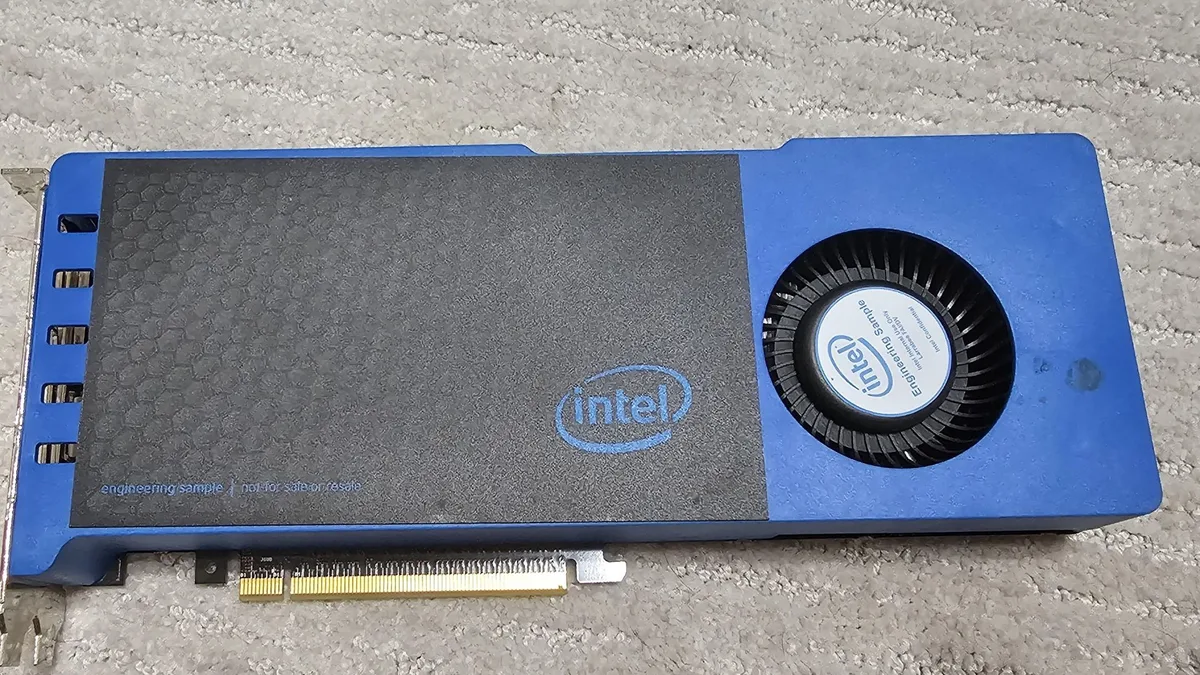
Seventeen years after Intel officially canceled its first consumer discrete graphics card attempt in December 2009, the legendary Intel Larrabee project has unexpectedly come back to life. After winning a lot of vintage computer gear from an abandoned storage unit auction, collector pkellythompson uncovered a complete workstation labeled Intel Visual Adrenaline. Far from being a dead display piece, the tower housed a working Larrabee GPU prototype alongside its original internal USB driver sticks, allowing the long-lost architecture to be benchmarked in Crysis for the very first time.
An Intel Visual Adrenaline Dev Kit with C0-Stepping Silicon
When the buyer opened the chassis to ask the r/PCHardware community for help identifying an unmarked dual-slot PCIe graphics card, hardware historians quickly realized they were looking at one of PC gaming's rarest artifacts. Only one other functional Larrabee unit was previously known to exist in public hands. This official Intel Visual Adrenaline development kit is built around a high-end Intel DX58SO motherboard (LGA 1366 X58 platform), paired with a dedicated diagnostic daughterboard and a C0-stepping engineering sample of the Larrabee GPU from the late stages of the project.
Bringing the machine back to life required careful hardware troubleshooting. On its initial power-up, the card's HDMI port output no signal and the system failed to boot into its hard drive. The culprit turned out to be a dead CMOS battery that had reset the motherboard BIOS, switching the storage controller from IDE to AHCI mode, combined with the prototype's firmware requiring a DVI connection for primary display initialization. Once a fresh CMOS battery was installed, IDE mode was restored, and a monitor was hooked up via DVI, the BIOS boot screen explicitly confirmed the Larrabee prototype before loading the original Windows 7 installation.
Two Unreleased Intel USB Driver Drives Rescued and Archived
What separates this discovery from a lifeless museum curiosity is the software bundled inside the storage unit. Alongside the PC, the collector found two original Intel USB flash drives holding roughly 82 MB and 728 MB of proprietary development files: internal graphics drivers, architectural documentation, software development kit (SDK) utilities, and VBIOS flashing tools.
To ensure these historic files are never lost to bit rot, the contents of both USB sticks have already been backed up and uploaded to the Internet Archive. With the recovered driver package installed, Windows 7 properly recognized the Larrabee processor and enabled hardware-accelerated Direct3D rendering. In an era where modern Intel server CPUs and discrete GPUs rely on specialized silicon pipelines, these preserved 2009 files offer a firsthand look at how Santa Clara's engineers translated Direct3D calls onto an x86 many-core array.
Check Availability for Intel Arc B580 on Amazon→
Can It Run Crysis? Jumping from 17 to 36 FPS
No late-2000s graphics prototype test would be complete without answering the ultimate benchmark question of its era: can it run Crytek's original 2007 Crysis? Running at 720p resolution (1280 × 720) with graphics set to Medium details and anti-aliasing disabled, the Larrabee C0 card initially managed just over 17 FPS on its baseline driver.
However, after digging deeper into the recovered USB archives, the owner uncovered a secondary, newer driver build. Installing that updated software more than doubled the frame rate in Crysis to roughly 36 FPS at 720p Medium. While that leap highlights how heavily Larrabee depended on software tuning, it also illustrates why Intel pulled the plug in late 2009: budget-friendly mid-range cards from 2008 like the GeForce 9600 GT and Radeon HD 3850 were already outpacing those numbers at a higher 1280 × 1024 resolution.
My Take on the Spec Sheet
For anyone fascinated by GPU microarchitecture, seeing Crysis run at 36 FPS on C0-stepping Larrabee silicon is pure hardware archaeology. Between 2006 and 2009, Intel attempted something radical: instead of building traditional fixed-function rasterizers like NVIDIA and AMD, Larrabee packed dozens of in-order x86 cores derived from the classic Pentium P54C, augmented with 4-way simultaneous multithreading, 64-bit instructions, and massive 512-bit Vector Processing Units (VPUs) linked via a 1,024-bit bi-directional ring bus. Tile-based rasterization was handled almost entirely in software. We have not yet had a physical unit on our desk,if the manufacturer's team would like to send over a review sample so we can put it through our full real-world testing protocol, our lab doors are wide open.
Doubling the frame rate from 17 to 36 FPS through a single driver revision shows both the flexibility and the fatal flaw of that software-defined pipeline. Emulating traditional fixed-function graphics stages on x86 cores consumed too much die area and power compared to contemporary GeForce 200 and Radeon HD 4800 GPUs. While Larrabee never shipped to gamers, its 512-bit vector engine directly birthed the Xeon Phi HPC line (Knights Ferry and Knights Corner) and laid the groundwork for AVX-512, teaching Intel the hard lessons that eventually led to the dedicated hardware blocks inside today's Intel Arc G3 Extreme gaming handhelds and desktop Battlemage cards.

PC hardware enthusiast and competitive gamer, Arthur 'Heimdall' splits his time between France and the UK working in enterprise B2B software solutions. A business school graduate passionate about component benchmarking, he has been building, modding, and tuning PCs since childhood, optimizing every thermal degree and millisecond of display latency. An avid gamer across Assassin's Creed and sandbox titles, he forged his alliance with Grimtag and Chaya during late-night World of Warcraft raids before joining Pro-Gamer.