Jesus, Joan of Arc, and WWII: Nintendo's Buried 1991 Famicom Disk System Game Time Twist Gets a Complete Human Fan Translation
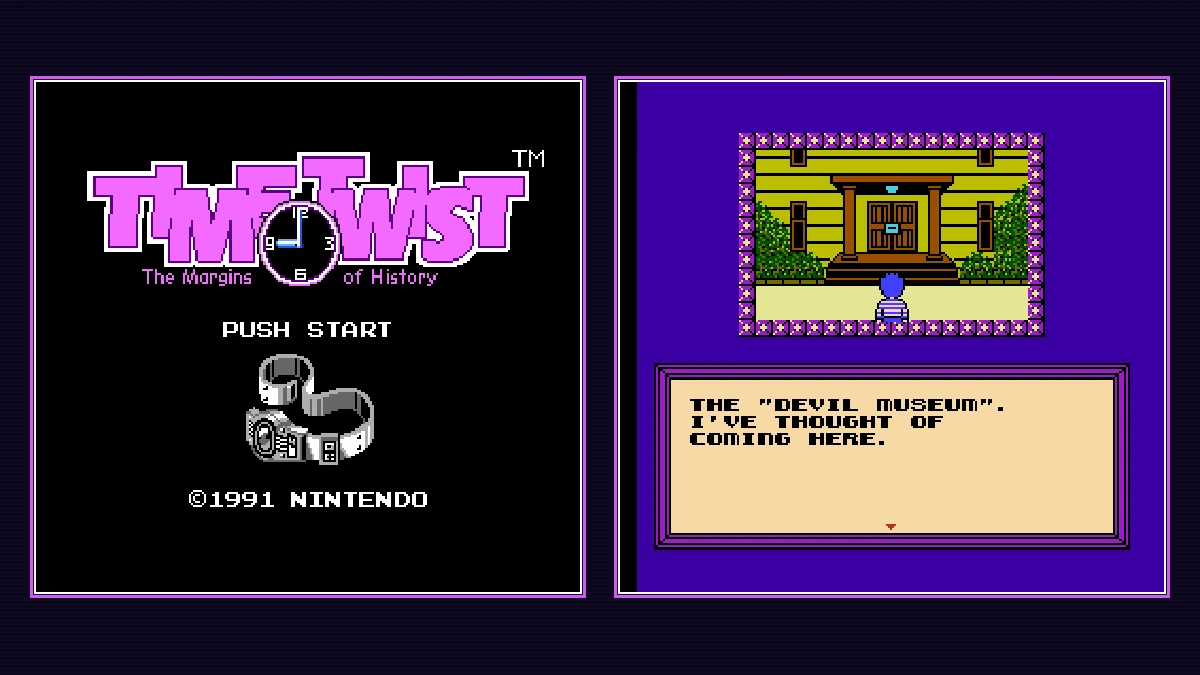
One of the most audacious and closely guarded curiosities in Kyoto's vault is finally playable in English without emulator workarounds. Originally released exclusively in Japan on July 26, 1991 as the final packaged retail release for the Famicom Disk System (FDS), the two-disk text adventure Time Twist: Rekishi no Katasumi de... (localized as Time Twist: The Margins of History) has received a complete, native Version 1.0 English translation patch. Published under a GPL-3.0 license on the romhack.ing database by hackers and translators FCC, Sudgy, and Her-Saki, the project brings Nintendo's strangest historical epic to Western players thirty-five years after it was quietly left behind in Japan.
A 100% Human-Made ROM Patch That Replaces Old Emulator Scripts
For decades, Time Twist: Rekishi no Katasumi de... was notorious among ROM hackers for its hostile internal text architecture. Co-developed by Nintendo and long-time adventure partner Pax Softnica across two separate floppy disks (Zenpen for Part 1 and Kouhen for Part 2), the game stored its original all-hiragana Japanese script using custom dictionary compression, bit-packed character symbols, and unforgiving record boundaries. Changing text lengths directly inside the disk images routinely broke pointer tables and crashed disk loads.
Until now, English-speaking players had to rely either on an experimental Lua script created by Sudgy that overlaid translated text in real time on specific legacy builds of the Mesen emulator, or on rough machine-translated experiments. The newly released Version 1.0 patch solves the underlying technical puzzle once and for all. Engineered by FCC (ROM hacking and text engine overhaul) alongside Sudgy (full script translation) and Her-Saki (manual translation), the localization was built entirely by human hands without any AI assistance.
The patch features a custom English title screen logo reading Time Twist: The Margins of History, fully localized command menus (Look, Talk, Listen, Move), and support for both the original No-Intro two-disk set (CRC32 63f06a01 and a7d51bfa) and a unified four-sided disk image (Time Twist (Merged).fds, CRC32 e88e2399). Because the translation is baked directly into the FDS ROM data, it runs natively on any standard Famicom Disk System emulator as well as original Famicom hardware via RAM adapters and drive emulators like the FDSStick. It is a milestone for retro preservation that echoes the English release of Kowloon's Gate Suzaku on Nintendo Switch 29 years after the PS1 original, proving that even the most unconventional Japanese adventure games eventually find their audience.
Demonic Possession, Joan of Arc, the American Civil War, and Infant Jesus
What makes Time Twist legendary among video game historians is the contrast between its pedigree and its taboo-shattering script. Produced with involvement from Shigeru Miyamoto, scored by Star Fox composer Hajime Hirasawa, and written and directed by Keiji Terui (best known for shaping the lore of The Legend of Zelda and writing for the Dragon Ball and Dr. Slump anime series), the game followed the same team's folkloric FDS adventures Famicom Mukashibanashi: Shin Onigashima (1987) and Yūyūki (1989). Instead of Japanese fairy tales, however, Terui's team plunged players straight into the darkest corners of real-world history.
The story opens on September 25, 1995, against a backdrop of late-20th-century occult television crazes. After a TV fortune-teller claims he will meet the girl of his dreams inside an abandoned building known as the "Devil Museum," a young boy visits the site and recites a supposed love charm during an earthquake. Instead of winning the girl's heart, the incantation shatters an ancient vessel sealing away the Devil. The demon swaps bodies with the teenager, traps the boy's soul inside its decaying demonic shell, breaks into the laboratory of physicist Dr. Simon to steal an experimental Time Belt, and flees into the past to corrupt human history.
Using the ability to temporarily possess both historical figures and animals, the disembodied protagonist chases the Devil across six distinct eras that violated virtually every content guideline enforced by Nintendo of America in the early 1990s:
- 1428 France (Hundred Years' War): Players cross paths with Joan of Arc amidst medieval warfare, religious trials, and witch hunts.
- 1861 United States (American Civil War): A remarkably candid chapter confronting Southern plantation slavery, a supremacist cult modeled on the Ku Klux Klan, and Abraham Lincoln.
- 1944 Occupied Germany (World War II): Set around a Nazi prisoner-of-war camp, featuring underground resistance fighters, swastika imagery, and a direct appearance by Adolf Hitler.
- Ancient Greece (334 BC) and Prehistory: Two chapters blending classical philosophy and mythology alongside Aristotle and Alexander the Great with a prehistoric struggle for survival among early hominids.
- Year 0 Bethlehem: In the game's most controversial sequence, the Devil travels to ancient Judea and attempts to possess the infant Jesus Christ in the manger at his birth, revealing the origin of the curse that first sealed the demon inside the museum jar.
Given its explicit religious figures and real-world historical atrocities, it is no mystery why Nintendo never localized Time Twist for North America or Europe, nor re-released it on the Wii and 3DS Virtual Console or the Nintendo Switch Online Famicom library. For narrative adventure fans already following the launch of Urban Myth Dissolution Center and Schrödinger's Call on Nintendo Switch 2, this long-awaited ROM translation finally opens the door to the boldest and strangest story Nintendo ever published.
My Perspective
It is hard not to laugh when you picture what Nintendo of America's localization censors in 1991 would have done if Time Twist had ever landed on their desks. At a time when Western releases had every religious cross scrubbed from shields and every bar renamed to a café, Nintendo's own Japanese producers were shipping a two-disk adventure starring the Devil, Joan of Arc, Abraham Lincoln, and baby Jesus. What impresses me most about the Version 1.0 patch from FCC, Sudgy, and Her-Saki is their refusal to cut corners: instead of settling for an AI dump or an emulator-locked overlay, they cracked Pax Softnica's brutal bit-packed text compression so the game runs natively on real Famicom hardware. That level of craftsmanship is exactly why community-driven game preservation remains irreplaceable.

Based on the outskirts of New York City, Chaya 'Chayane' spent five years studying software engineering in Montreal before returning to her home state. A Full-Stack developer and Deep Learning AI architecture researcher, she explores neural networks and algorithmic optimization while engineering data pipelines for Retrocharting and Gamescharting alongside Grimtag. A gamer for over 20 years and an avid collector of Nintendo history and The Legend of Zelda, she explored World of Warcraft's Azeroth before bringing her deep technical background to video game analysis.