VBoy Color Finally Reimagines the Nintendo Virtual Boy in Full Color and Stereoscopic 3D
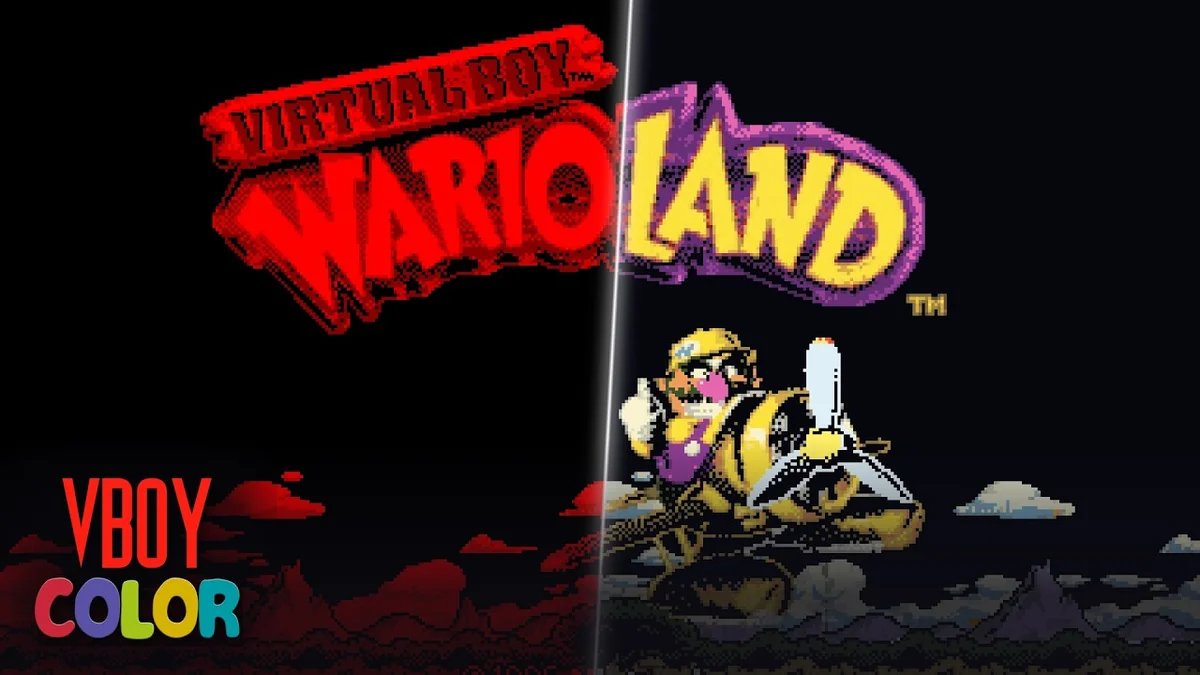
Released in 1995 and discontinued in less than a year, the Nintendo Virtual Boy has long been remembered as an eye-straining hardware oddity defined by its monochrome four-shade red-on-black display. Independent developer yuk27 is rewriting that legacy with VBoy Color, a free and open-source GPL-3.0 emulator that transforms the system's library into full color while preserving its original stereoscopic 3D depth.
Tile-by-Tile Tracking and Depth-Based Colorization Under the Hood
Whereas older Virtual Boy emulators typically relied on global screen tints or simple four-shade palette swaps that colored the entire frame uniformly, VBoy Color hooks directly into the video rendering pipeline. Built on top of the Beetle VB (Mednafen) emulation core and forked from the OpenXR and Vulkan foundation of VirtualBoyGo, the emulator records exactly which 8x8 graphics tile and background layer drew every individual pixel on screen.
This low-level tracking powers four distinct display modes:
- Auto Mode (Default): Every pixel is colored according to the element that drew it. Background layers receive depth-graded palettes ranging from dusk violet in the far plane to brick, amber, and sand up close, while character sprites receive their own multi-step palettes. For 3D vector and wireframe games drawn without standard tiles, such as Red Alarm and 3-D Tetris, the emulator calculates the stereoscopic parallax distance between the left and right eye images to color geometry dynamically from deep indigo in the distance to bright gold up close.
- Multicolor Mode: Inspired by the 3DS emulator Red Viper, this mode maps each of the hardware's four native brightness shades to a curated multi-hue palette.
- Gradient Mode: Maps screen brightness onto smooth multi-tone gradients including Jade, Ocean, Sunset, Ember, Frost, and Toxic.
- Tint Mode: Preserves the classic 1995 red-on-black aesthetic or lets players mix any custom monochrome tint.
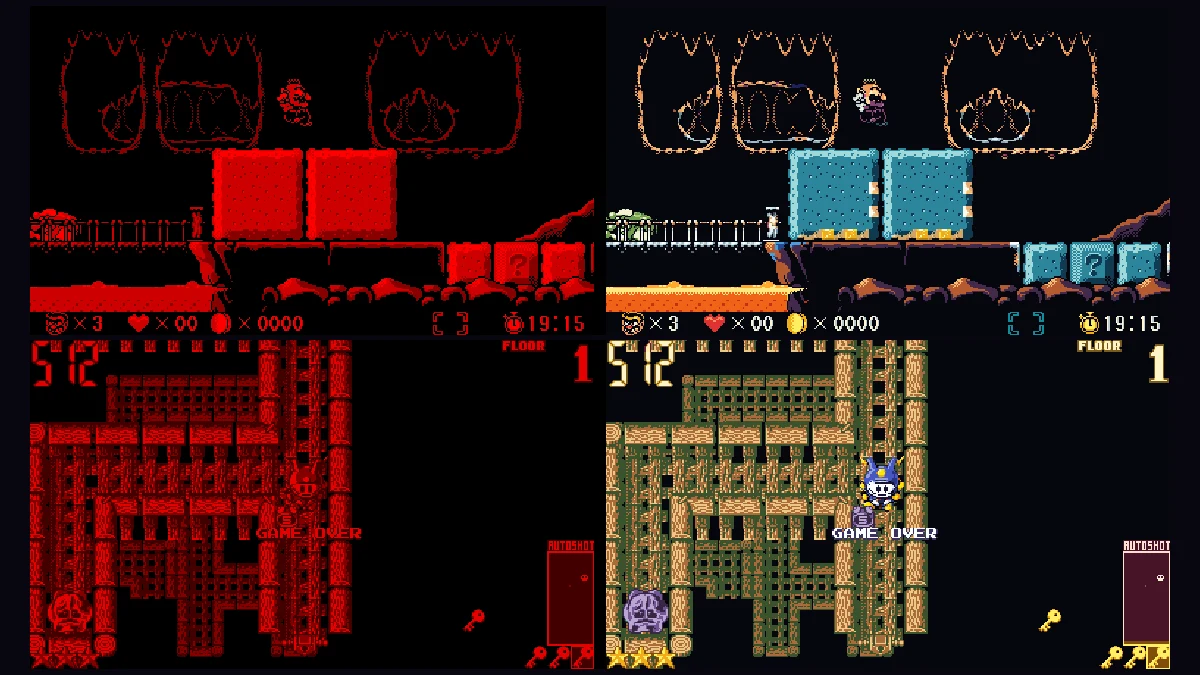
Thirteen Hand-Painted Color Packs Built In for Classic Virtual Boy Titles
Beyond automated depth coloring, the standout feature of VBoy Color is its support for custom Color Packs (.vbcp files). These packs assign hand-painted colors tile by tile to individual sprites, backgrounds, and UI elements. Because .vbcp files store only tile hashes and color mappings without any copyrighted ROM graphics, thirteen full-game packs ship directly inside the emulator.
Out of the box, players get tailored hand-painted colorization for Virtual Boy Wario Land, Jack Bros., Mario Clash, Mario's Tennis, Galactic Pinball, Teleroboxer, Bound High, Dragon Hopper, Innsmouth no Yakata, Panic Bomber, Space Invaders Virtual Collection, Vertical Force, and V-Tetris, alongside custom colored HUDs and menus for Red Alarm, 3-D Tetris, Virtual Bowling, and Golf.
The visual upgrade dramatically improves readability across rare cartridges whose collector prices can be tracked on the Retrocharting Virtual Boy price guide. In Virtual Boy Wario Land, cavern walls glow in warm orange, breakable blocks stand out in teal, and Wario wears his signature yellow cap, purple overalls, and white gloves even across the hub and minigames. In Jack Bros., Atlus mascot Jack Frost appears in crisp blue and white with hand-tuned facial details, while Mario Clash renders classic green pipes against grey ledges and brick walls.
Native Support Across Meta Quest, PC, Android Handhelds, and Nintendo Switch
VBoy Color is built to run both in virtual reality and on traditional flat screens. On standalone Meta Quest 2, Quest 3, Quest 3S, and Quest Pro headsets, as well as PC VR headsets via SteamVR, Quest Link, or Virtual Desktop, it delivers true stereoscopic 3D by rendering separate color-matched views for each eye, complete with mixed-reality passthrough so the virtual screen can float inside your room. On Quest 3, users can even run the display at 100 Hz to match an exact 2x multiple of the Virtual Boy's native 50 fps refresh rate.
Players without a VR headset can run native desktop and mobile builds on Windows 10/11, Linux, and Android phones, tablets, Android TV boxes, and dedicated retro handhelds from brands like Retroid, AYN, and Anbernic. On standard displays, stereoscopic depth remains accessible through side-by-side 3D output or Dubois-filtered anaglyph glasses (red/cyan, green/magenta, and amber/blue). In addition, a RetroArch (libretro) core is available for Windows, Linux, macOS, Android, and even homebrew-enabled Nintendo Switch consoles as of release v1.0.0-beta.12, reflecting the rapid momentum of community software engineering alongside recent milestones like the Nintendo Switch 2 ns2jb software exploit.
Rounding out the package are full RetroAchievements integration, customizable screen looks (Sharp pixels, Smooth OmniScale filtering, or an authentic LED scanline glow), Tool-Assisted Speedrun (.bk2) playback, and built-in PC capture tools (hotkeys F6 through F12) that export 3x PNG frames with .tiles maps so anyone can paint and import new color packs.
My Perspective
The Virtual Boy has always been trapped by a frustrating hardware contradiction: behind its awkward tabletop stand and searing red LEDs lay genuinely inventive action and platforming games, led by Virtual Boy Wario Land and Jack Bros. By tracking individual 8x8 tiles and using stereoscopic parallax to colorize depth planes, yuk27 solves the 1995 console's biggest visual flaw, where foreground hazards and background layers routinely bled into the same crimson wash. Playing these games in true stereoscopic 3D on a Meta Quest headset or an Android handheld with vibrant, hand-crafted palettes finally lets Nintendo's most misunderstood library shine on its own gameplay merits.

Based on the outskirts of New York City, Chaya 'Chayane' spent five years studying software engineering in Montreal before returning to her home state. A Full-Stack developer and Deep Learning AI architecture researcher, she explores neural networks and algorithmic optimization while engineering data pipelines for Retrocharting and Gamescharting alongside Grimtag. A gamer for over 20 years and an avid collector of Nintendo history and The Legend of Zelda, she explored World of Warcraft's Azeroth before bringing her deep technical background to video game analysis.