Beyond Loot Boxes: French Regulator Finds 39% of Teens Play Hybrid Casino Games Led by GTA Online and US Apps Like McLuck

While European digital storefronts are busy retroactively slapping PEGI 16 labels onto older games with paid loot boxes this fall, new empirical data from France's national gambling regulator shows that traditional loot crates are no longer the primary gambling gateway for teenagers.
Published by the Autorité Nationale des Jeux (ANJ) and the Excessive Gambling Research and Prevention Association (ARPEJ), the landmark ENJEU-Minors study surveyed 5,000 teenagers aged 15 to 17 to measure how "gamblification" operates across modern video games and mobile apps.
39.0% of Teens Play Hybrid Games, With GTA Online Ahead of Loot Boxes
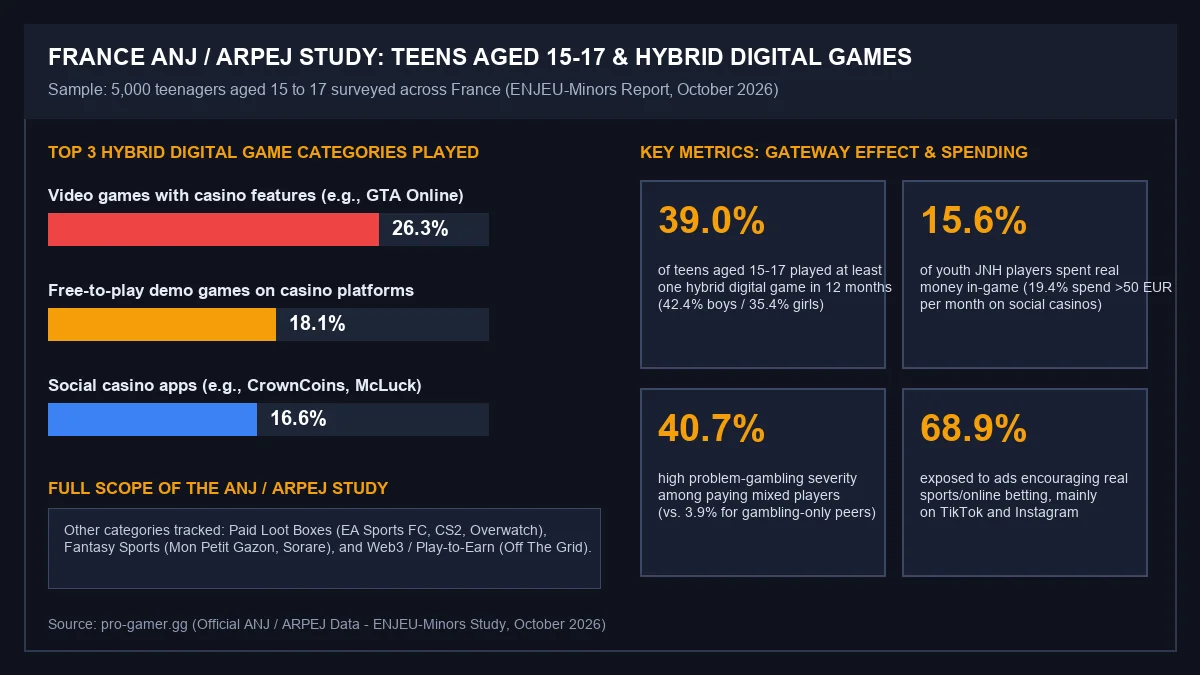
Across the 5,000-teen sample, 39.0% of 15-to-17-year-olds reported playing at least one "hybrid digital game" (jeu numérique hybride, or JNH) over the preceding 12 months, skewing higher among boys (42.4%) than girls (35.4%).
Rather than lumping every microtransaction together, researchers Marie-Line Tovar, Philippe Saliot, and Jean-Michel Costes tracked six distinct technical categories bridging gaming and real-money gambling:
- Video games with embedded casino mechanics (26.3%): Topping every other category, more than one in four teens played mainstream games featuring virtual roulette, blackjack, or slot machines, led by Grand Theft Auto Online and its Diamond Casino & Resort hub.
- Free-to-play casino demo portals (18.1%): Practice versions of real-money slots and table games hosted on sites such as VegasSlotOnline.
- Social and sweepstakes casino apps (16.6%): Mobile and browser platforms replicating Vegas slot machines with virtual tokens, with the French regulator specifically naming US-popularized operators CrownCoins and McLuck.
- Paid loot box titles: Randomized item containers and card packs in EA Sports FC Ultimate Team, Counter-Strike 2, Overwatch 2, and Genshin Impact.
- Fantasy sports platforms: Roster-prediction games tied to real-world athlete statistics, including Sorare, Mon Petit Gazon (MPG), and Fungiball.
- Web3 and Play-to-Earn (P2E) games: Blockchain and NFT-backed titles such as Off The Grid, The Sandbox, and Axie Infinity, which France now monitors under its experimental JONUM (Monetizable Digital Object Games) legal framework.
For American and international observers, the explicit inclusion of CrownCoins and McLuck alongside GTA Online and CS2 is striking. While US state attorneys general and the FTC have struggled to regulate sweepstakes casinos and opaque virtual currencies like Robux under a single federal standard, European regulators are now treating in-game casinos and social slots as part of the exact same behavioral funnel.
15.6% Spend Real Money as Problem-Gambling Severity Hits 40.7%
Among teenagers who play hybrid digital games, 15.6% spend real money on in-game currency, spins, or randomized packs. However, monthly spending habits diverge sharply depending on the genre.
While 38.7% of paying loot box players spend less than 10 euros ($11) per month, social casino players exhibit much heavier financial exposure: 19.4% of teens who pay in social casino apps spend more than 50 euros ($55) every month.
Even more concerning for regulators is the "gateway effect" into real-money gambling. Nearly six out of ten hybrid game players (58.8%) also participate in real-money gambling (sports betting, scratch cards, or lotteries), and two-thirds of underage gamblers reported playing hybrid casino-style video games before ever placing a real-money bet.
"This first-of-its-kind study in France highlights the porosity between real-money gambling and other digital games that incorporate gambling-like mechanics. It documents the growing 'gamblification' of digital games that resonate strongly with minors, while informing our regulatory oversight of emerging Web3 formats such as JONUM under the SREN law experiment."
Pascal Chèvremont, President of France's Autorité Nationale des Jeux (ANJ)
Measured using the Canadian Adolescent Gambling Inventory (CAGI / ICJA), 26.0% of "mixed" players (teens engaging in both hybrid video games and real-money betting) display a high problem-gambling severity score, compared to just 3.9% among teens who only engage in traditional lottery or scratch-card gambling.
When a teenager both plays mixed formats and spends real money inside hybrid digital games, that high-severity rate jumps to 40.7% (versus 14.1% for non-spending mixed players), correlating strongly with sleep disruption, anxiety, and mood disorders.

TikTok and Instagram Ad Targeting Meets a Parental Blind Spot
The report also pinpoints how social media algorithms accelerate the transition from virtual chips to real bookmakers. During their hybrid gaming activities, 68.9% of surveyed teenagers reported seeing advertisements pushing them toward real-money gambling, primarily on TikTok and Instagram.
At home, although 75.7% of teens say their parents are aware of their in-game spending, more than one in ten note that their parents underestimate or have no idea that real money can be spent inside these free-to-access ecosystems. With user-generated hubs and GTA clones multiplying ahead of 2027, ARPEJ director general Emmanuel Benoit warns that publisher retention loops, from daily prize wheels to near-miss audio cues, are conditioning underage players long before they reach legal casino age.

PC hardware enthusiast and competitive gamer, Arthur 'Heimdall' splits his time between France and the UK working in enterprise B2B software solutions. A business school graduate passionate about component benchmarking, he has been building, modding, and tuning PCs since childhood, optimizing every thermal degree and millisecond of display latency. An avid gamer across Assassin's Creed and sandbox titles, he forged his alliance with Grimtag and Chaya during late-night World of Warcraft raids before joining Pro-Gamer.