Outages Spread to PlayStation and Fortnite as U.S. Officials Rule Out Cyberattack and Point to AI-Driven Software Patches

Following a turbulent week of digital disruptions across commercial aviation, banking, and enterprise cloud suites, the wave of technical instability has spilled over into the video game industry. Short-lived service outages recently struck both the PlayStation network and Epic Games' Fortnite, prompting widespread public speculation about a coordinated cyberattack.
In response to growing concern, top U.S. national security and intelligence officials have stepped forward to rule out foreign hacking or state-sponsored sabotage. Instead, officials and cybersecurity analysts point to an unprecedented rush of emergency software patches driven by the rapid rise of artificial intelligence tools.
Marco Rubio and Jay Clayton Cite "Zero Evidence" of a Systemic Cyberattack
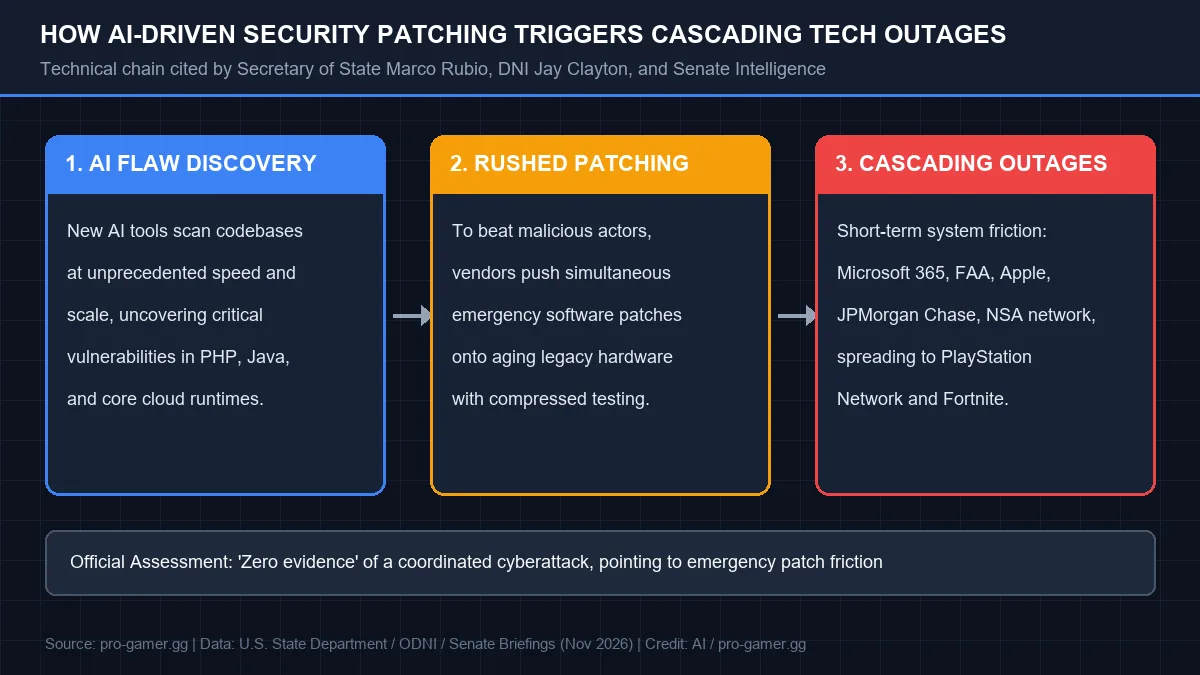
Speaking to reporters during an official trip to Manila, Philippines, U.S. Secretary of State and National Security Adviser Marco Rubio pushed back firmly against theories of a coordinated strike. According to briefings released via the U.S. Department of State, federal intelligence agencies have found "zero evidence whatsoever" linking the cascade of outages to foreign adversaries or criminal syndicates.
Rubio emphasized that the United States is "not under systemic attack," clarifying that the recent disruptions were separate, unconnected technical failures. Before reaching PlayStation services and Fortnite matchmaking lobbies, the string of glitches had hit Microsoft (disrupting Outlook and Teams), triggered a nationwide Federal Aviation Administration (FAA) ground stop, and delayed United Airlines operations.
Separate access issues also affected JPMorgan Chase online banking, Apple services, and an internal classified network at the National Security Agency (NSA). The cluster of gaming and consumer tech hiccups arrives at a moment when global backbone networks are already absorbing record-breaking 33 Tbps internet traffic surges across major exchange nodes.

The AI Patching Paradox: Flaws Discovered Faster Than Legacy Systems Can Adapt
To explain why so many unrelated platforms are experiencing service hiccups at the same time without a hostile breach, Director of National Intelligence (DNI) and White House AI czar Jay Clayton outlined a structural shift during congressional briefings. As noted in assessments from the Office of the Director of National Intelligence, new AI tools have dramatically accelerated the discovery of software vulnerabilities.
Security researchers and automated watchdogs are now using AI to scan massive codebases and uncover flaws in foundational programming languages such as PHP and Java at a fraction of the traditional time and cost. The gaming sector recently witnessed a preview of this dynamic during the emergency server shutdowns triggered by the critical PHP2Shell vulnerability, which forced multiple publishers offline to patch their backend databases.
To close these newly discovered security gaps before malicious actors can exploit them, cloud providers and gaming platforms are deploying heavy software patches at breakneck speed. As Marco Rubio noted, corporate efforts to rapidly plug security holes are at times "creating short-term disruption in the way the system works."
Senator Mark Warner Warns of Mounting Strain on Aging Infrastructure
On Capitol Hill, Senate Intelligence Committee leader Senator Mark Warner (D-Va.) highlighted the deeper operational dilemma facing both private tech companies and federal agencies. Organizations across every sector are under intense, simultaneous pressure to deploy intrusive security updates into core runtimes and authentication gateways, often compressing standard testing cycles.
During congressional testimony, Jay Clayton pointed out that while software capabilities and processing speeds are advancing rapidly, legacy hardware and underlying network equipment are aging much faster under the strain. When emergency patches alter kernel behavior or server clustering protocols on the fly, systems frequently fail to come back online cleanly after routine maintenance windows, resulting in login bottlenecks on PlayStation 5 and Fortnite.
For console and PC players alike, these brief service blackouts represent the collateral friction of an automated cybersecurity race where defensive patching moves faster than legacy server stability.
Check Availability PlayStation 5 Pro Availability on Amazon→
My Field Notes
Tracking these overnight infrastructure briefings from Quebec City, what stands out most is how completely the threat model for online gaming networks has flipped. For well over a decade, the primary nightmare for network engineers at Sony or Epic Games was a holiday DDoS flood aimed at login servers.
Now, live-service ecosystems are stumbling over their own defensive updates because AI scanners uncover critical code vulnerabilities faster than operations teams can regression-test their patches. Until backend server infrastructure catches up with the pace of automated vulnerability discovery, sudden thirty-minute authentication drops on PlayStation and Fortnite are going to be a recurring side effect of keeping the network secure.

Fortnite
Explore official trailers, technical specs and all latest coverage for Fortnite.

Originally from Lyon, France, gaming journalist Bastien "Orion" relocated nearly a decade ago to Quebec City's Saint-Roch district, right in the heart of eastern Canada's development studio hub. Before crossing the Atlantic, he honed his versatile reporting style across classic French gaming web portals and specialist television outlets in the 2000s and 2010s, notably with JeuxVideo.fr and JeuxNews. Equally passionate about AAA blockbusters, North American studio culture, retro preservation, and community modding projects, he anchors Pro-Gamer's transatlantic desk and real-time coverage of US and Japanese industry announcements.