AMD FSR 4.1.2 Lands in the Xbox Series X|S GDK: Exclusive Lite Model, 5.2 ms Series S Cost, and Mesa ACO Shader Compiler
Two weeks after AMD and Microsoft confirmed that machine-learning upscaling was headed to current-gen consoles, the actual code has arrived in developers' hands. With the release of the October 2026 Microsoft Game Development Kit (GDK v2610.0.9661), Redmond has officially enabled AMD FSR Upscaling 4 (version 4.1.2) for Xbox Series X and Xbox Series S development.
Delivered through the dedicated amd_fidelityfx_loader_xbox.dll library targeting Gaming.Xbox.Scarlett.x64, the neural upscaler does not work as a system-level toggle for older backward-compatible titles. Studios must explicitly integrate and tune FSR 4.1.2 within their DirectX 12 rendering pipelines through title updates or upcoming releases.
Full vs. Lite INT8 Models: An Xbox-Exclusive Optimization
Following the late-October rollout of INT8-based AMD FSR 4.1 across RDNA 2 hardware, Microsoft's official October 2026 GDK documentation details custom low-level console optimizations built alongside AMD. According to the Xbox engineering team, these hardware-specific tweaks deliver higher upscaling throughput per teraflop on Xbox Series X|S than desktop RDNA 2 graphics cards running the exact same Full INT8 neural model.
Even more importantly, Microsoft's official Xbox-GDK-Samples GitHub repository reveals two selectable INT8 model variants exclusive to Xbox consoles via the ffxXboxSetUseFsr4Lite API export: the default Full model and a brand-new Lite model.
Shrunk to less than half the size of the standard INT8 neural network, FSR 4 Lite was purpose-built for constrained compute budgets while retaining superior temporal stability and ghosting reduction over the older analytical FSR 3.1.6 algorithm. Developers can switch dynamically between FSR 4 Full, FSR 4 Lite, and FSR 3 at runtime across five scaling presets ranging from NativeAA (1.0x) and Quality (1.5x) down to Ultra Performance (3.0x).
Check Availability Xbox Series X Availability on Amazon→
Up to 5.2 ms on Xbox Series S and 304 MB of Dedicated VRAM
To help graphics programmers budget their frame times, Microsoft published official GPU pass costs in milliseconds (measuring the upscaler dispatch alone) across both consoles. Those numbers immediately explain why the Lite model is essential for the smaller Xbox Series S.
In a 60 FPS game, the entire frame budget sits at 16.67 milliseconds. Running the heavy FSR 4 Full model at a 1440p output on the 20-CU (4 TFLOPS) Xbox Series S consumes 5.2 ms by itself, eating nearly one-third of the total frame budget before scene geometry, lighting, or post-processing are even counted.
| Console | ML Model Variant (INT8) | Target Output Resolution | Upscaler Pass Time (ms) | Dedicated GPU Memory (4K Target) |
|---|---|---|---|---|
| Xbox Series X (52 CUs / 12 TFLOPS) | FSR 4 Lite | 1440p | 1.29 ms | 304.03 MB |
| Xbox Series X (52 CUs / 12 TFLOPS) | FSR 4 Lite | 4K (2160p) | 2.75 ms | 304.03 MB |
| Xbox Series X (52 CUs / 12 TFLOPS) | FSR 4 Full | 1440p | 1.95 ms | 304.03 MB |
| Xbox Series X (52 CUs / 12 TFLOPS) | FSR 4 Full | 4K (2160p) | 3.86 ms | 304.03 MB |
| Xbox Series S (20 CUs / 4 TFLOPS) | FSR 4 Lite | 1080p | 1.90 ms | Resolution-dependent |
| Xbox Series S (20 CUs / 4 TFLOPS) | FSR 4 Lite | 1440p | 3.40 ms | Resolution-dependent |
| Xbox Series S (20 CUs / 4 TFLOPS) | FSR 4 Full | 1080p | 2.90 ms | Resolution-dependent |
| Xbox Series S (20 CUs / 4 TFLOPS) | FSR 4 Full | 1440p | 5.20 ms | Resolution-dependent |
Switching to FSR 4 Lite drops the Series S pass time down to a much more manageable 1.9 ms at 1080p and 3.4 ms at 1440p. Meanwhile, the 52-CU Xbox Series X reconstructs a 4K output (from a 1440p internal render in Quality mode) in 2.75 ms using FSR 4 Lite and 3.86 ms using FSR 4 Full.
That 2.75 ms to 3.86 ms window is remarkably competitive for a 2020 RDNA 2 chip without dedicated matrix cores, especially when compared with Sony's 2 ms PSSR 2 pass on the 300 TOPS PS5 Pro and 4.4 ms QSSR pass on the base PS5. On the memory side, both Full and Lite variants allocate the exact same intermediate buffer footprint: 304.03 MB of dedicated GPU memory (318,799,872 bytes, with zero aliasable memory) when targeting 4K output from a 1440p render.
Mesa's ACO Shader Compiler (+16% Speedup) and MSIXVC2 Default Packaging
Beyond machine-learning upscaling, the October 2026 GDK introduces a second major low-level boost for Xbox Series X|S: an experimental AMD Compiler (ACO) for console shaders. Adapted directly from the open-source Mesa ACO shader compiler on Linux originally championed by Valve for SteamOS, this tool gives studios an alternative to the standard Xbox shader compiler.
In Microsoft's initial benchmarks across partner studios, compiling shaders through ACO has delivered between 2% and 16% improvements in both compilation speed and runtime GPU performance depending on engine bottlenecks.
Finally, GDK version 2610.0.9661 promotes the MSIXVC2 packaging format to general availability as the default standard for Windows PC games on the Microsoft Store and PC Game Pass. Byte-level change tracking cuts patch download sizes by 64% to 94% while reducing hash-tree overhead by over 90%, alongside new Publisher Content packages that let studios host and update game files directly from their own CDNs.
My Perspective on the Spec Sheet
Microsoft's official GDK telemetry finally puts hard millisecond numbers on what INT8 neural upscaling actually costs on RDNA 2 console silicon. A 5.2 ms raw dispatch time for the Full model at 1440p on Xbox Series S is simply too steep for fast-paced 60 FPS shooters where input latency is king, which makes the custom Lite model at 1.9 ms (1080p) and 2.75 ms (4K on Series X) the real star of this release, especially when paired with a free 2% to 16% shader boost from Mesa's ACO compiler.
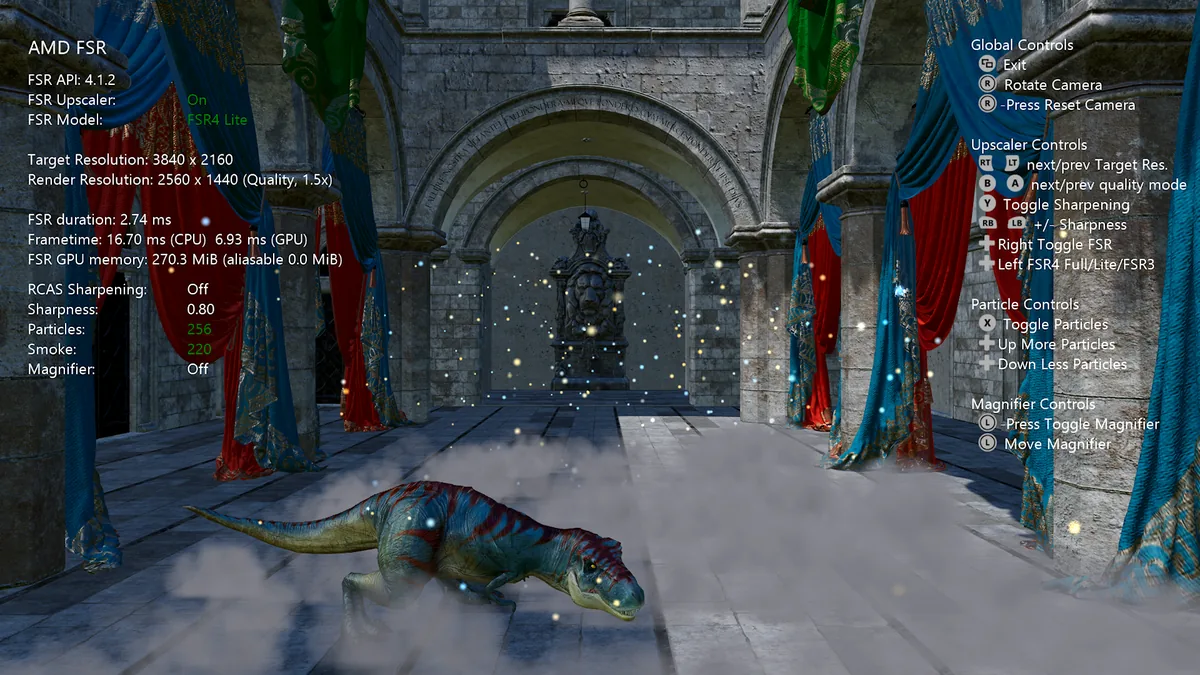
This initial breakdown relies on Microsoft's official Sponza sample metrics and GDK v2610.0.9661 release notes, so we still need to verify real-world frame pacing, particle disocclusion stability, and the 304 MB VRAM trade-off once the first commercial Unreal Engine 5 titles patch in FSR 4.1.2. If the engineering teams at Xbox or AMD want to share PIX profiling captures or early test builds with our lab, our HDMI 2.1 frame-analysis rig is ready to put both Full and Lite models through a full pixel-by-pixel stress test.

Based on the outskirts of New York City, Chaya 'Chayane' spent five years studying software engineering in Montreal before returning to her home state. A Full-Stack developer and Deep Learning AI architecture researcher, she explores neural networks and algorithmic optimization while engineering data pipelines for Retrocharting and Gamescharting alongside Grimtag. A gamer for over 20 years and an avid collector of Nintendo history and The Legend of Zelda, she explored World of Warcraft's Azeroth before bringing her deep technical background to video game analysis.