$0.64 per GB Yet 6.5x More Wafers: Why AI Server HBF Memory Kills Any Hope for Cheaper NVMe SSDs
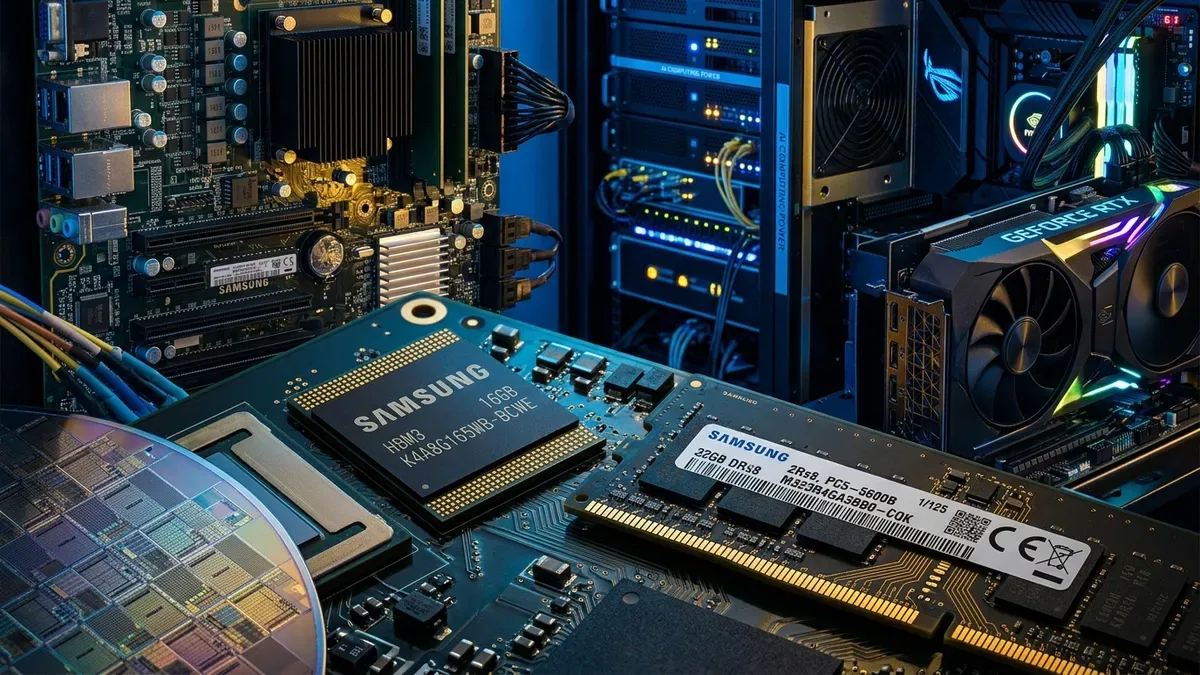
Waiting for consumer PC and console storage prices to drop back down to historical lows is rapidly becoming a losing bet. Just as builders were hoping for relief on M.2 NVMe SSD pricing in late 2026, an emerging memory tier engineered for artificial intelligence data centers is threatening to drain global flash fabrication lines: HBF (High Bandwidth Flash). According to a new semiconductor supply chain and cost analysis from Bernstein Research, an 8-Hi HBF stack costs just $0.64 per gigabyte to produce, yet consumes a staggering 6.5 times more silicon wafers per gigabyte than standard TLC NAND.
HBF vs. HBM4: One-Tenth the Cost per Gigabyte for AI Inference
Spearheaded by SanDisk and SK hynix and recently standardized through the Open Compute Project (OCP) alongside Google and Tenstorrent using UCIe interconnects, High Bandwidth Flash applies 3D vertical stacking directly to NAND flash dies. Much like DRAM-based HBM, an HBF module stacks eight or sixteen 3D NAND dies linked by thousands of Through-Silicon Vias (TSVs) and bonds them directly onto a base logic controller die using CBA (CMOS directly Bonded to Array) technology.
While raw NAND flash cells remain orders of magnitude slower than DRAM in random access, AI inference workloads (such as hosting massive model weights, Mixture-of-Experts (MoE) routing tables, and KV caches) are overwhelmingly read-heavy. By scheduling thousands of simultaneous read operations across stacked dies through massive parallelism, the HBF logic die delivers aggregate bandwidths between 0.4 TB/s and 3.0 TB/s.
From a data center balance sheet perspective, the cost gap is transformative. Bernstein Research estimates that an 8-Hi HBF stack costs roughly $0.64 per GB (built on a base-case raw die cost near $0.22/GB), compared to $6.78 per GB for a comparable 8-Hi HBM4 stack. Offering ten times lower cost per gigabyte for high-capacity AI inference makes HBF irresistible to cloud hyperscalers, extending the exact fab bottleneck we examined in SK hynix's warning over memory shortages lasting until 2030.
The 6.5x Wafer Drain: How Consumer M.2 SSDs Pay the Silicon Tax
Why does a memory technology that costs one-tenth as much as HBM4 spell bad news for your next PC or PlayStation 5 SSD upgrade? Because inside a 300mm semiconductor cleanroom, HBF is extraordinarily silicon-hungry. Bernstein Research calculates a 6.5x wafer multiplier: manufacturing 1 GB of HBF consumes 6.5 times the silicon wafer area of 1 GB of ordinary TLC NAND used in consumer M.2 SSDs.
This 6.5x silicon penalty is the product of three compounding architectural trade-offs:
- The SLC vs. TLC Cell Penalty (2.9x multiplier): To hit high read throughput and sustain endurance under continuous server workloads, HBF operates cells in single-level cell (SLC) mode storing just one bit per cell, rather than the denser three-bit-per-cell (TLC) design used in gaming SSDs.
- The Die Area Penalty (1.725x multiplier): Carving out silicon real estate for thousands of vertical TSV interconnects and high-speed I/O wiring significantly inflates the footprint of each individual NAND die.
- The Stacking Yield Loss Penalty (1.3x multiplier): Advanced multi-die vertical stacking and hybrid CBA bonding introduce a 1.3x yield penalty compared to conventional planar packaging (2.9 × 1.725 × 1.3 ≈ 6.5).
The Jevons Paradox Hits PC and PS5 Storage
In semiconductor economics, this cost-to-wafer ratio triggers a textbook case of the Jevons paradox: slashing the per-gigabyte cost of high-bandwidth AI memory from $6.78 to $0.64 does not save wafer capacity, it unleashes an explosion in total demand. As hyperscalers deploy HBF en masse to keep larger models resident in near-compute memory, NAND fabricators including Samsung, SK hynix, SanDisk, and Kioxia are heavily incentivized to divert 300mm NAND wafer starts away from lower-margin consumer M.2 drives.
PC builders have already watched this exact scenario play out across system memory, where HBM wafer reallocation drove up DDR5 and legacy DRAM pricing, a ripple effect we recently saw when the 16GB Raspberry Pi 5 surged to $385 due to the LPDDR4X memory crunch. That upward pressure is already visible on retail shelves in November 2026: flagship PCIe 4.0 drives like the 2TB Samsung 990 PRO now regularly trade around $390 on promotion (against a $640 retail ceiling), far above the bargain prices seen before the AI storage boom.
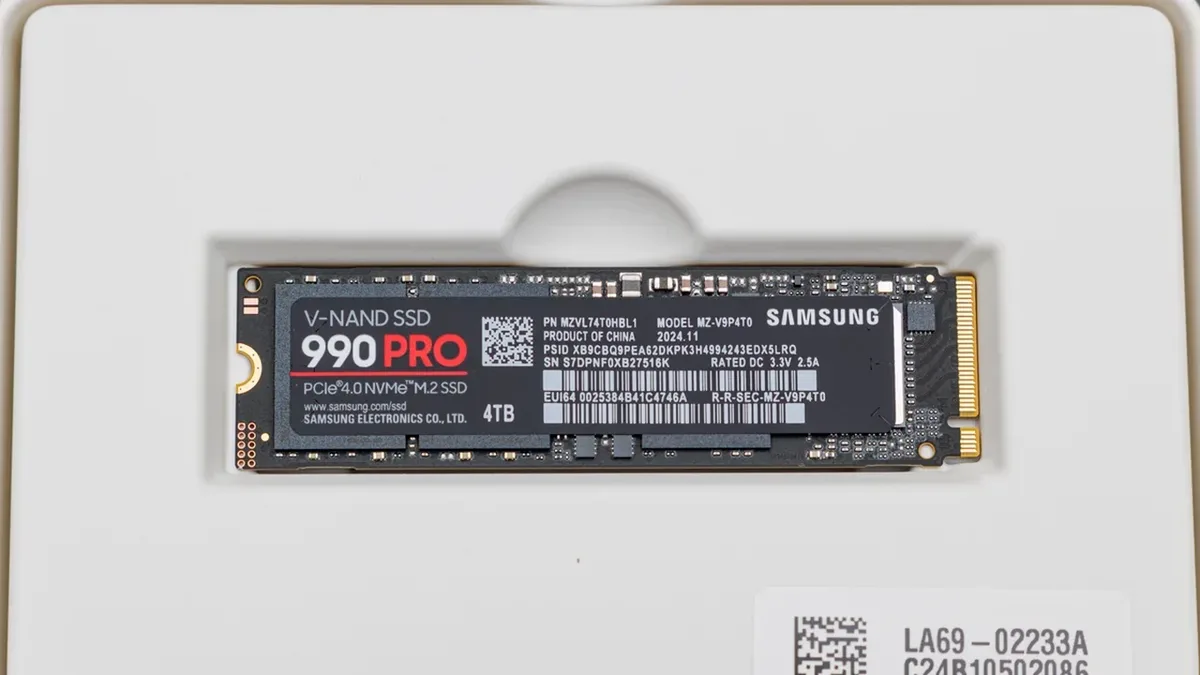
Samsung 990 PRO 2TB PCIe 4.0 NVMe M.2 SSD
- 2TB V-NAND TLC
- PCIe 4.0 x4 NVMe 2.0 (M.2 2280)
- Read 7,450 MB/s
- Write 6,900 MB/s
- PC and PS5 Compatible
My Take on This Memory Architecture
Looking at the HBF wafer math, I am seeing the exact same playbook that strangled the consumer RAM market over the past eighteen months. After cannibalizing DRAM wafer capacity to feed HBM3e and HBM4 stacks, sending desktop DDR5 and GPU GDDR7 prices into orbit, AI infrastructure giants are now coming directly for our NAND flash wafers. When an AI server stack consumes 6.5 times more silicon per gigabyte than standard TLC NAND while commanding data center margins, fab executives will not hesitate to reallocate their cleanrooms. If you need a 2TB or 4TB M.2 NVMe upgrade for your gaming rig or PS5 ahead of next year's 200GB+ blockbusters, my advice is straightforward: lock in a drive during the first decent autumn discount you spot, because NAND fabs are shifting their priority away from consumer gaming hardware.

PC hardware enthusiast and competitive gamer, Arthur 'Heimdall' splits his time between France and the UK working in enterprise B2B software solutions. A business school graduate passionate about component benchmarking, he has been building, modding, and tuning PCs since childhood, optimizing every thermal degree and millisecond of display latency. An avid gamer across Assassin's Creed and sandbox titles, he forged his alliance with Grimtag and Chaya during late-night World of Warcraft raids before joining Pro-Gamer.