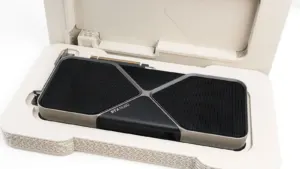
1.6 GHz Instead of 3.04 GHz: Why the ASUS XG Core Radeon RX 9060 XT LP Halves Its Boost Frequency Within a 75W Envelope
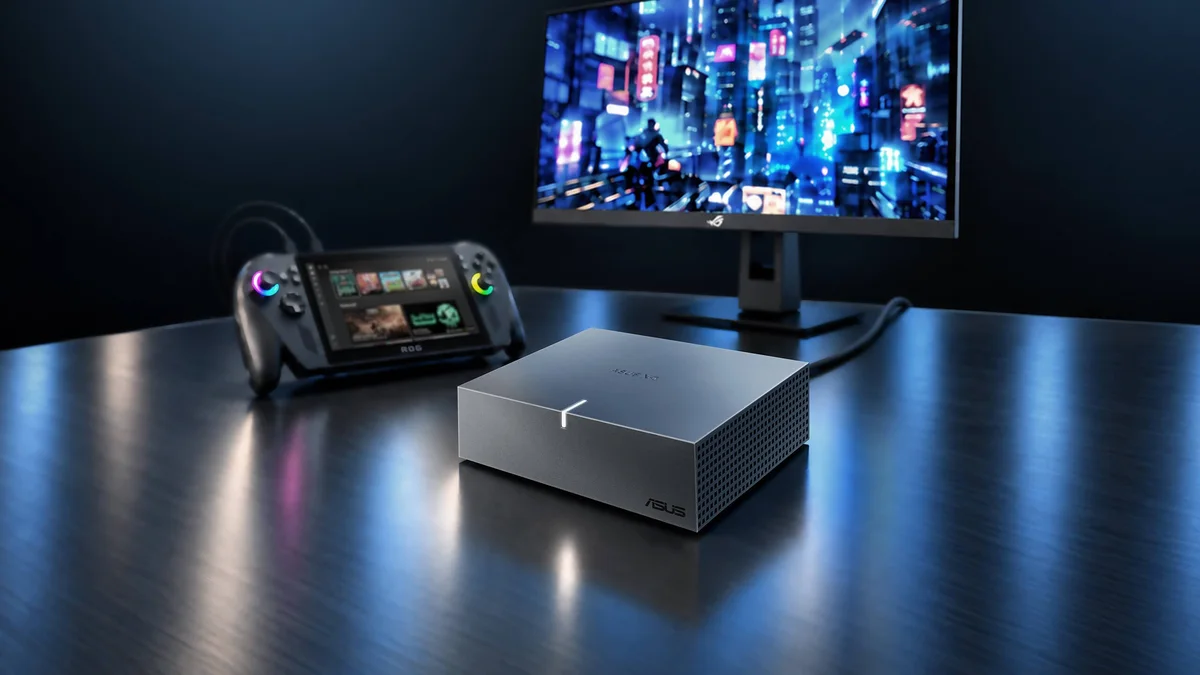
Packing a modern desktop-class graphics processor with 16GB of dedicated video memory into a strict 75W power envelope demands immediate physical trade-offs. With the latest update to the official ASUS XG Core Radeon RX 9060 XT LP specification page, the hardware maker has revealed the exact cost of that miniaturization: operating frequencies cut nearly in half compared to standard desktop graphics cards.
A Full 2,048-Core AMD Navi 44 GPU Constrained Within a 75W Ceiling
First shown at Gamescom 2026 as a sleeker, travel-friendly alternative to the ROG XG Mobile family, the ASUS XG Core Radeon RX 9060 XT LP 16GB GDDR6 (model XG-CORE-RX9060XT-LP-16G) houses a low-profile variant of AMD's Navi 44 XTLP silicon built on the RDNA 4 architecture. Rather than disabling compute clusters to save power, ASUS and AMD kept the entire execution engine intact.
Inside the enclosure sits the full configuration of 2,048 Stream Processors (all 32 RDNA 4 Compute Units enabled), paired with 16GB of GDDR6 memory running at 20 Gbps across a 128-bit memory interface. While board partners have already been spotted preparing a PowerColor Radeon RX 9050 8GB Low Profile facing the 75W PCIe slot dilemma for entry-level builds, this RX 9060 XT LP implementation retains its full 16GB VRAM buffer and delivers up to 406.3 AI TOPS (INT4 Matrix Sparsity) to accelerate local AI models alongside gaming workloads.
The defining hardware constraint of this low-profile design lies in its power delivery. Whereas a standard desktop Radeon RX 9060 XT draws between 140W and 182W through a dedicated 8-pin PCIe power cable, the GPU inside the XG Core is powered entirely through its internal PCIe slot without any auxiliary PCIe power connectors. Even more demanding, the 75W total power limit covers the entire unit,including both the Navi 44 XTLP graphics processor and the internal 40Gbps USB4 controller that links the dock to laptops, gaming handhelds, and mini-PCs.
1,010 MHz Game Clock and 1,600 MHz Boost: The Price of Slot-Powered Efficiency
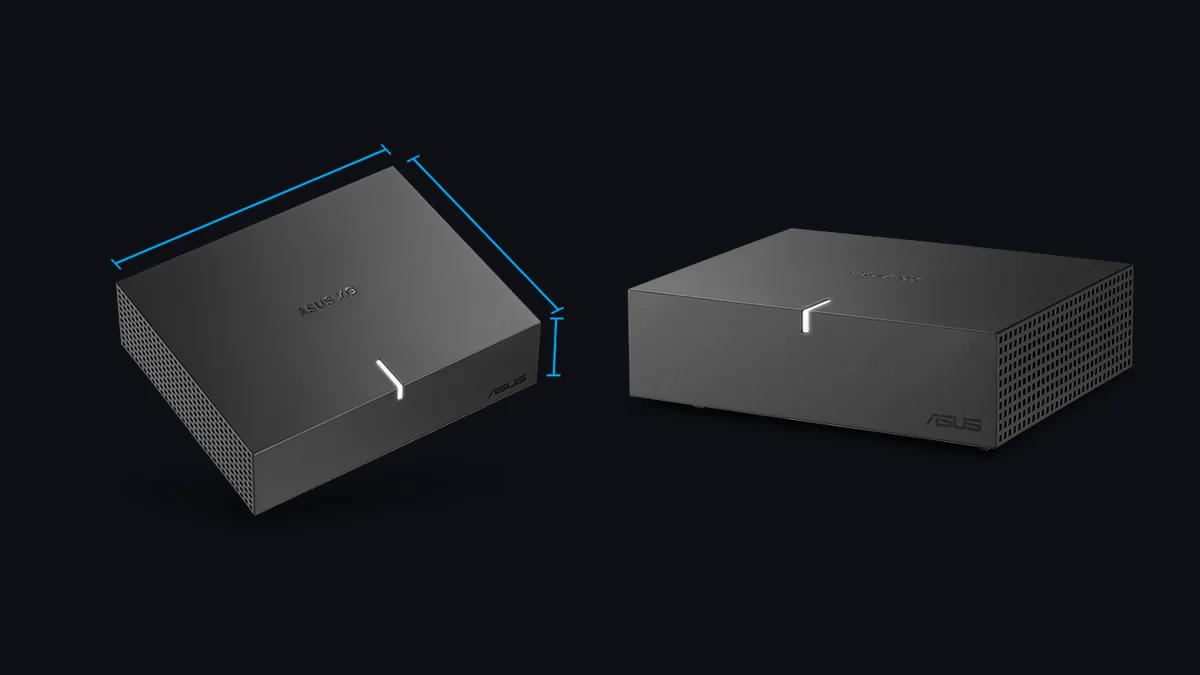
To prevent power spikes and keep thermals under control inside a compact 144 × 117 × 39 mm shell, ASUS engineers aggressively pulled back the RDNA 4 voltage-frequency curve. The newly published clock speeds stand in stark contrast to typical desktop Radeon RX 9000 figures:
- Default Mode: a 1,010 MHz Game Clock and a maximum Boost Clock of up to 1,600 MHz.
- OC Mode (via ASUS GPU Tweak III): a 1,030 MHz Game Clock (+20 MHz) and a maximum Boost Clock of up to 1,620 MHz (+20 MHz).
- Standard Desktop / RX 9060 XT LP Comparison (140W-160W): a 1,380 MHz base clock (nearly 37% higher) and a Boost Clock reaching 3,040 MHz to 3,130 MHz.
That represents nearly a 47% reduction in peak boost frequency compared to a full-power desktop card. It sits at the opposite end of the spectrum from what unlocked RDNA 4 silicon can achieve when given ample headroom, such as the Radeon RX 9070 GRE pushed to 3.9 GHz on AMD's RDNA 4 silicon. Here, enabling OC Mode in GPU Tweak III adds a token 20 MHz, as the hard 75W ceiling leaves virtually zero room for higher voltage states.
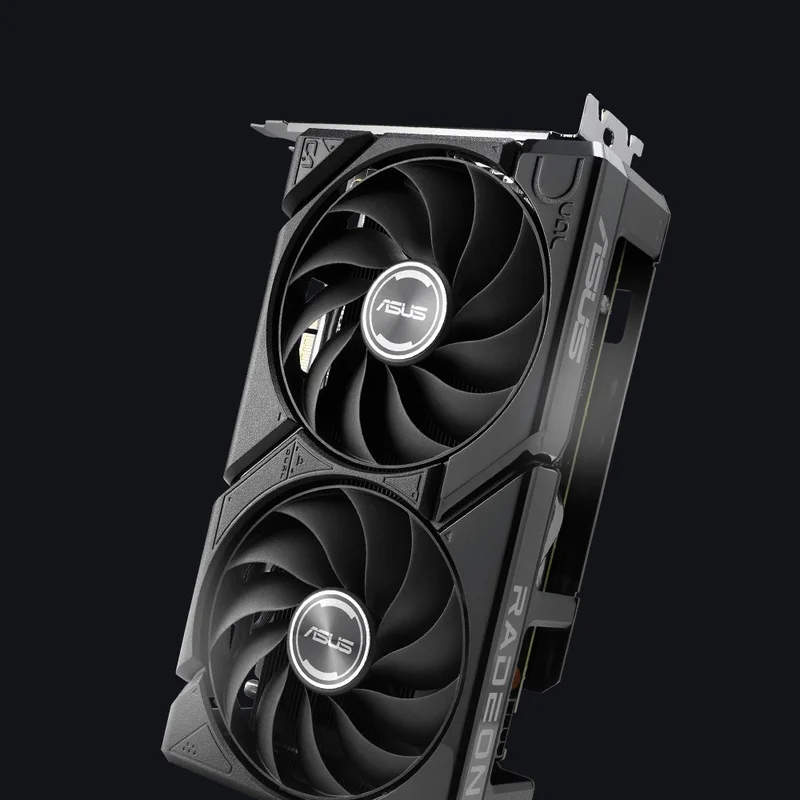
ASUS Dual Radeon RX 9060 XT 16GB GDDR6
- Full AMD Navi 44 RDNA 4 GPU (2,048 Cores)
- 16GB GDDR6 20 Gbps on 128-bit Bus
- Full Desktop Boost Clocks (over 3.0 GHz)
- Dual Axial-tech Fan Cooling Design
40Gbps USB4 Connectivity, Native Display Outputs, and Target Workloads
Despite the steep frequency cut, the ASUS XG Core Radeon RX 9060 XT LP targets a specific audience: owners of thin-and-light notebooks, compact mini-PCs lacking an internal PCIe slot, and portable gaming handhelds equipped with a 40Gbps USB4 / USB-C port. Setup is completely plug-and-play, requiring no chassis disassembly or bulky workstation power bricks.
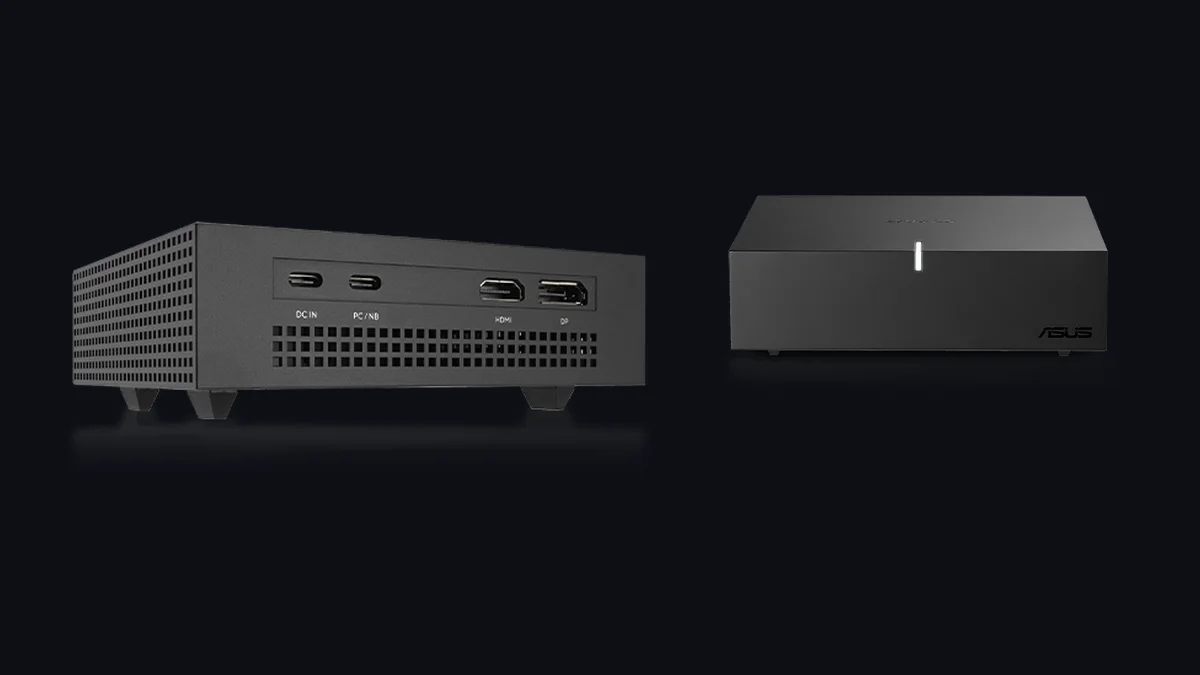
Along the rear panel, the I/O layout provides everything needed to drive up to two external monitors simultaneously at up to 4K (3840 × 2160) resolution with HDCP 2.3 support:
- 1x USB Type-C (PC/NB): 40Gbps data connection to the host laptop, handheld, or mini-PC.
- 1x USB Type-C (DC IN): dedicated power input (bundled with a USB-C DC cable, power cord, USB-C data cable, and adapter).
- 1x Native HDMI 2.1b and 1x Native DisplayPort 2.1a output.
Check Availability for Radeon RX 9060 XT 16GB Graphics Cards on Amazon→
My Take on the Spec Sheet
At first glance, dropping from 3,040 MHz down to 1,600 MHz looks like a brutal cut. From an electrical engineering standpoint, however, ASUS's approach makes a lot of sense. GPU power scaling is never linear: pushing silicon through its final 30% of clock speed past 2.5 GHz requires a steep voltage wall that nearly doubles power draw. By keeping the full 2,048-core Navi 44 die,and crucially its full 16GB of 20 Gbps GDDR6 memory,running around 1.6 GHz, ASUS places the RDNA 4 architecture right in its efficiency sweet spot. We have not had this unit on our test bench yet to measure real-world thermals or how much the 40Gbps USB4 tunnel bottlenecks frame pacing, so we will wait for hands-on testing before rendering a final verdict. Still, for boosting a handheld or mini-PC at 1080p/1440p and running memory-hungry local AI models without a 200W space heater on your desk, running a wider GPU at lower clocks beats a heavily cut-down chip screaming at redline. We have not yet had a physical unit on our desk,if the manufacturer's team would like to send over a review sample so we can put it through our full real-world testing protocol, our lab doors are wide open.

PC hardware enthusiast and competitive gamer, Arthur 'Heimdall' splits his time between France and the UK working in enterprise B2B software solutions. A business school graduate passionate about component benchmarking, he has been building, modding, and tuning PCs since childhood, optimizing every thermal degree and millisecond of display latency. An avid gamer across Assassin's Creed and sandbox titles, he forged his alliance with Grimtag and Chaya during late-night World of Warcraft raids before joining Pro-Gamer.