ASRock AMD BC-250 Mining Board Mod: How the Salience Project Unlocks a 40-Unit RDNA 2 GPU from Half-Price PlayStation 5 Silicon
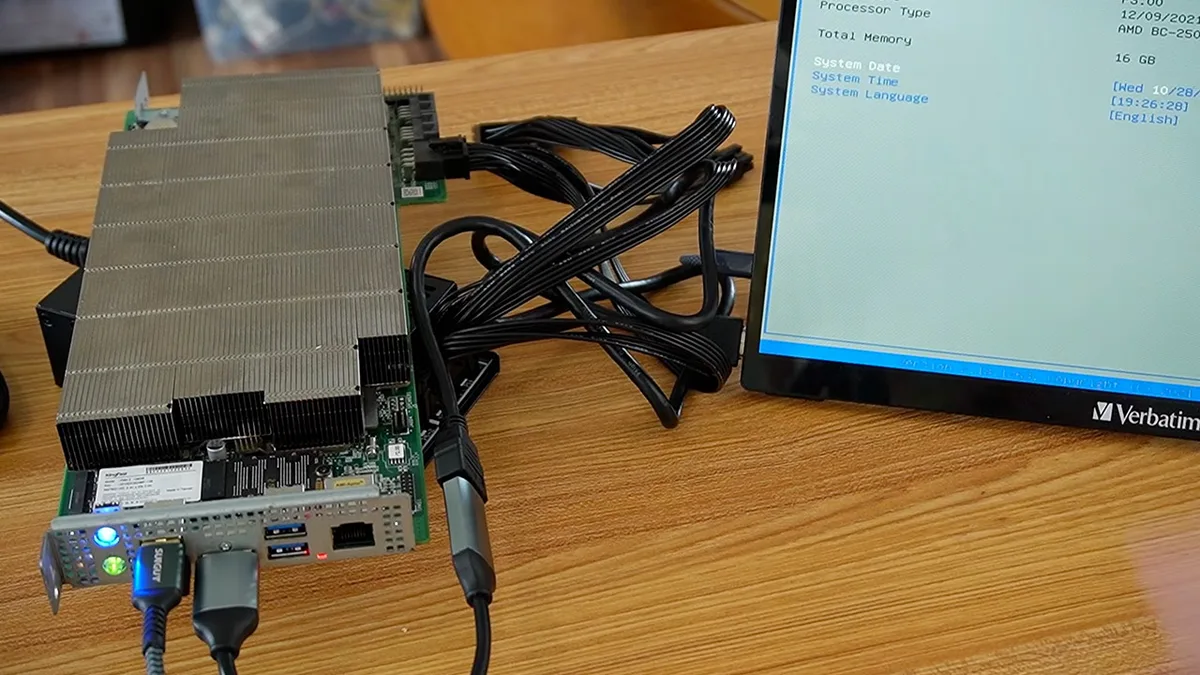
After two recent PlayStation 5 price hikes pushed Sony's Digital Edition console close to the $600 mark and ongoing memory supply constraints wiped out hopes for late-generation discounts, hardware modders have carved out a clever alternative from industrial e-waste. Highlighted by tech creator Salience (Wyatt Holm) alongside open-source tools built by the bc250-collective community, a DIY hardware project is turning surplus ASRock AMD BC-250 cryptocurrency mining motherboards into compact Linux gaming PCs for roughly half the price of a retail console.
From 2022 Ethereum Racks to Sony's Custom Cyan Skillfish PS5 Silicon
These single-board systems originally rolled off assembly lines around 2022 during the height of the cryptocurrency boom. Designed by ASRock to populate high-density Ethereum mining server racks, the AMD BC-250 is built around a semi-custom AMD APU codenamed Cyan Skillfish, derived directly from the Ariel silicon die that powers the PlayStation 5. Once Ethereum transitioned away from Proof-of-Work mining, thousands of racks became obsolete overnight, flooding Chinese surplus vendors and secondhand marketplaces with bare boards priced between $100 and $200.
Beneath its massive passive aluminum server heatsink sits the exact architectural foundation of Sony's current-generation console: a 7nm AMD Zen 2 processor paired with RDNA 2 graphics and 16GB of unified GDDR6 memory across a 256-bit bus shared between the CPU and GPU. Out of the box, factory firmware restricts the mining variant to 6 active CPU cores (12 threads) and 24 graphics Compute Units (CUs) in order to salvage partially defective dies and cap rack power draw.
Unlocking All 8 Zen 2 Cores and 40 RDNA 2 Compute Units on Bazzite Linux
What makes the community effort documented across elektricM's GitHub repositories and the BC250 Control Center utility so compelling is that the physical silicon still houses all 8 Zen 2 cores (16 threads) and 40 RDNA 2 Compute Units. By comparison, a standard retail PlayStation 5 only enables 36 of the 40 CUs physically etched onto its die.
Because AMD never released official Windows graphics drivers for this enterprise mining chip, the entire software stack relies on gaming-focused Linux distributions such as Bazzite OS or CachyOS. The software pipeline mirrors how Bazzite Linux turns the PS5 into a Steam Machine, except the standalone ASRock BC-250 motherboard is completely free from Sony's hypervisor locks and firmware restrictions.
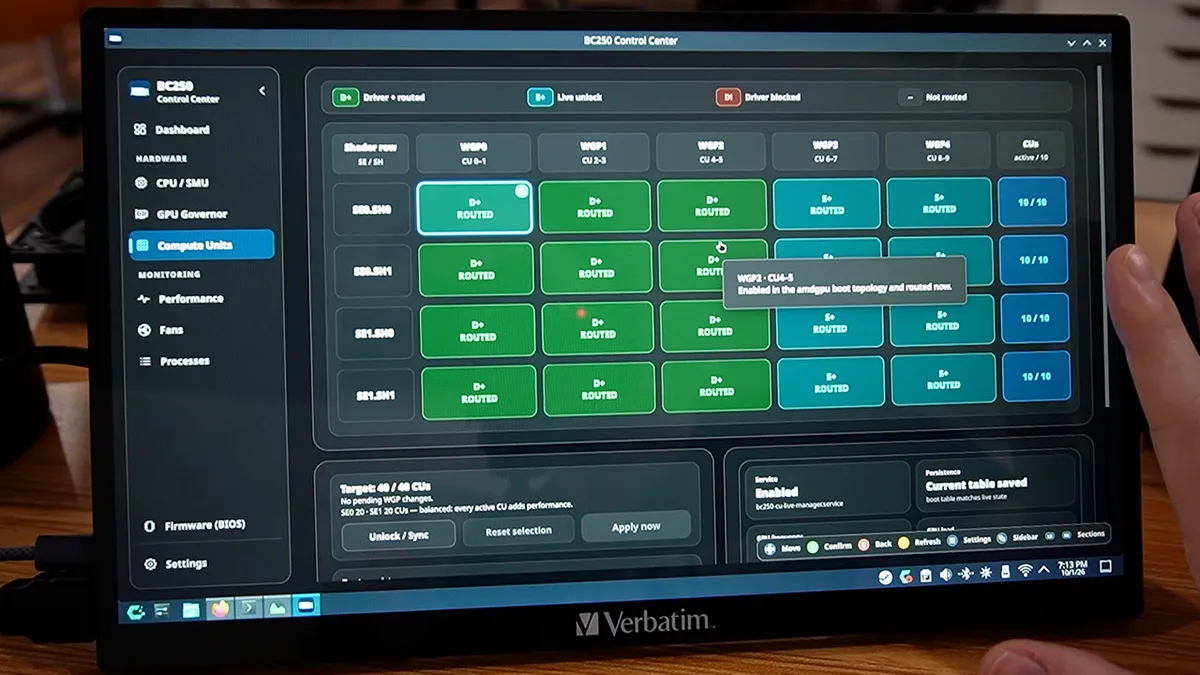
Without permanently flashing or risking hardware damage to the board, community scripts handle the unlock dynamically during system initialization:
- CPU Core Validation: A startup script verifies electrical stability on the two dormant Zen 2 cores before re-enabling them for a full 8-core, 16-thread configuration.
- 40-CU GPU Register Routing: A second tool (managed via
bc250-cu-live-manager.service) sets two graphics registers as the Linuxamdgpudriver loads, exposing all 40 RDNA 2 Compute Units to the operating system.
Silicon lottery still plays a decisive role: since many of these chips were binned for mining due to minor manufacturing defects, not every board can sustain the full 40-CU unlock. Some units top out at 32 or 36 active Compute Units, though users can immediately revert the routing table in software if visual artifacts or crashes occur.
Hardware Assembly, Flex-ATX Power, and 3D-Printed Enclosure for $250 to $300
Turning a bare server blade into a living-room rig requires a few custom hardware touches. For his build, Salience used the 3D-printed enclosure files and wiring guides created by maker John Till (Pocket Adventures). On the I/O panel, the board provides a single DisplayPort 1.4 video output, USB ports, Gigabit Ethernet, and one M.2 slot supporting both NVMe and SATA SSDs.
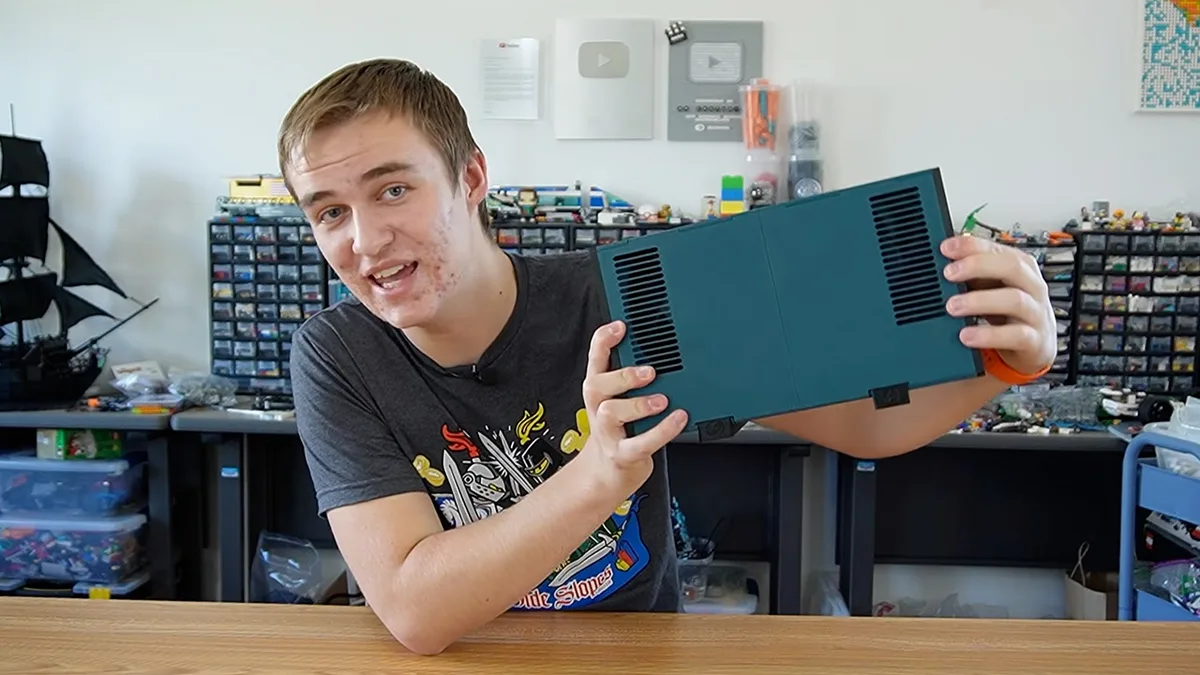
Power delivery demands a clean, steady 12-volt rail fed through a standard 8-pin PCIe power connector alongside two smaller auxiliary plugs. Salience pairs the board with a compact 500W Flex-ATX power supply (Apevia ITX-PFC500W). Because the factory passive heatsink was engineered to sit inside a high-static-pressure server rack, builders must apply fresh thermal paste and mount two 120mm cooling fans directly onto the 3D-printed shell to tame the extra heat output once all 40 CUs are firing.
Factoring in the secondhand BC-250 board, a Flex-ATX power supply, an M.2 SSD, cooling fans, and the 3D-printed case, the complete build comes in between $250 and $300,roughly half the outlay of a brand-new PlayStation 5 Digital Edition.
Check Availability for M.2 SSDs and Flex-ATX PSUs on Amazon→
1080p Gaming Benchmarks: Stock 24 CUs vs Unlocked 40 CUs
After partitioning the 16GB pool of unified GDDR6 memory between system RAM and VRAM in the BIOS, testing at 1080p on High settings through Steam on Linux shows substantial frame rate gains once the extra CPU cores and Compute Units are unlocked:
- Grand Theft Auto V: Frame rates jump from a modest 58 FPS on stock settings (6 cores / 24 CUs) to a smooth 72 FPS with all 8 cores and 40 CUs enabled (+24%).
- Hitman 3 (World of Assassination): Performance climbs from 58 FPS to 69 FPS at 1080p High.
- Marvel's Spider-Man 2: Frame rates rise from a choppy 36 FPS at default clocks to a far more playable 46 FPS after the full unlock (+27%).
- Cyberpunk 2077: Runs smoothly at 1080p by dialing down a few crowd and shadow settings while enabling AMD FidelityFX Super Resolution 2 (FSR 2) in Balanced mode.
Key Hardware Trade-Offs Compared to a Retail PlayStation 5
Even with all 40 Compute Units active, a modified BC-250 rig still trails a retail PlayStation 5 in raw frame pacing across the heaviest current-gen titles. Two hardware bottlenecks explain the gap: conservative core clock speeds compared to Sony's aggressive variable-frequency boost profile, and an M.2 storage slot limited to PCIe 2.0 speeds that cannot match the PS5's bespoke PCIe 4.0 SSD controller.
Builders also have to work around a permanent silicon limitation: AMD's hardware video encoding and decoding engine (VCN / Video Core Next) is fused off on these mining chips. All media playback and video streaming rely entirely on software decoding across the Zen 2 CPU cores, while 3D gaming leans heavily on the rapid evolution of the open-source Linux Vulkan stack, which continues to gain optimizations as seen in the recent Mesa 26.2.6 RADV driver release.
My Perspective on the Spec Sheet
We haven't had the ASRock AMD BC-250 board or Salience's 3D-printed enclosure on our lab test bench yet to measure sustained VRM thermals and acoustic levels under load, but looking strictly at the silicon and price-to-performance ratio, this mod is a standout achievement. Getting a 256-bit unified 16GB GDDR6 memory bus paired with up to 40 RDNA 2 Compute Units under Bazzite Linux for under $300 easily outmuscles any new budget mini-PC running a bandwidth-starved Radeon 780M or 890M iGPU on standard system RAM.
That said, prospective builders need to be realistic about the quirks of repurposed server hardware. Having no hardware VCN video decoder makes it poorly suited as a low-power media streamer, and taming a 500W Flex-ATX power supply alongside dual 120mm fans requires careful fan-curve tuning so your desk doesn't sound like a data center. If you enjoy tinkering with Linux and don't mind rolling the dice on the silicon lottery, there is nothing else in the sub-$300 bracket that comes close to this level of raw rasterization power.

PC hardware enthusiast and competitive gamer, Arthur 'Heimdall' splits his time between France and the UK working in enterprise B2B software solutions. A business school graduate passionate about component benchmarking, he has been building, modding, and tuning PCs since childhood, optimizing every thermal degree and millisecond of display latency. An avid gamer across Assassin's Creed and sandbox titles, he forged his alliance with Grimtag and Chaya during late-night World of Warcraft raids before joining Pro-Gamer.