ASUS ROG XG Station 3 Launches in Europe at €399: Thunderbolt 5 Speeds Arrive, Without a Power Supply in the Box
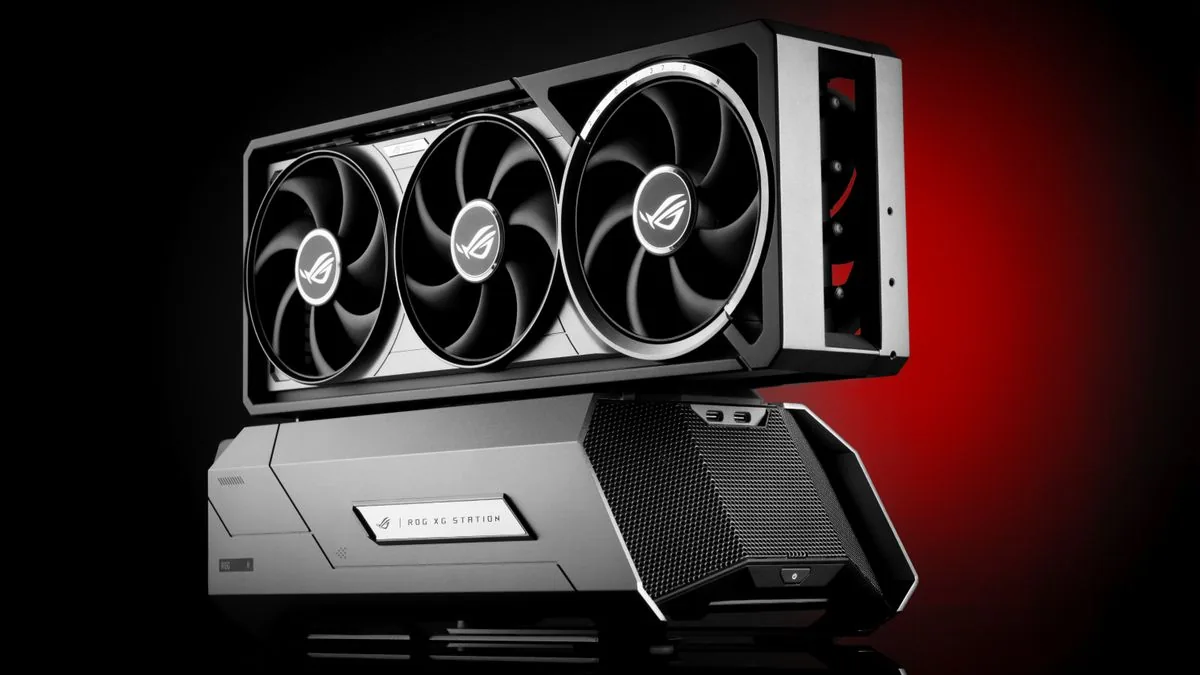
ASUS Republic of Gamers has officially launched the ROG XG Station 3 in Europe at a €399 recommended retail price. While Thunderbolt 5 finally widens the bandwidth bottleneck that held back external GPU docks for years, buyers need to budget separately for both an SFX power supply and the graphics card itself.
Announced via an official press release on November 25, 2026 from Ratingen, Germany, the ROG XG Station 3 is now rolling out across Germany, Austria, and Switzerland at €399 / CHF 399 incl. VAT through specialist hardware retailers and online stores, with wider European listings appearing as low as €349 at select shops. ASUS has not confirmed US pricing or a North American release date yet.
Following our earlier technical breakdown of the ROG XG Station 3 spec sheet, this commercial launch clarifies the true cost of adopting a Thunderbolt 5 eGPU setup. Out of the box, the €399 package includes the open-frame dock, a 100 cm Thunderbolt 5 USB-C cable, and standard documentation, nothing more.
The Real Cost Goes Well Beyond the €399 Price Tag
Unlike older enclosed eGPU boxes that shipped with an integrated power supply, the ROG XG Station 3 ships without a PSU. As confirmed on the official ASUS Republic of Gamers product page, users must purchase and install their own compact SFX or SFX-L power supply.
Standard ATX units will not fit inside the 324.6 x 173.0 x 104.7 mm base. ASUS officially recommends a 750W or higher 80 PLUS Gold SFX or SFX-L PSU, such as its ROG Loki lineup, depending on the graphics card installed. In practice, a reliable 750W to 1000W SFX power supply adds roughly €140 to €220 before you even buy a desktop GPU.
Market timing adds another layer to the total build cost. With ongoing GeForce RTX 50 supply cuts squeezing retail GPU prices, pairing the dock with a capable SFX unit and a modern flagship card quickly pushes the complete external setup into the €1,500 to €2,500 range.
Thunderbolt 5, 140W Charging, and Open-Frame BTF 2.5 Support
From a hardware standpoint, ASUS built the XG Station 3 to remove the two biggest headaches of past eGPU docks: narrow interface bandwidth and cramped GPU clearance. Its upstream Thunderbolt 5 interface delivers up to 80 Gbps of bidirectional bandwidth, doubling Thunderbolt 4, and reaches up to 120 Gbps via Bandwidth Boost for heavy display workloads. Backward compatibility with Thunderbolt 4 laptops is supported, though at lower throughput.
Single-cable desk setups are handled via up to 140W USB Power Delivery to the host machine. ASUS notes in its FAQ that high-wattage gaming laptops with discrete GPUs may still need their own power adapter under full load. A downstream Thunderbolt 5 port supports up to three 4K displays alongside the GPU's native video outputs and provides up to 36W for phones or accessories, joined by two front-mounted 10 Gbps USB-C ports.
- Host Interface: Thunderbolt 5 (80 Gbps bidirectional, up to 120 Gbps Bandwidth Boost, up to 140W USB PD), compatible with Thunderbolt 4 hosts
- Expansion I/O: 1x downstream Thunderbolt 5 port (up to 36W PD, up to three 4K displays) and 2x front USB 10 Gbps Type-C ports
- GPU Clearance & Compatibility: Supports NVIDIA GeForce RTX 50 Series, RTX PRO 6000 Series, AMD Radeon RX 9000 Series, and Intel Arc cards up to 360 x 139 x 93 mm
- BTF 2.5 Ready: Integrated GC-HPWR 16-pin slot enables cable-free power for ASUS BTF cards like the TUF RTX 5080 BTF or ROG Astral RTX 5090 BTF, alongside standard PCIe GPUs
- Power Supply Requirement: Separate SFX or SFX-L PSU required (750W+ 80 PLUS Gold recommended, not included)
- OS & Design: Microsoft Windows 11 (version 25H2 or later) required, macOS not supported, open-frame metal pedestal with Aura Sync RGB lighting
My Test Bench
I have not had the ROG XG Station 3 on my test bench yet, so I will not speculate on real-world frame pacing over Thunderbolt 5 or how loud an exposed triple-fan card gets sitting right next to a laptop. Looking strictly at the official specifications and pricing, though, ASUS is clearly targeting a very narrow audience.
Going open-frame is a smart engineering decision that solves clearance and airflow issues for massive modern GPUs, and native GC-HPWR support for BTF 2.5 cards keeps desk cabling remarkably clean. Still, charging €399 for a bare chassis without a power supply while excluding macOS entirely makes this a niche luxury accessory. If you already own a recent Thunderbolt 5 Windows 11 ultraportable and refuse to maintain two separate PCs, the modularity makes sense. For most desktop-focused gamers, putting that same combined budget toward a compact Mini-ITX rig will remain the more practical route.

PC hardware enthusiast and competitive gamer, Arthur 'Heimdall' splits his time between France and the UK working in enterprise B2B software solutions. A business school graduate passionate about component benchmarking, he has been building, modding, and tuning PCs since childhood, optimizing every thermal degree and millisecond of display latency. An avid gamer across Assassin's Creed and sandbox titles, he forged his alliance with Grimtag and Chaya during late-night World of Warcraft raids before joining Pro-Gamer.