Google DeepMind Launches Genie 4: Real-Time 720p Interactive Worlds With Native Audio and Live Prompt Steering
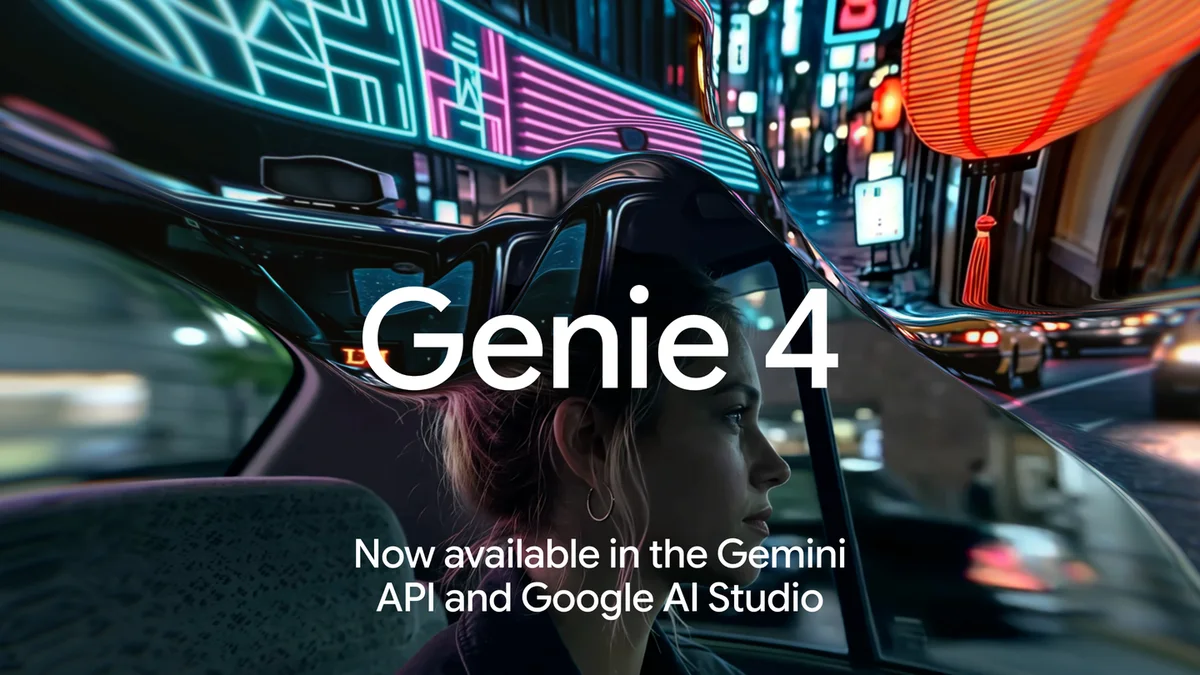
Google DeepMind has officially launched Genie 4, pushing generative world models past silent, pre-locked tech demos into continuous, playable simulations. Built directly on the Gemini model family, Genie 4 generates interactive 3D and 2D environments in real time at 720p resolution and 24 frames per second. Unlike earlier iterations where visual parameters were frozen the moment a session started, users can now seed worlds from reference images, navigate with standard keyboard and mouse controls, and reshape the environment mid-session using live natural language prompts while the model generates synchronized native audio on the fly.
Reference Image Seeding and Mid-Session Steering Powered by Gemini Omni
In previous world models such as Genie 2 and Genie 3, a user could step inside a generated scene for one to three minutes, but altering the scenario meant restarting the simulation from scratch. As detailed in Google DeepMind's official Genie 4 research showcase, the new architecture solves this by pairing two core components from the Gemini ecosystem. Gemini Omni (specifically leveraging Gemini Omni Flash) anchors every scene in realistic physical appearance and behavior, handling object collisions, flowing water, swaying foliage, and lighting reflections, while core Gemini reasoning models preserve spatial continuity and object permanence as the camera moves.

For game designers, technical artists, and spatial engineers, this hybrid architecture unlocks two major workflow upgrades:
- Reference image and hybrid prompting: Creators can feed Genie 4 a single reference image, a text prompt, or both simultaneously. Whether the input is a stylized city street illustration, a grainy 16mm documentary frame, or a handcrafted 3D stained-glass landscape, Genie 4 turns the static frame into an explorable world while strictly preserving the original color palette, lens distortion, and artistic constraints.
- Real-time environment steering midway through play: While actively moving through the world with keyboard and mouse controls, users can enter live text prompts to alter the simulation on the fly. You can trigger a sudden alpine blizzard, shift the camera perspective, adjust lighting, or introduce new interactive characters without breaking scene coherence.
This shift toward on-the-fly neural world generation directly echoes broader industry debates surrounding how generative AI and neural engines are reshaping the economics of $2 billion blockbuster game development, giving smaller teams a way to prototype playable spaces in seconds rather than months.
Native Multimodal Audio, SIMA Agent Training, and Gemini API Access
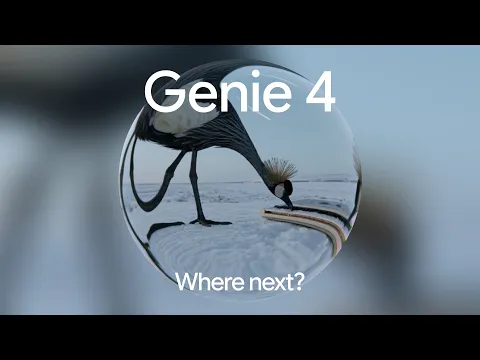
Genie 4 also breaks the silence of earlier world models by introducing native, on-the-fly audio generation. Instead of stitching pre-recorded sound effects onto a video feed, the model synthesizes acoustics dynamically in response to player movement and environmental physics. Across DeepMind's live recordings, ranging from a first-person downhill ski course with subtle HUD markers to a 140 km/h first-person dragon race and a Victorian porcelain workshop, footsteps crunch over dry leaves, hardwood floorboards creak underfoot, wind gusts roar at high altitude, and generated characters speak directly to the player.
| Technical Specification | Genie 2 / Genie 3 | Genie 4 (Current Release) |
|---|---|---|
| Real-Time Output | Action-controllable 3D (1 to 3-minute sessions) | Continuous 720p stream at up to 24 frames per second |
| Input Modalities | Single initial image or text prompt | Text prompt, reference image, or combined hybrid input |
| Mid-Session Editing | Locked at generation start | Live natural language steering (weather, lighting, NPCs) |
| Audio Engine | Silent video output only | Synchronized native audio (ambience, SFX, music, dialogue) |
| Developer & User Access | Research preview & early Project Genie | Project Genie (AI Ultra), Google AI Studio & Gemini API |
Beyond creative prototyping, Google DeepMind positions Genie 4 as an infinite training ground for embodied AI and generalist gaming agents like SIMA. In its frontier robotics trials with Gemini Robotics, the lab demonstrated Gemini 4 Argon generating multi-step task plans and feeding them as live text captions into Genie 4 while the simulation rendered in real time. Sustaining that level of low-latency multimodal inference underscores why high-level leadership and silicon roadmap battles across GPU giant NVIDIA and Arm remain critical to the future of real-time neural rendering.
Every video frame and audio stream produced by Genie 4 carries Google's imperceptible SynthID watermark. The model is rolling out now to eligible Google AI Ultra subscribers inside Project Genie, while developers can build directly with it through the Gemini API (via the Interactions API) and interactive starter canvases in Google AI Studio.
My Perspective
Having tracked world models since the original 11-billion-parameter Genie struggled to push 2D platformer frames at 1 fps in early 2024, seeing Genie 4 sustain 720p at 24 fps while accepting live text overrides and generating spatial audio feels like a genuine inflection point. Let's be realistic about its current limits: Genie 4 will not replace deterministic engines like Unreal Engine 5 or Unity for shipping commercial multiplayer games anytime soon, especially since DeepMind openly notes that visual details and object permanence can still drift during extended sessions or after heavy prompt edits. However, as an interactive greyboxing canvas where a level designer can drop in a single concept sketch, walk around it with WASD keys, and test lighting or weather shifts in real time via the Gemini API, it is one of the most compelling pre-production tools we have seen yet.

Based on the outskirts of New York City, Chaya 'Chayane' spent five years studying software engineering in Montreal before returning to her home state. A Full-Stack developer and Deep Learning AI architecture researcher, she explores neural networks and algorithmic optimization while engineering data pipelines for Retrocharting and Gamescharting alongside Grimtag. A gamer for over 20 years and an avid collector of Nintendo history and The Legend of Zelda, she explored World of Warcraft's Azeroth before bringing her deep technical background to video game analysis.