Backwards Slides and "Loud Knife" Shotguns: Royal Armouries Firearms Expert Breaks Down Gaming's Worst Gun Mistakes

When you spend hours analyzing 3D engine kinematics frame by frame, the slightest mechanical misalignment jumps right off the screen. As Keeper of Firearms and Artillery at the UK's national Royal Armouries museum in Leeds, Jonathan Ferguson has spent years dissecting video game weapon models with surgical precision.
Surrounded by a historic collection of more than 75,000 firearms and artillery pieces, the military historian has watched the industry evolve from rough early-2000s meshes to sub-millimeter photogrammetry scans. Now lending his voice and direct mechanical consulting to the tactical shooter Hell Let Loose: Vietnam, the firearms specialist has pinpointed the recurring engineering mistakes that still trip up development studios.
Misunderstood Pistol Slides and the Legacy of Mirrored 3D Meshes
Even in massive modern blockbusters that push storage drives to the limit, such as the Call of Duty: Modern Warfare 4 campaign, semi-automatic handgun kinematics remain the number one trap for 3D animators. Jonathan Ferguson frequently points out that how pistol slides reciprocate, lock back, and cycle still defies physical reality in far too many games.
On a real handgun like a Colt M1911A1 or a modern polymer striker-fired pistol, the magazine follower pushes the slide stop upward to lock the slide to the rear the exact millisecond the last cartridge is spent. Yet many animation rigs still skip this mechanical interaction or force the character to rack the slide during a tactical reload when a live round is already chambered, needlessly ejecting an unfired cartridge onto the dirt while ignoring true "+1" chamber capacity.

Then there is the original sin inherited from early competitive shooters like Counter-Strike: mirrored 3D weapon models. To save video memory or show off moving parts to the camera, artists historically flipped right-handed weapon meshes horizontally, placing the ejection port on the inboard side and flinging scorching brass casings straight across the shooter's face.
Still, Ferguson readily admits that modern 3D weapon artists and military advisers have raised the bar so high that his own job as a nitpicker is getting tougher every year:
"I can really nitpick things, and it gets increasingly hard to actually nitpick that stuff because the detail has become so good. Occasionally, I find out that's because of something I've said, which is kind of rewarding, but I also feel bad because it's making people do extra work."
Jonathan Ferguson, Keeper of Firearms & Artillery at the Royal Armouries Museum
The "Loud Knife" Shotgun Trope vs. Real-World Ballistics
If there is one ballistic myth that consistently frustrates the British firearms curator, it is how multiplayer designers balance shotguns. For over two decades, video game damage curves reduced 12-gauge combat shotguns to what Ferguson wryly calls a "loud knife".
In countless arcade shooters, buckshot pellets spread out like harmless confetti and lose nearly all kinetic energy past five meters. On a real firing range, standard 12-gauge 00 buckshot holds a tight, lethal pattern and devastating terminal velocity well out to 35 to 45 meters.
- Exaggerated Cone Spread: game engines routinely code shotgun spread angles ten times wider than a real cylinder-bore barrel to protect close-quarters multiplayer pacing.
- Cliff-Edge Damage Fall-Off: mathematical damage curves often drop pellet damage to near zero beyond fifteen paces, though modern titles like Red Dead Redemption 2 and Insurgency: Sandstorm finally respect authentic effective ranges.
- Copy-Pasted Animation Skeletons: forcing a standard AR-15 or AK animation rig onto a bullpup rifle or vintage submachine gun causes fingers to clip through receivers or yank on phantom charging handles.
Walking the tightrope between strict mechanical authenticity and fast-paced readability defines the entire shooter genre, whether you are playing a hardcore military sim or jumping into Halo: Combat Evolved running for 128 players where arena balance takes priority over real-world physics.
From Nitpicking to Direct Studio Consulting on Hell Let Loose: Vietnam
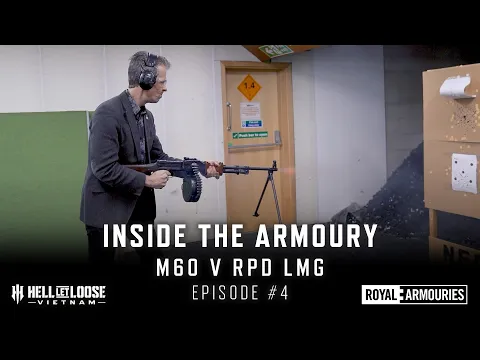
Rather than just critiquing games after launch, Ferguson and the Royal Armouries built a dedicated consultation pipeline for game developers. Studios including Team17, Expression Games, Rebellion, and Facepunch now work directly with the Leeds museum vault to scan, photograph, and record historical firearms first-hand.
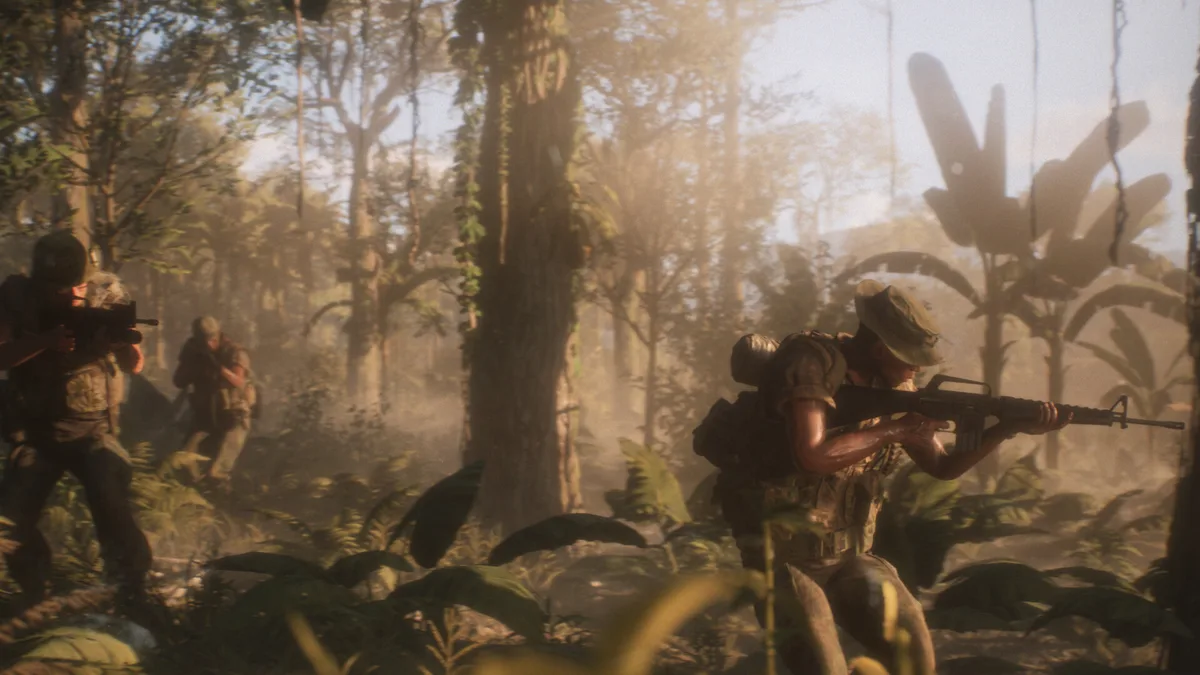
That collaboration takes center stage in Hell Let Loose: Vietnam, slated for release in 2026 on PC, PS5, and Xbox Series X|S. Expression Games' 3D artists and audio engineers visited the Royal Armouries to capture period-authentic weapons including the M16A1 rifle paired with the M203 grenade launcher, the M60 and RPD light machine guns, and the Chinese Type 54 pistol alongside the classic M1911A1.
As a bonus for firearm mechanics enthusiasts, Ferguson recorded official in-game voice lines for the project. Clicking on individual weapons and grenades inside the loadout screen of Hell Let Loose: Vietnam plays audio breakdowns voiced by Ferguson himself, detailing the mechanical quirks and combat history of each piece of gear.
My Test Bench: Why Authentic Weapon Kinematics Matter at 240Hz
When you dial in your mouse sensor sensitivity down to the millimeter and lock your frametimes at 240Hz, weapon kinematics are far more than cosmetic window dressing. An accurate reload animation, complete with proper slide-stop timing, realistic bolt carrier mass, and authentic acoustic feedback, directly shapes player muscle memory and target tracking.
Watching studios trade generic stock sound effects for live acoustic recordings captured inside the Royal Armouries' underground firing range proves how far technical craftsmanship has come in the FPS space. The real test arrives when Hell Let Loose: Vietnam deploys onto live servers in 2026, putting every cyclic rate and ballistic drop curve under live fire.

PC hardware enthusiast and competitive gamer, Arthur 'Heimdall' splits his time between France and the UK working in enterprise B2B software solutions. A business school graduate passionate about component benchmarking, he has been building, modding, and tuning PCs since childhood, optimizing every thermal degree and millisecond of display latency. An avid gamer across Assassin's Creed and sandbox titles, he forged his alliance with Grimtag and Chaya during late-night World of Warcraft raids before joining Pro-Gamer.