NVIDIA DLSS 5 Gets 2X Faster AI Model With 20% Lower VRAM Usage Ahead of October Launch
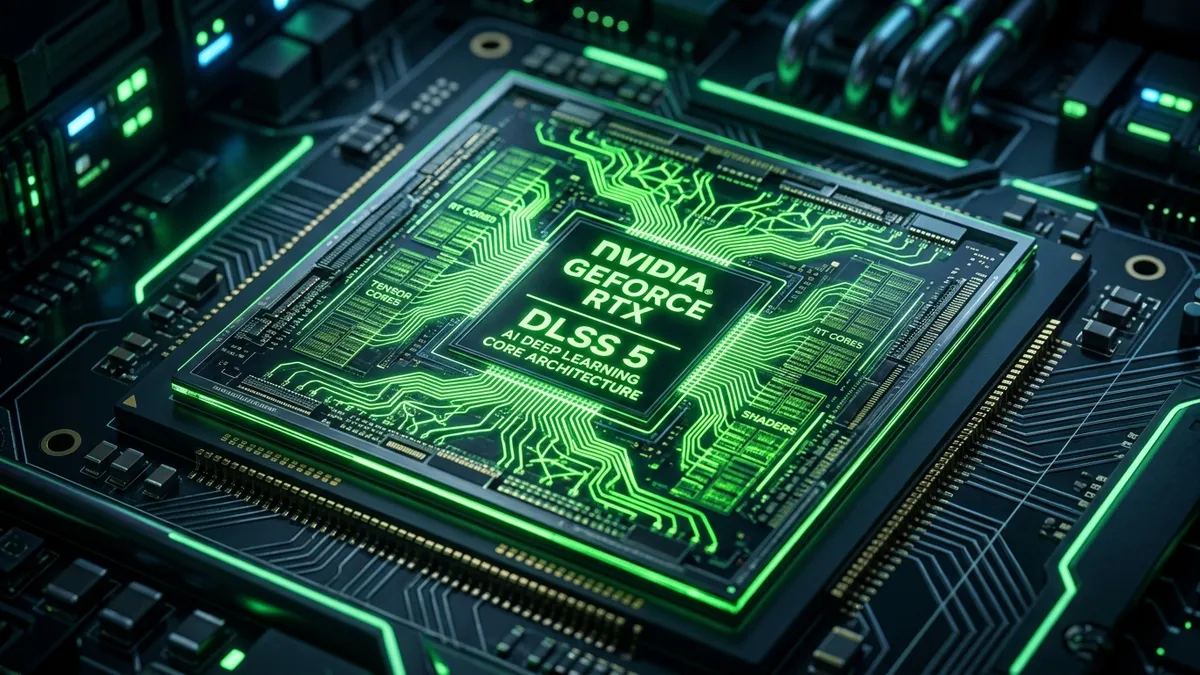
NVIDIA is gearing up to roll out a major architectural upgrade for its DLSS 5 ecosystem. Scheduled to arrive on October 16, 2026, alongside the next Game Ready driver branch, this software refinement delivers a crucial dual breakthrough for PC gamers: an AI neural inference model that runs twice as fast while cutting video memory (VRAM) allocation by 20%.
Tensor Cores Unchained: Neural Inference Latency Cut in Half
At the center of this technical leap is a deep optimization of the neural networks driving 3D-Guided Neural Rendering. While early implementations of the DLSS 5 stack put considerable stress on Tensor Core computational budgets with each frame dispatch, the updated inference matrices halve calculation overhead. The evolutionary trajectory is striking: this October 2026 revision is now ten times faster than the experimental technology preview demonstrated back in March.
Slashing inference latency yields immediate benefits for frame pacing. In demanding modern game engines where the core rendering pipeline must juggle geometric passes, complex materials, and neural inference simultaneously, shaving precious milliseconds off the tensor workload helps smooth out frame delivery and lifts 1% low frame rates during intense action sequences.
Critical Relief for VRAM: 20% Smaller Footprint Across All Tiers
Memory pressure has emerged as one of the biggest bottlenecks for PC gaming rigs, particularly on graphics cards equipped with 8GB, 12GB, or even 16GB of video buffer when running full path tracing at high resolutions. In an industry climate where global memory manufacturing faces severe AI enterprise constraints, recovering a full fifth of video memory previously occupied by the DLSS model provides immediate headroom.
Check GeForce RTX graphics cards on Amazon→
By pruning neural weights and streamlining intermediate tensor buffers, the update helps prevent costly overflow into system RAM over the PCIe bus. Enthusiasts targeting 1440p and 4K displays gain valuable breathing room, eliminating micro-stutters and texture degradation caused by VRAM thrashing.
Beyond Simple Frame Reconstruction: The Power of 3D-Guided Neural Rendering
Unlike early upscaling techniques that operated purely on 2D motion vectors and spatial data, 3D-Guided Neural Rendering leverages depth buffers, polygonal geometry, and surface properties to reconstruct lighting and fine details with remarkable fidelity. Specular highlights, indirect bouncing light, and complex atmospheric effects maintain temporal stability, much like what we observed when analyzing modern path tracing overhauls and volumetric rendering in PC titles.
Showcase games renowned for heavy ray tracing workloads serve as the premier proving ground to experience these performance dividends firsthand.
Hardware Lab Verdict: What This Upgrade Means on the Bench
Testing hardware through generations of architectural changes, I have often seen software promises fall short when pushed to native limits under heavy workloads. However, the performance-to-memory gains documented in NVIDIA's latest engineering release tackle the number one headache for PC enthusiasts in 2026: card longevity in an era of demanding full-path ray tracing. Cutting neural inference latency in half while returning 20% of VRAM back to the engine demonstrates that algorithmic optimization remains a formidable multiplier for graphics hardware.

PC hardware enthusiast and competitive gamer, Arthur 'Heimdall' splits his time between France and the UK working in enterprise B2B software solutions. A business school graduate passionate about component benchmarking, he has been building, modding, and tuning PCs since childhood, optimizing every thermal degree and millisecond of display latency. An avid gamer across Assassin's Creed and sandbox titles, he forged his alliance with Grimtag and Chaya during late-night World of Warcraft raids before joining Pro-Gamer.