EA and Savvy Games: Saudi Arabia Reportedly Weighs Landmark Merger to Build a Global Gaming Juggernaut

Saudi Arabia is no longer content with simply accumulating minority shares across the gaming industry: it is now actively preparing to unite its crown jewels to build the single largest interactive entertainment conglomerate on Earth. According to a blockbuster investigative report published Thursday by Bloomberg, the Saudi Public Investment Fund (PIF) is seriously evaluating a direct merger between Electronic Arts (EA) and Savvy Games Group.
This strategic move, currently being analyzed behind closed doors by senior fund leadership, seeks to bring all of the kingdom's sprawling gaming assets under unified corporate governance. The underlying ambition is unmistakable: forging an unrivaled gaming titan equipped to go toe-to-toe with tech behemoths like Tencent, Sony, and Microsoft.
An $80 Billion Juggernaut Under the Saudi Flag
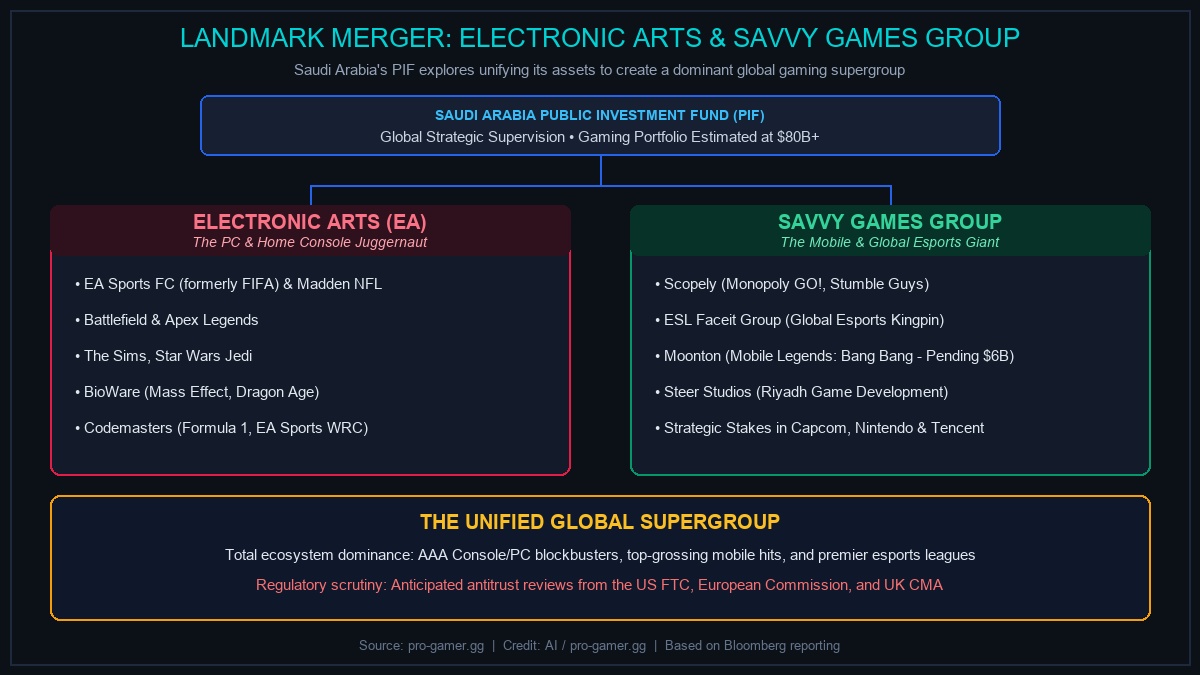
To grasp the tectonic scale of this proposed consolidation, one only needs to look at the portfolio assembled by the PIF under Crown Prince Mohammed bin Salman. In early August 2026, the sovereign wealth fund finalized its landmark leveraged buyout of Electronic Arts for $55 billion, taking the iconic California publisher completely private.
Simultaneously, its dedicated commercial subsidiary, Savvy Games Group, has been aggressively scooping up critical pillars of the wider industry:
- The headline $4.9 billion acquisition of Scopely, the mobile juggernaut behind global revenue monsters like Monopoly GO! and Stumble Guys.
- Comprehensive control over international competitive gaming via ESL Faceit Group, which operates the vast majority of premier tournaments in Counter-Strike 2 and Dota 2.
- The pending $6 billion acquisition of Chinese mobile studio Moonton, creators of the massive multiplayer sensation Mobile Legends: Bang Bang.
By formally folding Electronic Arts into Savvy Games Group, Riyadh would not merely create a loose financial holding company, but an operational mega-publisher commanding more than $80 billion in consolidated gaming assets.
Console, Mobile, and Esports: Total Ecosystem Dominance
From an operational standpoint, the proposed combination represents textbook industrial synergy. Historically, Electronic Arts has dominated living room consoles and PC rigs with multi-billion-dollar evergreen franchises like EA Sports FC (formerly FIFA), Battlefield, Apex Legends, The Sims, and BioWare's narrative RPGs. However, EA has frequently stumbled when attempting to replicate that level of runaway success in the cutthroat mobile arena.
That is precisely where an integration with Savvy Games changes the game. By pairing Scopely and Moonton's lethal mobile monetization and live-ops expertise with EA's world-class intellectual properties, the merged entity would immediately become a dominant force across iOS and Android. Combine that with ESL's near-monopoly on tier-one esports production, and you have an airtight closed-loop pipeline where the same corporate entity creates the competitive shooter, runs the world championship, and sells the broadcast sponsorships.
As we analyzed in our recent look at platform price hikes and publisher monetization shifts, heavy corporate consolidation invariably trickles down to players through evolving battle pass models, digital storefront shifts, and ecosystem locking.
The Antitrust Hurdle: Will Global Regulators Intervene?
While the prospect of a unified gaming colossus thrills Gulf financiers, executing the merger faces substantial friction. First is the sequence of events: Bloomberg reports that no formal corporate restructuring will take place until Savvy successfully wraps up regulatory clearances for its $6 billion Moonton buyout.
Second is the antitrust landscape. Following the grueling multi-year battle surrounding Microsoft's acquisition of Activision Blizzard, regulatory watchdogs—including the US Federal Trade Commission (FTC), the European Commission, and the UK's Competition and Markets Authority (CMA)—are hyper-vigilant regarding market concentration. Even though the PIF already controls both entities, consolidating their market power and distribution networks under a single corporate banner is guaranteed to invite rigorous regulatory scrutiny.
My Take: The Death of the Independent Legacy Publisher
Let us cut through the corporate jargon: this Bloomberg revelation puts an official stamp on what I have been watching unfold across the industry for months. The nostalgic era of legacy publishers like EA, Ubisoft, or Activision charting their own destinies on public stock exchanges solely through retail game sales is finished.
Modern gaming is now an arena of sovereign wealth funds and trillion-dollar tech titans. Between Silicon Valley cloud giants, Tencent's relentless international expansion, and Riyadh's vast petrodollar investments, the production budgets required for cutting-edge AAA blockbusters have ballooned so high that only nation-states or tech behemoths can bankroll the risk. If this merger crosses the finish line, Saudi Arabia will no longer be an eager outside investor trying to buy credibility—it will sit firmly at the head of the table.

SEO consultant for over 20 years and digital entrepreneur, Charles 'Grimtag' Ronchain is the founder of Pro-Gamer.gg, Retrocharting.com, and Gamescharting.com. A competitive gamer, streamer, and retro game collector, he has worked in the video game industry for over 15 years, notably as a consultant for leading game price comparison platforms. Passionate about real-time performance data and gaming technology, he analyzes competitive esports, gaming hardware benchmarks, and creator workflows on Pro-Gamer.gg with an authentic player perspective.