1,250Hz Native 1440p Gaming Monitor: TCL CSOT Showcases Its 27-Inch APEX Oxide+ 50 Display at DTC 2026
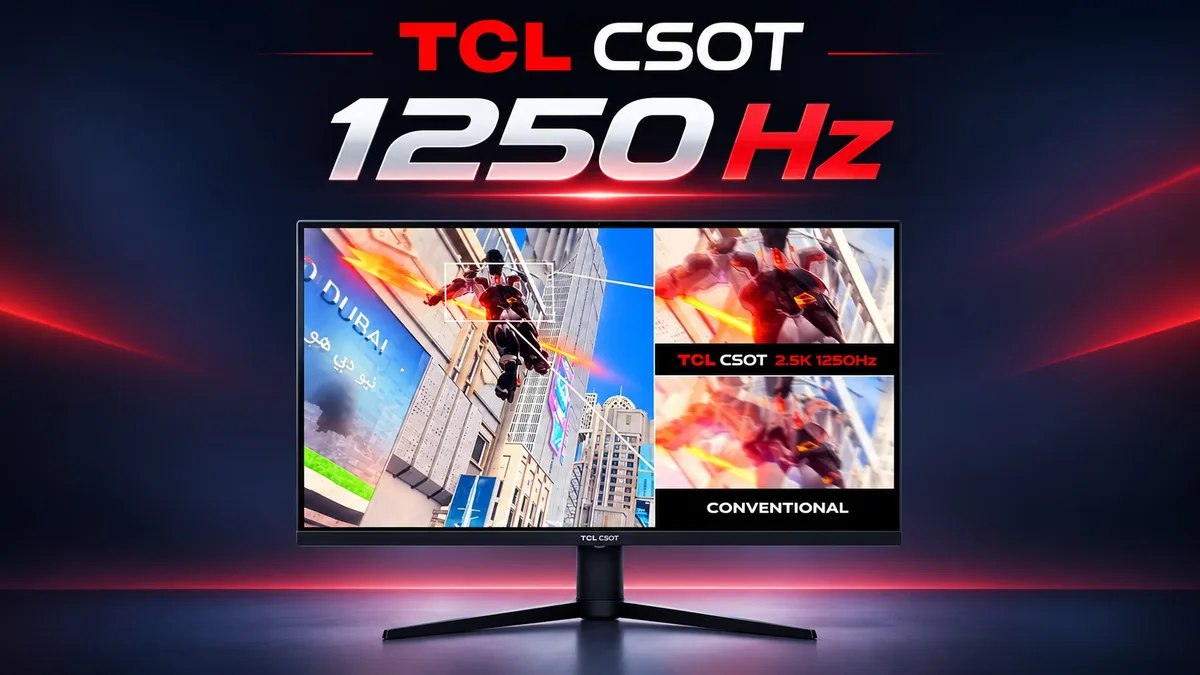
The thousand-hertz barrier has officially fallen at native 1440p resolution. During its annual DTC 2026 (Global Display Tech-Ecosystem Conference) in Wuhan, TCL CSOT unveiled the world's first 27-inch desktop gaming monitor prototype capable of running at a native 1,250 Hz refresh rate in QHD (2560 × 1440). While previous ultra-high-refresh panels pushing past 1,000 Hz forced players to drop down to 1080p or even 720p, this display drives all 3.68 million pixels at full speed without resolution downscaling.
No More 720p Dual-Mode Compromises: Inside the APEX Oxide+ 50 Backplane
Until now, breaking the 1,000 Hz threshold came with a heavy visual trade-off. Existing commercial displays and prototypes approaching four-digit refresh rates, such as the AOC AGON PRO AGP257FT (1,050 Hz at 1080p) or TCL's own 27P2A Ultra (which runs at 550 Hz in QHD and relies on a dual-mode switch to hit 1,040 Hz at 720p), were bottlenecked by thin-film transistor switching speeds. As vertical resolution increases, the time window available to charge each row of sub-pixels shrinks dramatically: at 1,250 Hz, the panel has a frame interval of just 0.8 milliseconds to refresh the entire screen.
To overcome that electrical ceiling at native 1440p, TCL's display manufacturing arm equipped this 27-inch desktop panel with its new APEX Oxide+ 50 backplane, built on UHMO (Ultra-High Mobility Oxide) technology. According to the specification plaque displayed at the Wuhan booth, the backplane achieves a carrier mobility rating of 50 cm²/V·s. By comparison, conventional amorphous silicon (a-Si) sits below 1 cm²/V·s, and standard IGZO oxide backplanes typically operate between 10 and 30 cm²/V·s. Reaching 50 cm²/V·s allows the transistor layer to switch fast enough to drive a 2560 × 1440 matrix at 1,250 frames per second.
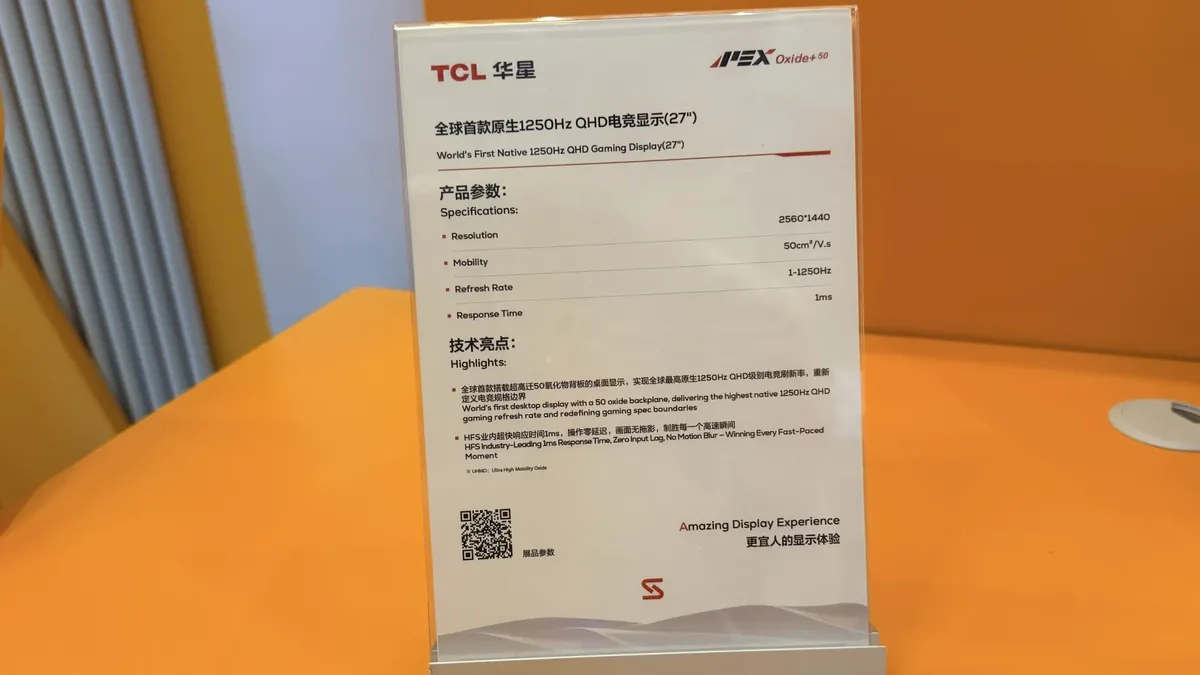
While early reports left the underlying panel chemistry unspecified, the official DTC 2026 specification plaque explicitly identifies an HFS (High Fringe Field Switching) LCD structure paired with the 50 oxide backplane. This milestone builds on the company's recent high-speed display push, which included supplying the 360 Hz OLED laptop panel featured in Lenovo's Legion prototype alongside the NVIDIA N1X-powered Yoga 9n. On the 1,250 Hz desktop unit, TCL CSOT lists a 1 ms response time and a wide variable refresh rate window spanning from 1 Hz to 1,250 Hz, allowing the screen to scale down dynamically during static desktop workloads.
TCL CSOT 27-Inch 1,250 Hz QHD Prototype Specifications
| Feature | Official Specification (DTC 2026) |
|---|---|
| Screen Size & Form Factor | 27-inch desktop gaming display (16:9 aspect ratio) |
| Native Resolution | QHD / 2.5K (2560 × 1440 pixels) with no dual-mode downscaling |
| Refresh Rate Range | 1,250 Hz native (variable refresh rate from 1 Hz to 1,250 Hz) |
| Panel & Backplane Architecture | HFS LCD with APEX Oxide+ 50 UHMO backplane |
| Electron Mobility | 50 cm²/V·s (Ultra-High Mobility Oxide) |
| Rated Response Time | 1 ms (0.8 ms frame cycle at 1,250 Hz) |
| Companion DTC 2026 Prototype | 27-inch QHD IJP OLED (Inkjet-Printed OLED) at 500 Hz (100% DCI-P3, < 1 ms) |
Display Bandwidth Limits and the CPU Power Required for 1,250 FPS
Alongside the 1,250 Hz oxide display, TCL CSOT also demonstrated a second 27-inch QHD gaming monitor at the Wuhan conference using IJP OLED (Inkjet-Printed OLED) technology, running at 500 Hz with a sub-1 ms response time and 100% coverage of the DCI-P3 color gamut. While TCL CSOT confirmed it is working with OEM hardware partners to bring the 1,250 Hz panel to the commercial market, no retail release window or pricing has been announced yet.
Pushing a 1440p monitor to 1,250 Hz in real-world PC gaming also raises massive bandwidth and processing challenges. Sending an uncompressed 2560 × 1440 signal at 1,250 Hz in 8-bit or 10-bit color requires well over 110 Gbps of raw video bandwidth, exceeding both the 80 Gbps ceiling of DisplayPort 2.1a (UHBR20) and the 96 Gbps limit of HDMI 2.2. Relying on DSC (Display Stream Compression) will therefore be mandatory. Even in lightweight esports titles such as Counter-Strike 2 or Valorant, sustaining over 1,000 frames per second at 1440p will demand the single-threaded headroom of upcoming desktop processors like AMD's TSMC N2X-based Ryzen Zen 6 lineup to prevent severe CPU frametime bottlenecks.
My Test Bench
What stands out most to me on the Wuhan spec plaque isn't just the headline 1,250 Hz figure, but the fact that TCL CSOT achieved it at a native 2560 × 1440 resolution. On current dual-mode monitors, dropping down to 720p on a 27-inch screen just to unlock 1,000 Hz makes distant targets in tactical shooters look far too soft to justify the motion speed gain. By pushing its UHMO backplane to 50 cm²/V·s on an HFS panel, TCL CSOT proves that backplane electronics no longer need to sacrifice pixel density to break the one-millisecond frame barrier. Still, at 1,250 Hz, each frame only stays on screen for 0.8 ms: for an HFS LCD panel to deliver true 1,250 Hz motion clarity without pixel persistence overlap, its actual gray-to-gray liquid crystal transitions must consistently beat that 0.8 ms window, which keeps the upcoming 500 Hz and 700 Hz inkjet-printed OLED panels very much in the fight.

PC hardware enthusiast and competitive gamer, Arthur 'Heimdall' splits his time between France and the UK working in enterprise B2B software solutions. A business school graduate passionate about component benchmarking, he has been building, modding, and tuning PCs since childhood, optimizing every thermal degree and millisecond of display latency. An avid gamer across Assassin's Creed and sandbox titles, he forged his alliance with Grimtag and Chaya during late-night World of Warcraft raids before joining Pro-Gamer.